Basic Electronics and Electrical Engineering: Chapter 6: Measurement and Instrumentation
Permanent Magnet Moving Coil [PMMC] Instruments
Construction, Principle of Operation, Torque Equation, Advantages, Limitations
![Permanent Magnet Moving Coil [PMMC] Instruments - Construction, Principle of Operation, Torque Equation, Advantages, Limitations](https://www.poriyaan.in/media/articlewww/img-Perma-45.jpg)
1. Construction of permanent Magnet Moving Coil 2. Principle of Operation of PMMC Instrument 3. Torque Equation 4. Shape of Scale 5. Sources of error 6. Advantages of PMMC Instrument 7. Limitations of PMMC Instrument
PERMANENT
MAGNET MOVING COIL [PMMC] INSTRUMENTS
The permanent magnet
moving coil instruments are the most accurate type of DC measurements. The
working principle of these instruments is same as that of a DC motor. When a
current carrying conductor (coil) is placed in a magnetic field, the conductor
(coil) experiences a force and tends to move. Hence, as the coil is moving and
the magnetic field is produced by a permanent magnet the instrument is called
as permanent magnet moving coil instrument. This basic principle is called as
principle is called as D'Arsonal principle. The amount of force experienced by
the conductor (coil) is directly proportional to the current passing through
the coil. The PMMC instrument is a direct reading type, provided with a pointer
and a scale.
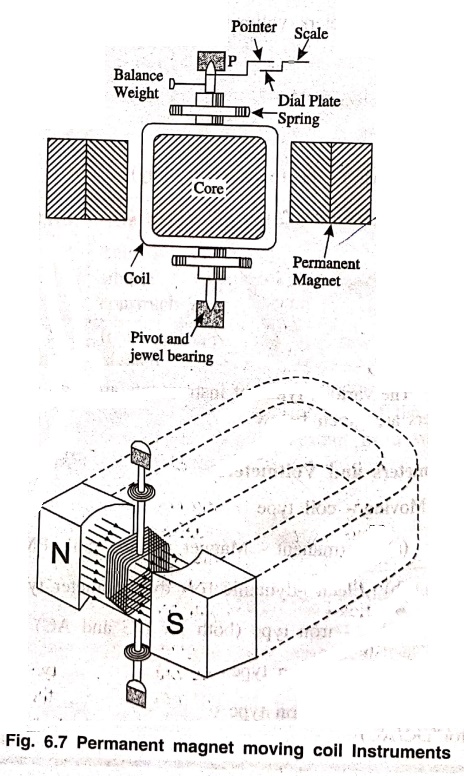
Construction of permanent Magnet Moving Coil
Fig. 6.7 shows the
general constructional features of a permanent magnet moving coil [PMMC]
instrument.
1. Moving Coil
The moving coil is
wound with many turns of enamelled (or) silk covered copper wire on a
rectangular aluminium former which is pivoted on jewelled bearings. The coil
can move freely in the field of a permanent magnet. Most voltmeter coils are
wound on metal frames to provide the required electromagnetic damping. Most
ammeter coils are wound on non magnetic formers, because coil turns are
effectively shorted out by the ammeter shunt. Therefore the coil itself
provides electromagnetic damping.
2. Magnet System
Normally a concentric
structure is used, which is two sector shaped Alnico magnets, having round
cylindrical faces. They are placed inside a soft iron steel ring and the
assembly is diecast together. So the steel ring provides a return path for the
magnetic circuit and shields the assembly from stray magnetic fields.
3. Control
The control torque is
provided by two phosphor bronze hair springs. These springs also serve as leads
to the coil.
4.
Damping
Eddy current damping is
produced by the movement of the aluminium former moving in the magnetic fields
of the permanent magnet.
5.
Pointer and Scale
The pointer is carried
by the spindle and moves over a graduated scale.
Principle of Operation of PMMC Instrument
A current in the moving
coil causes motor action as the coil is controlled by the control springs. Thus
the necessary deflecting torque is produced, by which the moving coil deflects
and a pointer attached to the spindle moves over a graduated scale. If the
direction of the current in the coil is changed, then the direction of motion of
the coil also changes as the magnetic field is a permanent magnet.
Thus in permanent
magnet moving coil instruments, the operating torque depends on the direction
of the operating current. This type of instruments are polarised. So, if PMMC
meters are connected for AC measurements, then the deflecting torque is a
pulsating one and the meter will not read. That is, the meter will read the
average value of the measuring quantity.
Torque Equation
Let,
l
= Length of vertical side of the coil in metre.
d
= Length of horizontal side of the coil in metre.
A = area of the coil.
N = number of turns in
the coil.
B = flux density in the
coil.
I = current in the
coil.
KS = spring
constant.
ϕ = Angle of
deflection.
∝
=
angle between the direction of magnetic field and conductor.
Td =
deflecting torque.
Tc = controlling
torque.
G = displacement
constant = NBA
The equation for
deflecting torque can be obtained from the basic law of electromagnetic torque
and given by,
Deflecting torque, Td
= Force × distance
= NBIA
Td= GI
Where,
G=NBA
The controlling torque
is provided by the spring and is proportional to the angular deflection of the
pointer.
Controlling torque, Tc
= KSθ
At the final steady state
position of the pointer, Tc = Td
KSθ = GI
θ = (G/KS)I
I ⇒
θ ∝ I
Thus, the deflection is
directly proportional to the current passing through the coil. The pointer
deflection can therefore be used to measured current.
Shape of Scale
As the angle of
deflection is directly proportional to the operating current, the scale of the
PMMC instrument is linear (uniform).
Sources of error
1. Weakening of
permanent magnets due to ageing and temperature effects.
2. Weakening of springs
due to ageing and temperature effects.
3. Change of resistance
of the moving coil with temperature.
4. When the instruments
range is extended in an moving coil instrument with a manganic shunt, the error
is relatively larger due to the larger change in resistance of copper moving
coil to that of the manganic shunt.
Advantages of PMMC Instrument
1. Uniform scaling
2. The power
consumption is very low (25 microwatts to 100 microwatts).
3. The torque - weight
ratio is high which gives a high accuracy. The accuracy is of the order of
generally 2 percent of full scale deflection.
4. A single instrument
may be used for many different current and voltage range by of using different
values of shunts and multipliers, respectively.
5. The operating forces
vare larger due to large flux densities and so the error due to stray magnetic
fields is small.
6. Self shielding
magnets make the core magnet mechanism useful in air‒craft and aerospace
applications where a multiplicity of instruments must be maintained in close
proximity to each other.
7. Sensitivity is high.
8. It has high
accuracy.
9. Instrument is free
from hysteresis error.
Limitations of PMMC Instrument
1. These instruments
are useful only for DC measurements. The torque reverses as the current
reverses and so when it is used with AC the pointer cannot follow the rapid
reversals. Since the deflection corresponds to the mean torque the pointer
reads zero.
2. Ageing of permanent
magnet and the control springs, introduces the errors.
3. The cost of these
instruments are higher than the moving iron [MI] instruments.
4. The friction due to
jewel‒pivot suspension, introduces errors. [This can be eliminated by using
Tact Band suspension in the Instruments].
Basic Electronics and Electrical Engineering: Chapter 6: Measurement and Instrumentation : Tag: Basic Engineering : Construction, Principle of Operation, Torque Equation, Advantages, Limitations - Permanent Magnet Moving Coil [PMMC] Instruments
Basic Electronics and Electrical Engineering: Chapter 6: Measurement and Instrumentation
Under Subject

Basic Electronics and Electrical Engineering
EE25C04 1st Semester ECE Dept | 2025 Regulation | 2nd Semester 2025 Regulation
Related Subjects

English Essentials I
EN25C01 1st Semester | 2025 Regulation | 1st Semester 2025 Regulation

தமிழர் மரபு - Heritage of Tamils
UC25H01 1st Semester | 2025 Regulation | 1st Semester 2025 Regulation

Applied Calculus
MA25C01 Maths 1 M1 - 1st Semester | 2025 Regulation | 1st Semester 2025 Regulation
Applied Physics I
PH25C01 1st Semester | 2025 Regulation | 1st Semester 2025 Regulation

Applied Chemistry I
CY25C01 1st Semester | 2025 Regulation | 1st Semester 2025 Regulation

Makerspace
ME25C04 1st Semester | 2025 Regulation | 1st Semester 2025 Regulation
Computer Programming C
CS25C01 1st Semester | 2025 Regulation | 1st Semester 2025 Regulation
Computer Programming Python
CS25C02 1st Semester | 2025 Regulation | 1st Semester 2025 Regulation
Fundamentals of Electrical and Electronics Engineering
EE25C03 1st Semester | 2025 Regulation | 1st Semester 2025 Regulation

Introduction to Mechanical Engineering
ME25C03 1st Semester | 2025 Regulation | 1st Semester 2025 Regulation

Introduction to Civil Engineering
CE25C01 1st Semester Civil Department | 2025 Regulation | 1st Semester 2025 Regulation
Essentials of Computing
CS25C03 1st Semester - AID CSE IT Department | 2025 Regulation | 1st Semester 2025 Regulation

Applied Physics I Laboratory
PH25C01 1st Semester practical Laboratory Manual | 2025 Regulation | 1st Semester Laboratory 2025 Regulation

Applied Chemistry I Laboratory
CY25C01 1st Semester practical Laboratory Manual | 2025 Regulation | 1st Semester Laboratory 2025 Regulation

Computer Programming C Laboratory
CS25C01 1st Semester practical Laboratory Manual | 2025 Regulation | 1st Semester Laboratory 2025 Regulation

Computer Programming Python Laboratory
CS25C02 1st Semester practical Laboratory Manual | 2025 Regulation | 1st Semester Laboratory 2025 Regulation
Engineering Drawing
ME25C01 EEE Mech Dept | 2025 Regulation | 2nd Semester 2025 Regulation
Basic Electronics and Electrical Engineering
EE25C04 1st Semester ECE Dept | 2025 Regulation | 2nd Semester 2025 Regulation