Basic Electronics and Electrical Engineering: Chapter 5: Induction Motors
Operational Principle of Three Phase Induction Motor
According to the Lenz's law, the direction of rotor currents will be such that they tend to oppose the cause producing them.
PRINCIPLE
OF OPERATION
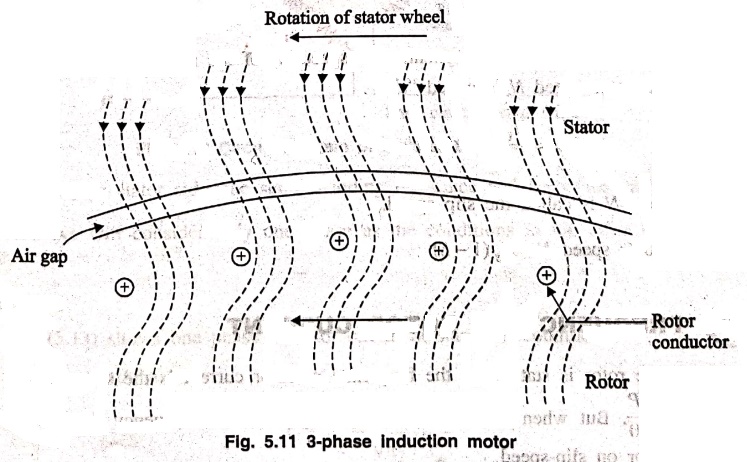
Consider a portion of 3‒phase
induction motor as shown in Fig. 5.11. The operation of the induction motor can
be explained as below:
When the 3‒phase stator
windings are fed by a 3‒phase supply, a rotating magnetic field is set up which
rotates the stator at synchronous speed Ns = 120 f/p,
The rotating field
passes through the air gap and cuts the rotor conductors, which as yet, are
stationary. Due to the relative speed between the rotating flux and the
stationary rotor, emfs are induced in the rotor conductors. Since the rotor
circuit is short‒circuited, current start flowing in the rotor conductors.
The current carrying
rotor conductors are placed in the magnetic field produced by the stator.
Consequently, mechanical force acts on the rotor conductors. The sum of the
mechanical forces on all the rotor conductors produces a torque which tends to
move the rotor in the same direction as the rotating magnetic field.
According to the Lenz's
law, the direction of rotor currents will be such that they tend to oppose the
cause producing them. In this case, the cause which produces rotor current is
the relative velocity between the rotating flux of the stator and the
stationary rotor conductors. Hence to reduce the relative speed, the rotor
starts running in the same direction as that of the flux and tries to catch up
with the rotating flux.
Basic Electronics and Electrical Engineering: Chapter 5: Induction Motors : Tag: Basic Engineering : - Operational Principle of Three Phase Induction Motor
Basic Electronics and Electrical Engineering: Chapter 5: Induction Motors
Under Subject

Basic Electronics and Electrical Engineering
EE25C04 1st Semester ECE Dept | 2025 Regulation | 2nd Semester 2025 Regulation
Related Subjects

English Essentials I
EN25C01 1st Semester | 2025 Regulation | 1st Semester 2025 Regulation

தமிழர் மரபு - Heritage of Tamils
UC25H01 1st Semester | 2025 Regulation | 1st Semester 2025 Regulation
Applied Calculus
MA25C01 Maths 1 M1 - 1st Semester | 2025 Regulation | 1st Semester 2025 Regulation
Applied Physics I
PH25C01 1st Semester | 2025 Regulation | 1st Semester 2025 Regulation

Applied Chemistry I
CY25C01 1st Semester | 2025 Regulation | 1st Semester 2025 Regulation
Makerspace
ME25C04 1st Semester | 2025 Regulation | 1st Semester 2025 Regulation
Computer Programming C
CS25C01 1st Semester | 2025 Regulation | 1st Semester 2025 Regulation
Computer Programming Python
CS25C02 1st Semester | 2025 Regulation | 1st Semester 2025 Regulation
Fundamentals of Electrical and Electronics Engineering
EE25C03 1st Semester | 2025 Regulation | 1st Semester 2025 Regulation
Introduction to Mechanical Engineering
ME25C03 1st Semester | 2025 Regulation | 1st Semester 2025 Regulation

Introduction to Civil Engineering
CE25C01 1st Semester Civil Department | 2025 Regulation | 1st Semester 2025 Regulation
Essentials of Computing
CS25C03 1st Semester - AID CSE IT Department | 2025 Regulation | 1st Semester 2025 Regulation

Applied Physics I Laboratory
PH25C01 1st Semester practical Laboratory Manual | 2025 Regulation | 1st Semester Laboratory 2025 Regulation

Applied Chemistry I Laboratory
CY25C01 1st Semester practical Laboratory Manual | 2025 Regulation | 1st Semester Laboratory 2025 Regulation

Computer Programming C Laboratory
CS25C01 1st Semester practical Laboratory Manual | 2025 Regulation | 1st Semester Laboratory 2025 Regulation

Computer Programming Python Laboratory
CS25C02 1st Semester practical Laboratory Manual | 2025 Regulation | 1st Semester Laboratory 2025 Regulation
Engineering Drawing
ME25C01 EEE Mech Dept | 2025 Regulation | 2nd Semester 2025 Regulation
Basic Electronics and Electrical Engineering
EE25C04 1st Semester ECE Dept | 2025 Regulation | 2nd Semester 2025 Regulation