Basic Electronics and Electrical Engineering: Chapter 4: Synchronous Machines
Synchronous Machines: 2 Marks Important Questions with Answers
Basic Electronics and Electrical Engineering: Chapter 4: Synchronous Machines: 2 Marks Important Questions with Answers
Basic Electronics and Electrical Engineering
Chapter 4:
Synchronous Machines
2 Marks Important Questions with
Answers
1.
Compare: Synchronous generator and DC generator?
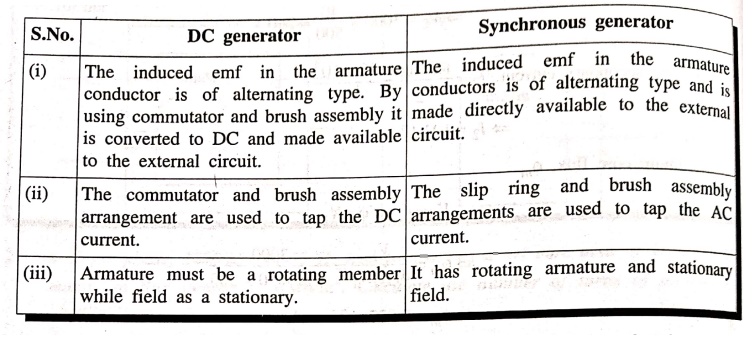
DC generator
(i) The induced emf in
the armature conductor is of alternating type. By using commutator and brush
assembly it is converted to DC and made available to the external circuit.
(ii) The commutator and
brush assembly arrangement are used to tap the DC current.
(iii) Armature must be
a rotating member while field as a stationary.
Synchronous generator
(i) The induced emf in
the armature conductors is of alternating type and is made directly available
to the external circuit.
(ii) The slip ring and
brush assembly arrangements are used to tap the AC current.
(iii) It has rotating
armature and stationary field.
2.
Which type of synchronous machine is used with hydraulic turbines? What is
their operating speed range?
Salient pole type
synchronous machine is used with hydraulic turbines. It has the speed range
from 125 rpm to 500 rpm.
3.
Why is the field system of an alternator made as a rotor?
(i) The output current
can be led directly from fixed terminals on the stator (or armature windings)
to the load circuit, without having to pass it through brush contacts.
(ii) It is easier to
insulate stationary armature winding for high ac voltages, which may have as
high a value as 30 kV (or) more.
(iii) The sliding
contacts i.e., slip‒rings are transferred to the low‒voltage, low‒power DC
field circuit which can, therefore, be easily insulted.
(iv) The armature
windings can be more easily brazed to prevent any deformation, which could be
produced by the mechanical stresses set up as a result of short‒circuit current
and the high centrifugal forces brought into play.
4.
Compare salient pole rotor and cylindrical pole rotor?

Salient pole type
(i) Diameter is high
and axial length is small.
(ii) Poles are
projecting out from the surface.
(iii) Air gap is non
uniform.
(iv) Mechanically weak
(v) Preferred for low
speed alternators.
(vi) Prime movers used
are hydraulic turbines.
(vii) For same size,
the rating is smaller than cylindrical type.
(viii) Separate damper
winding is proposed.
Smooth cylindrical type
(i) Small diameter and
large axial length.
(ii) Insulated portion
of the cylinder acts as poles, hence poles are non projecting.
(iii) Air gap is
uniform.
(iv) Mechanically
robust.
(v) Preferred for high
speed alternators.,
(vi) I.C. engine.
(vii) For same size,
rating is higher than salient pole type.
(viii) Separate damper
is not necessary.
5.
Mention the two types of alternator.
The two, types of
alternators are,
(i) Salient pole type
(ii) Smooth cylindrical
type
6.
Define pitch factor and distribution factor as applied to an alternator.
Pitch factor
Coil‒span factor Kp
(or) Kc is defined as the ratio between vector sum of induced emfs per coil to
the arithmetic sum of the induced emfs per coil.
Distribution factor
The distribution factor
is defined as the ratio between emf with distributed winding to the emf with
concentrated winding.
17.
Write down the Emf equation of an alternator.
Actually available
voltage/phase = 4.44 KC Kdf
T ϕ volts
Where,
KC = pitch
or coil span factor = cbs a/s
Kd = distribution
factor = (sin mβ/2) / (m sin β/2)
f = frequency of induced
emf in Hz
ϕ = flux / pole in
weber.
T = No.of coils per
phase.
8.
Write down any four advantages of short‒pitch winding in synchronous machines.
Some of the advantages
of short‒pitch winding in synchronous machines are
(i) They save copper of
end connections.
(ii) They improve the
wave‒form of the generated emf.
(iii) Due to
elimination of high frequency harmonics, eddy current and hysteresis loss are
reduced.
(iv) It increases the
efficiency.
9.
What are the factors affecting alternator size?
The factors affecting
the alternator size are,
(i) In larger machines,
power output per kilogram increases as the alternator power increases.
(ii) As alternator size
increases, cooling problem becomes more serious, since large machines
inherently produce high power loss per unit surface area (N/m2).
10.
Define voltage regulation of alternator?
The voltage regulation
of an alternator is defined as "the rise in voltage when full‒load is
removed (field excitation and speed remaining the same) divided by the rated
terminal voltage".
% regulation “up” = [ (E0‒V) / V ]
× 100
E0 = No load induced emf
V = Rated terminal voltage
11.
What is synchronous impedance.
It is the ratio between
open circuit voltage to short circuit current which are obtained from the OCC
and SCC test.
Zs = E1(open‒circuit
voltage) / I1(short‒circuit current)
ZS =
synchronous impedance
12.
What is synchronous reactance?
Synchronous reactance
is the combined effect of armature leakage reactance / phase and fictitious
reactance / phase.
XS = XL
+ Xa
13.
What are the reasons for drop in voltage from no load to full road?
When an alternator is
loaded, the current flowing in the windings causes drop in the terminal voltage.
The drop is due to the following reasons.
(i) voltage drop in the
resistance of the winding.
(ii) voltage drop in
the reactance of the winding.
(iii) voltage drop due
to armature reaction.
14.
What constructional features makes the flux distribution over the armature of
the synchronous machine uniform in a salient pole type rotor?
The pole face is shaped
such that the radial air gap length increases from the pole centre to pole
tips. This results in uniform flux distribution.
15.
What are the advantages of synchronous motor?
The advantages of
synchronous motors are
(i) The speed is always
synchronous irrespective of the load.
(ii) It can be used as
synchronous condenser for power factor improvement.
Basic Electronics and Electrical Engineering: Chapter 4: Synchronous Machines : Tag: Basic Engineering : - Synchronous Machines: 2 Marks Important Questions with Answers
Basic Electronics and Electrical Engineering: Chapter 4: Synchronous Machines
Under Subject

Basic Electronics and Electrical Engineering
EE25C04 1st Semester ECE Dept | 2025 Regulation | 2nd Semester 2025 Regulation
Related Subjects

English Essentials I
EN25C01 1st Semester | 2025 Regulation | 1st Semester 2025 Regulation

தமிழர் மரபு - Heritage of Tamils
UC25H01 1st Semester | 2025 Regulation | 1st Semester 2025 Regulation
Applied Calculus
MA25C01 Maths 1 M1 - 1st Semester | 2025 Regulation | 1st Semester 2025 Regulation
Applied Physics I
PH25C01 1st Semester | 2025 Regulation | 1st Semester 2025 Regulation

Applied Chemistry I
CY25C01 1st Semester | 2025 Regulation | 1st Semester 2025 Regulation
Makerspace
ME25C04 1st Semester | 2025 Regulation | 1st Semester 2025 Regulation
Computer Programming C
CS25C01 1st Semester | 2025 Regulation | 1st Semester 2025 Regulation
Computer Programming Python
CS25C02 1st Semester | 2025 Regulation | 1st Semester 2025 Regulation
Fundamentals of Electrical and Electronics Engineering
EE25C03 1st Semester | 2025 Regulation | 1st Semester 2025 Regulation
Introduction to Mechanical Engineering
ME25C03 1st Semester | 2025 Regulation | 1st Semester 2025 Regulation

Introduction to Civil Engineering
CE25C01 1st Semester Civil Department | 2025 Regulation | 1st Semester 2025 Regulation
Essentials of Computing
CS25C03 1st Semester - AID CSE IT Department | 2025 Regulation | 1st Semester 2025 Regulation

Applied Physics I Laboratory
PH25C01 1st Semester practical Laboratory Manual | 2025 Regulation | 1st Semester Laboratory 2025 Regulation

Applied Chemistry I Laboratory
CY25C01 1st Semester practical Laboratory Manual | 2025 Regulation | 1st Semester Laboratory 2025 Regulation

Computer Programming C Laboratory
CS25C01 1st Semester practical Laboratory Manual | 2025 Regulation | 1st Semester Laboratory 2025 Regulation

Computer Programming Python Laboratory
CS25C02 1st Semester practical Laboratory Manual | 2025 Regulation | 1st Semester Laboratory 2025 Regulation
Engineering Drawing
ME25C01 EEE Mech Dept | 2025 Regulation | 2nd Semester 2025 Regulation
Basic Electronics and Electrical Engineering
EE25C04 1st Semester ECE Dept | 2025 Regulation | 2nd Semester 2025 Regulation