Linear Algebra: UNIT I: Vector Spaces
Vector Spaces: 2 Marks Important Questions with Answer
Linear Algebra
Important Two Marks Questions with Answers: Linear Algebra: UNIT I: Vector Spaces
Linear Algebra:
UNIT I: VECTOR SPACES
TWO MARKS
QUESTIONS AND ANSWERS
1. Prove that the identity vector is
unique in vector space
The
vector 0 is unique. (ie) The identity is unique.
Proof:
Let
x ∈ V and e, e' ∈ V
x+e = V and x+e' = V
x+e
= x+e'
e = e' (By cancellation law)
2. Prove that the inverse vector is
unique in vector space.
The vector y is unique
(ie) The inverse is unique
Proof:
Let
x ∈ V and y, y' ∈ V
x+y = 0 and x+y' = 0
x+y
= x+y'
y=y' (By cancellation law)
3. In a vector space V, show that
(a + b) (x + y) = ax + ay + bx + by for any
x,y ∈ V and a, b ∈ F.
Solution:
We
know that for each element a in F and
each pair of elements x, y in V, then
a (x + y) = ax + ay
and also for each pair of elements (a, b) in F and each element x in V then
(a+b) x = ax + bx.
Based
on these two conditions, (a+b) (x + y) can be written as
(a+b) (x + y) = a (x + y) + b (x+y) (or)
(a+b)x + (a + b)y
= ax + ay + bx+ by (or) ax + bx + ay + by
4. Define a vector space V over a
field F.
A
vector space (or linear space) V over a field "F" consists of a set
on which two operations (called addition & scalar multiplication) are
defined so that for each pair of elements x, y ∈ V there is a unique element x+ye ∈ V and for each element
"a" in F and each element x
in V there is a unique element ax in
V, such that the following conditions hold.
1.
For all x, y ∈
V, x+y=y+x (Commutative law)
2.
For all x, y, z ∈
V, (x + y) + z = x + (y + z). (Associative law)
3.
There exists an element in V denoted by 0 such that x+0= x_for each x in V.
4.
For each element x in V there exists an element y in V such that x+y=0.
5.
For each element x in V, 1.x = x.
6.
For each pair of elements a, b ∈
F and each element x in V (a b) x = a (bx).
7.
For each element "a" in F and each pairs of elements x, y in V, a (x
+ y) = ax + ay.
8.
For each pair of elements a, b in F and each element x in V, (a + b) x = ax +
bx.
5. Define a subspace of a vector space
over F.
A
subset W of a vector space V over a field F is called a subspace of V if W is a
vector space over F with the operations of addition and scalar multiplication
defined on V.
In
any vector space V, {0} and V are subspaces.
6. Let Fn = {(a1, a2, а3 ... аn)/ai
∈ F} be a vector space. Let W = { (a1, a2, 0, 0, ..... 0)/a1, a2 ∈ F} is a subset of Fn.
Then prove that W is a subspace of Fn.
Solution:
Let
w1 = (a1, a2, 0, 0, ..... 0)
w2 = (b1, b2, 0, 0, ... 0), w1, w2 ∈ W.
Let
α, β ∈ F
αw1+ βw2 = α (a1, a2, 0, 0, ... 0) + β(b1, b2, 0, 0, ... 0)
=
(α a1, α a2, 0, 0, ...) + (β b1, βb2, 0, 0, 0)
=
(α a1 + βb1, α a2 + β
b2, 0, 0, ... 0) ∈ W.
W is a subspace of Fn.
7. How many matrices are there in
the vector space Mm×n (z2)?
Solution:
There
are 2mn vectors in this vector space.
8. Prove that (At)t
= A for each A ∈ Mm×n (F).
Solution:
We
have (At)ij=Aji
Thus
[(At)t]ij = (At)ji = Aij
So
that (At)t = A as required.
9. Prove that A+At is
symmetric for any square matrix A.
Solution:
We
know that
A+At = At+A
=
At+(At)t
=
(A + At)t
10. What are the possible subspaces
of R2?
Solution:
(i)
{0} is the subspace of R2.
(ii)
R2 is the subspapce of R2 and
(iii)
Lines through the origin are subspace of R2.
11. Prove that the union of two
subspaces of a vector space is not a subspace.
Solution:
Let
A= {(a, 0, 0)/a ∈ R} and B={(0, b, 0)/b ∈ R}
Then
A + B = (a, 0, 0) + (0, b, 0) = (a, b, 0) ∈
W.
Hence
W is a subspace of R3.
12. Let V=R3; S={(1, 2,
0), (0, −5,−7)} and V= (2,−5,7) ∈ V. Verify V is a
linear combination of S or not.
Solution:
Let
us consider v = αv1 + βv2
(2,−5,7) = α(1, 2, 0) + β(0, −5,−7) = (α, 2α,
0) + (0, −5β, −7 β)
(2,−5,7) = (α, 2α−5β, −7B)
Comparing
on both sides we get α = 2, 2α−5β = −5 and −7β=7
From
the first and last terms, we have
α=2
and β=− 1.
Substitute
these two values in the middle term, we get
2(2)−5(−1)=−5
⇒ 9 ≠ −5
v
is not a linear combination of S.
13. Prove that a subset W of a
vector space V is a subspace of V if and only if L[W] = W.
Solution:
Given
that W is a subspace of V.
To
prove L (W) = W, let x ∈
L(W), such that xi ∈
W, αi ∈
F.
x=Σαixi for i = 1, 2, 3 ... n
x=Σαixi ∈ W.
Since
W is a subspace of V, it is closed under addition and multiplication.
L(W)  W and W L (W)
L (W) =
W.
Hence
the proof.
14. Verify whether the vectors u =
(1, 2, 3); v = (0, 1, 2) and W = (0, 0, 1) generates R3 or not.
Solution:
Let (x, y, z) ∈ R3, and a, b, c ∈ F.
(x, y, z) = au + by + cw
= a(1, 2, 3) + b(0, 1, 2) + c(0, 0, 1)
= (a, 2a, 3a) + (0, b, 2b) + (0, 0, c)
(x,
y, z) = (a, 2a + b, 3a+2b+c)
Comparing
the corresponding terms on both sides, we get
a
= x;
2a
+ b = y;
b=y−2x
3a+2b+c=z
c=z−2(y−2x)−3x.
c=z−2y+x
Hence
any vector in R3 can be generated by u, v, w.
15. Show that the matrices 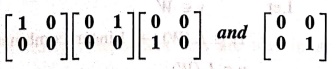 generate M2×2(R).
Solution:
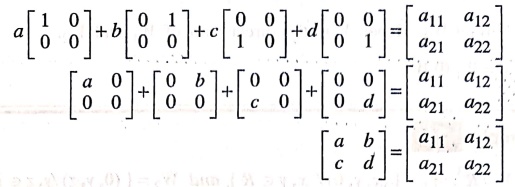
By
comparing on both sides a = a11,
b=a12, c=a21 and d=a22.
The
given matrices generate M2×2(R).
16. Show that Pn(F) is
generated by {1, x, x2, x3 ... xn }
Solution:
Let
S = {1, x, x2, x3, x2, ... xn }.
Let
α=a0+a1x+a2x2
+ a3t3… +anxn
be any arbitrary number of Pn where a0, a1, a2 …an ∈
F.
Then
α is the linear combination of polynomials 1, x, x2, x3...
xn over the field F.
S
generates Pn(F).
17. Prove that the set
S = { (1, 0, 0, − 1), (0, 1, 0, −
1), (0, 0, 1, −1), (0, 0, 0, 1)} is linearly independent.
Solution:
Now
we must show that the only linear combinations of vectors in S that equals the
zero vector is the one in which all the coefficients are zero.
Suppose
that a1, a2, a3
and a4 are scalars such
that
a1(1,
0, 0, −1)+ a2(0, 1, 0, −1)
+ a3(0, 0, 1, −1) + a4(0, 0, 0, 1) = (0, 0, 0, 0)
(a1, 0, 0, −a1) +
(0, a2, 0, − a2) + (0,
0, a3, −a3) + (0,
0, 0, a4) = (0, 0, 0, 0)
⇒ a1=0;
a2=0; a3=0
−a1−a2−a3 + a4 =0
⇒ а4=0.
Clearly
the only solution to this system is
a1
=0, a2 = 0, a3=0 and a4 = 0 and so S is linearly
independent.
18. Let V=R4. Prove that
v1 = (1, 0, 1, 0); v2 = (0, 1, 0, 1); v3=(0,0,0,2)
are linearly independent?
Solution:
We
know that av1+bv2+cv3=0
a(1,
0, 1, 0) + b(0, 1, 0, 1) + c(0, 0, 0, 2) = 0
(a,
0, a, 0) + (0, b, 0, b) + (0, 0, 0, 2c) = (0, 0, 0, 0)
(a,
b, a, b + 2c) = (0, 0, 0, 0)
a=0;
b=0; b+2c=0.
⇒ c = 0
a=0=b=c
The
vectors v1, v2, v3 are linearly independent.
19. Define minimal generating set.
Minimal generating set:
Let V be a vector space over F and S contained in V then S is called minimal
generating set for V if
(i)
L(S) = V.
(ii)
No proper subset of S will generate.
20. Define finite and infinite
dimensional vector spaces over F.
Finite Dimensional:
A vector space is called finite dimensional if it has a basis consisting of a
finite number of vectors. The unique number of vectors in each basis for V is
called the dimension of V and is denoted by dim (V).
A
vector space that is not finite−dimensional is called infinite−dimensional.
Examples:
1.
The vector space {0} has dimension zero.
2.
The vector space Fn has dimension n.
3.
The vector space Mm×n (F) has dimension mn.
4.
The vector space Pn(F) has dimension n + 1.
5.
Over the field of complex numbers, the vector space of complex numbers has
dimension 1. (A basis is { 1 })
6.
Over the field of real numbers, the vector space of complex numbers has
dimension 2. {A basis is { 1, i } }
21. Verify the following set forms a
basis or not for P2(R) given that { −1 − x + 2x2, 2 +
x−2x2, 1−2x+4x2 }
Solution:
To
verify these vector are linearly independent or not let us choose a, b, c as
scalars such that
a(−1−x+2x2) + b(2+x−2x2)
+ c(1−2x+4x2) = 0
(−a−ax
+2ax2) + (2b+ bx − 2bx2) + (c−2cx+4cx2)=0
Then
−a+2b+c=0 ...(1)
−a+b−2c=0 ...(2)
2a−2b+4c=0 ...(3)
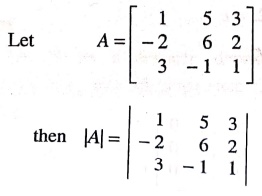
=
−1[4 −4] − 2[− 4 + 4] + 1[2 − 2] = 0
The given set of vectors are linearly
dependent.
Hence
these set of vectors does not form a basis for P2(R).
22. Find the dimension of W, where W
= { (a1, a2, a3, a4, α5) ∈ F5/a1+a3+a5
= 0, a2 = a4 }.
Solution:
a1, a2, a3 are
choosen by us to be they are independent.
(a1, a2, a3, а2, − а1 − а3)
= α1 (1, 0, 0, 0, − 1) + a2 (0, 1, 0, 1, 0) + a3(0, 0,
1, 0, −1)
{(1,
0, 0, 0, −1), (0, 1, 0, 1, 0), (0, 0, 1, 0, −1)) is a basis of W.
dim (W)
= 3.
23. Find the dimension of W for W =
{ (x1, x2, x3)/x1+x2+x3=0}
Solution:
(x1, x2, x1−x2) = x1(1, 0, − 1) + x2(0,
1, − 1)
B = {(1,
0, −1), (0, 1, −1)} is a basis of W
dim (W) = 2.
24. Find the dimensions of W, where
W= {(a1, a2, a3, a4, а5) ∈ F5/α1−α3−α4=0}
Solution:
(a1, a2, a3, а1 ‒ a3, a5)
= a1(1, 0, 0, 1, 0) + a2(0, 1, 0, 0, 0) + a3(0, 0, 1, − 1, 0) + a5(0,
0, 0, 0, 1).
B = { (1, 0, 0, 1, 0), (0, 1, 0, 0, 0), (0, 0,
1, − 1, 0), (0, 0, 0, 0, 1)} is a basis of W
. dim (W) = 4.
25. Find the dimensions of W for
W = { (a1, a2, a3, a4, α5) ∈ F5/a2 = a3
= a4 and a1+a5
= 0 }
Solution:
(a1, a2, a2, a2,−a1)
= a1 (1, 0, 0, 0, −1) + a2 (0, 1, 1, 1, 0)
B = {(1,
0, 0, 0, ‒1), (0, 1, 1, 1, 0)}
dim (W)
= 2.
Linear Algebra: UNIT I: Vector Spaces : Tag: maths, mathematics : Linear Algebra - Vector Spaces: 2 Marks Important Questions with Answer
Linear Algebra: UNIT I: Vector Spaces
Under Subject
Linear Algebra
MA25C02 2nd Semester | 2025 Regulation
Related Subjects

English Essentials II
EN25C02 2nd Semester | 2025 Regulation | 2nd Semester 2025 Regulation

Tamils and Technology தமிழர்களும் தொழில்நுட்பமும்
UC25H02 2nd Semester | 2025 Regulation | 2nd Semester 2025 Regulation
Linear Algebra
MA25C02 2nd Semester | 2025 Regulation
Transforms and its Applications
MA25C03 2nd Semester EEE Dept | 2025 Regulation | 2nd Semester 2025 Regulation

Applied Physics (CE) II
PH25C02 2nd Semester Civil, Agri Depts | 2025 Regulation | 2nd Semester 2025 Regulation
Applied Physics (CSIE) II
PH25C03 2nd Semester AIDS, CSE, IT, CSE(CY) Dept | 2025 Regulation | 2nd Semester 2025 Regulation
Applied Physics (EE) II
PH25C04 2nd Semester EEE Dept | 2025 Regulation | 2nd Semester 2025 Regulation

Applied Physics (ME) II
PH25C05 2nd Semester Mechanical Dept | 2025 Regulation | 2nd Semester 2025 Regulation
Applied Chemistry (CE) II
CY25C02 2nd Semester Civil Dept | 2025 Regulation | 2nd Semester 2025 Regulation

Applied Chemistry (ME) II
CY25C03 2nd Semester Mechanical Dept | 2025 Regulation | 2nd Semester 2025 Regulation

Electron Devices
EC25C01 2nd Semester ECE Dept | 2025 Regulation | 2nd Semester 2025 Regulation

Digital Principles and Computer Organization
CS25C06 2nd Semester AIDS, CSE, IT, CSE(CY) Dept | 2025 Regulation | 2nd Semester 2025 Regulation

Basic Electrical and Electronics Engineering
EE25C01 2nd Semester | 2025 Regulation | 2nd Semester 2025 Regulation

Basic Civil and Mechanical Engineering
GE25C01 2nd Semester EEE Dept | 2025 Regulation | 2nd Semester 2025 Regulation
Data Structures using CPlusPlus
CS25C05 2nd Semester ECE Dept | 2025 Regulation | 2nd Semester 2025 Regulation
Engineering Drawing
ME25C01 EEE, Mech, Agri, EEE Depts | 2025 Regulation | 2nd Semester 2025 Regulation
Data Structures and Algorithms
CS25C04 2nd Semester EEE Dept | 2025 Regulation

Circuits and Network Analysis
EC25C02 2nd Semester ECE Dept | 2025 Regulation | 2nd Semester 2025 Regulation

Engineering Mechanics
ME25C02 2nd Semester Mech, Civil, Agri Depts | 2025 Regulation | 2nd Semester 2025 Regulation
Object Oriented Programming (OOPs)
CS25C07 2nd Semester CSE, CSE(CY) Depts | 2025 Regulation | 2nd Semester 2025 Regulation