Linear Algebra: UNIT I: Vector Spaces
Vector Spaces: Theorems Part 7 - Example Solved Problems
Important Example Solved Problems - Engineering Maths or Mathematics - Vector Spaces: Theorems Part 7 - Example Solved Problems
Vector Spaces - Theorems Part 7
Example Problems
Example
Verify
that the following sets are bases for R3 or not.
(i)
{(1, 0, −1), (2, 5, 1), (0, −4, 3)}
(ii)
{ 1, − 3, − 2), (− 3, 1, 3), (− 2, − 10, − 2) }
Solution:
(i)
Let v1 = (1,0,− 1), v2 = (2, 5, 1) and v3 =
(0,−4, 3)
To
verify that the set is bases for R3,
Let
us verify the linear independence.
Suppose that a1, a2, a3 are
scalars, such that
a1
(1, 0, −1) + a2 (2, 5, 1) + a3 (0,− 4, 3) =
(0, 0, 0)
(a1, 0, −a1)+(2α2,
5a2, α2) + (0, −4a3, 3α3) = (0, 0, 0)
a1+2a2 = 0 …... (1)
5a2−4a3 = 0 ……. (2)
−α1+
a2+3a3 = 0 ... (3)
By
solving these three equations, we get
a1
=0, a2 =0 and a3=0
The
given set is linearly independent.
We
know that any linearly independent subset of V that contains exactly n vectors
is a basis for V.
Hence the set is a basis for R3.
(ii)
Let v1 = (1,− 3,−2), v2 = (− 3, 1, 3) and v3=(−2,
−10, −2).
Let
a1v1 + a2v2 + a3v3 = 0
a1(1,
−3, −2) + a2(−3, 1, 3) + a3(−2,−10, −2) = (0, 0, 0)
(a1, −3a1, − 2a1)
+ (−3a2, α2, 3a2) + (− 2a3, − 10a3, − 2a3) = (0, 0, 0)
a1−3a2−2a3=0 ………..(1)
−3a1+ a2 − 10a3 = 0 ………..(2)
−
2α1 +3α2−2a3
= 0 ………..(3)
Now
the equation (1)×3; 3a1−9a2−6a3 = 0
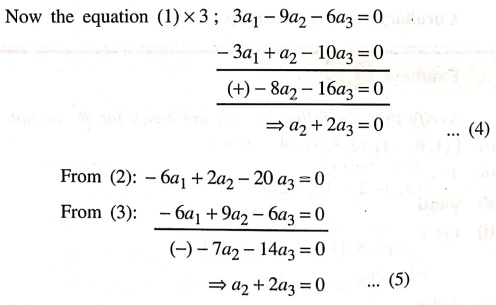
From
(4) and (5); a2+2a3
=0
⇒ a2=2a3
a2 / ‒2 = a3 / 1
a2=−2 and a3 = 1. Then a1
= −4.
Hence
the given sets are linearly dependent.
The
given set is not a basis for R3.
Example 6
Let
S = {(2,−3, 1), (1, 4, −2), (−8, 12,−4), (1, 37, −17), (−3, −5, 8)} Show that S
is a basis for R3.
Solution:
Let
v1 = (2,3, 1), v2 = (1,4,−2)
v3
= (−8, 12, 4), v4 = (1, 37, −17) and v5 = (−3,−5, 8)
The
given vectors of triplets of real numbers. They generate R3 if they
are linearly independent.
But
the dimension of R3 is only 3.
Randomly,
we can select three vectors and then we can show that they are linearly
independent degenerate R3.
Let
us consider S = { v1, v3, v5 }
Then
a1v1+ a2v3
+ a3v5 = 0
a1(2,
−3, 1) + a2(−8, 12,−4)+ a3
(−3, −5, 8) = (0, 0, 0)
(2a1, 3a1, a1)
+ (−8a2, 12a2, −4a2)
+ (−3a3, −5a3, 8a3)
= 0
2a1−8α2−3a3 = 0 .. (1)
−
3a1+12a2−5a3=0 …….(2)
a1
−4a2+8a3 = 0 …….(3)
Solving
these equations we get a1
= 0, a2 = 0 and a3 = 0
.S=
{v1, v3, v5 } is linearly independent and
forms a basis.
Example 7
Let S={(2, 3, 5), (8,
12, 20), (1, 0, −2), (0, 2, 1), (7, 2, 0) }.
Show that S is a basis
for R3.
Solution:
It
is given that v1 = (2,−3, 5), v2= (8,−12, 20), v3
= (1,0,−2), v4= (0,2−1) and v5 = (7, 2, 0).
Let
us select a basis for R3 that is a subset of S.
Let
us select v1 = (2, 3, 5) to be a vector in the basis.
Since
4v1 = 4(2,−3, 5) = (8, 12, 20) = v2,
v1
and v2 are linearly dependent.
We should not consider v2 = (8, 12,
20) as a set. Hence v1, v3, v4 and v5
are the remaining set of vectors. Since this set belongs to R3, we
can consider any three among v1, v3, v4 and v5.
As
a random, let us consider S = { v1, v3, v4 }
Then
a1v1 + a2 v3 + a3v4
= 0
a1
(2,−3, 5)+a2 (1, 0, −2)+ a3 (0,2,−1)=(0, 0, 0)
(2a1,−3a1, 5a1)
+ (a2, 0, − 2a2) +
(0, 2a3, ‒ a3)
= (0, 0, 0)
2a1
+ a2 = 0 …….(1)
−3α1+2a3 = 0 …….(2)
5α1−2a2−a3=0 …….(3)
By
solving these three equations we get a1
=0, a2 = 0 and a3=0.
S
= {v1, v3, v4 } is a subset and linearly
independent.
The
set S forms a basis for R3
Example 8
Verify whether S={(1,
4, 6), (1, 5, 8), (2, 1, 1), (0, 1, 0)} is linearly independent or not on R3.
Solution:
Let
S = {(1, 4, 6), (1, 5, 8), (2, 1, 1), (0, 1, 0)}
Let
v1 = (1,4,−6), v2 = (1, 5, 8), v3 = (2, 1, 1)
and v4 = (0, 1, 0)
Then
a1v1 + a2v2 + a3v3 + a4v4
= 0
a1(1, 4, − 6) + a2(1, 5, 8) + a3(2,
1, 1) + a4(0, 1, 0) = (0, 0, 0)
(a1, 4a1, − 6a1)
+ (a2, 5a2, 8a2)
+ (2a3, a3, a3) + (0, a4, 0) = (0, 0, 0)
a1+
a2+2a3=0 ...
(1)
4a1 + 5a2 + a3 +4 =0 ... (2)
−6α1+8a2+ a3 = 0 ... (3)
Let
us put a4 = 1 in equation
(2). Then
a1+
a2+2a3 = 0 .. (1)
4a1
+5α2+a3 = −1
.. (2)
−6a1+8a2+ a3 = 0 .. (3)
Solving
these equations, we get
a1
= ‒ 5/37
a1
= − 13/111
a1
= 14/111
and
a4 = 1.
Hence
the given sets are linear dependent on R3.
Example 9
Verify, whether the
given polynomials
{x3−2x2+1,
4x2−x+3, 3x−2} generate P3(R) or not.
Solution:
Given
that the sets are x3 − 2x2+1, 4x2−x+3 and 3x−2.
All
the three polynomials have degree less than or equal to 3.
The
given sets of polynomials belong to P3 (R).
But,
generally the given set of vector in Pn(R) has the dimension n+1.
..
The above given three polynomials must have the dimension 4.
.
The given set of polynomials cannot span P3(R).
Thus
the given polynomials cannot generate P3(R).
Example 10
Verify the following
set of vectors in R3 forms a basis or not? S={v1, v2,
v3} where v1 = (1, 0, − 1), v2 = (2, 5, 1)
& v3 = (0, − 4, 3).
Solution:
To
verify these vectors are linearly independent choose a, b, c are scalars such
that.
a(1, 0, −1) + b(2, 5, 1)
+ c(0, −4,3)=(0, 0, 0)
(a,
0,− a)+(2b, 5b, b) + (0, −4c, 3c) = (0, 0, 0)
⇒ a+2b+0=0 ...(1)
0+5b−4c=0
...(2)
−
a+b+3c=0 ...(3)
By
solving these three equations (1) (2) & (3) we get
a=0, b=0 & c = 0.
The
vectors are linearly independent.
Let
(x, y, z) ∈
R3
(x,
y, z) = a (1, 0, −1) + b (2, 5, 1) + c (0, −4, 3)
(x,
y, z) = (a, 0,− a) + (2b, 5b, b) + (0, −4c, 3c)
a+2b+0c
= x …….(4)
0a+5b−4c=y …….(5)
−
a+b+3c=z …….(6)
From
equations (4), (5) & (6) we notice that L(s) = V.
S
generates V⇒S
is a basis of V.
Hence
the given set is basis for R3.
Example 11
Let S = {v1,
v2, v3} where v1 = (1, −3, −2), v2
= (−3, 1, 3), v2 = (−2, −10, −2). Verify whether S forms a basis or
not?
Solution:
To
verify these vectors are linearly independent or not choose a, b, c as scalars
such that,
a(1,−3,−2) + b(−3, 1, 3) + c(−2, −10,−2) = (0,
0, 0)
(a,− 3a, −2a)+(−3b, b, 3b) + (−2c, 10c, −2c) =
(0, 0, 0)
Then
a−3b−2c=0 …….(1)
−3a+b−10c
= 0 …….(2)
−2a+3b−2c=0 …….(3)
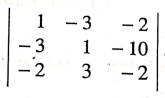 = 1 [1−2+30] + 3[6−20] − 2[−9+2]
=
1[28] + 3[14] −2[7]
=
28−42+ 14
=
42−42=0
Since = 0 the given vectors are linearly dependent.
Hence,
the given set of vectors does not form a basis.
The
set of vectors is not a basis for R3.
Example 12
Verify the following
set forms a basis or not for P2(R) given that {−1−x+2x2,
2+x−2x2, 1−2x+4x2}
Solution:
To
verify these vector are linearly independent or not let us choose a, b, c as
scalars such that
a(−1−x+2x2) + b(2+x−2x2)
+ c(1−2x+4x2) = 0
(−a−ax
+2ax2) + (2b+ bx − 2bx2) + (c−2cx+4cx2)=0
Then
−a+2b+c=0 ...(1)
−a+b−2c=0 ...(2)
2a−2b+4c=0 ...(3)
Let 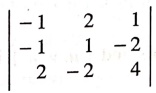
=
−1[4 −4] − 2[− 4 + 4] + 1[2 − 2] = 0
The given set of vectors are linearly
dependent.
Hence
these set of vectors does not form a basis for P2(R).
Example 13
Verify the following
set of vectors forms a basis or not for P2(R) given that {−1 +2x+4x2,
3−4x−10x2, −2−5x−6x2 }
Solution:
To
verify these vectors are linearly independent or not let us choose a, b, c as
scalars such that
a (− 1 + 2x + 4x2) + b (3 − 4x − 10x2)
+ c (− 2 − 5x − 6x2) = 0
(−a+2ax+4ax2)+(3b
− 4bx − 10bx2) + (− 2c −5cx − 6cx2) = 0
Then
−a+3b−2c=0 ...(1)
2a−4b−5c=0 ...(2)
4a−10b−6c=0 ...(3)
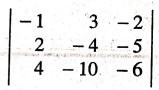
=
−1[24−50] −3[−12+20] − 2[−20+16]
=
−1[−26] −3[8] −2[4]
=
26−24+8
=
10
Hence
the determinant of the matrix is 10≠0 the given set of vectors are linearly
independent.
Hence
the given set of vectors forms a basis for P2(R).
Example 14
Let u, v and w be three
distinct vectors of a vector space V. If {u, v, w} is a basis for V, then show
that {u+v+w, v+w, w} also a basis for V.
Solution:
It
is given that, u, v, w be the distinct vectors and { u, v, w} is a basis for V.
Now
to prove {u+v+w, v+w, w} is a basis for V.
We
have to prove that it is linearly independent.
Let
us consider a1v1
+ a2v2 + a3v3 ... + anvn
= 0
That
means a1 = 0, a2 = 0, a3 =
0... an = 0.
a1(u
+v+w) + a2(v + w) + a3(w)
= (0, 0, 0)
a1u
+ a1v + a1w + a2v + a2w
+ a3w = (0, 0, 0)
а1(u) + (α1 + a2) v + (α1 + a2+ а3) w = 0
Since
it is given that { u, v, w} is a basis for V, it is linearly independent.
(ie)
a1 =0, a1+α2 = 0, a1 + a2+ a3=0
a1
=0, a2 = 0 and a3 =
0.
{ u + v + w, v+w, w} is linearly independent.
Hence
it is a basis for the vector space V.
Example 15
Let u and v be two
vectors of a vector space V. If {u, v} is a basis for V and c1 and c2
are non−zero scalars, then prove that
{ u + v, c1u } and { c1u, c2v} are also
the bases for V.
Solution:
It
is given that { u, v} is a basis for V.
(i)
To prove { u + v, c1u }, {
c1u, c2v} are
bases for V,
Then
a1 (u+v) + a2 (c1u) = 0
. a1u
+ a1v + а2c1u = 0
(a1
+ c1α2)u + (a1)v=0.
Since
{u, v} is basis, it is linearly independent.
(a1 + a2c1)
= 0 and a1=0. Since a1 = 0, a2 = 0
a1(u
+ v) + a2 (c1u) = 0 we get a1 =0, a2 = 0.
Therefore
{ u+v, c1u } is linearly
independent.
(ii)
Now to prove { c1u, c2v}
is a basis for V
Let
a1(c1u) + a2(c2v)
= 0
(a1 c1) u + (a2 c2) v=0
Since
{u, v} is linearly independent,
a1c1=0
and a2 c2 = 0
a1=0
and a2 =0
a1
(c1u) + a2 (c2v)=0 we get a1
= 0 and a2 = 0.
{c1u, c2v} is
linearly independent.
Hence
it forms a basis for V.
Example 16
Find the dimension of
W; where
W = {(a1, a2, a3, a4, a5) ∈ F5/a1+a3+α5=0, a2 = α4}
Solution:
a1, a2, a3 are
choosen by us to be they are independent.
(a1, a2, a3, а2, − а1 − а3)
= α1 (1, 0, 0, 0, − 1) + a2 (0, 1, 0, 1, 0) + a3(0, 0,
1, 0, −1)
{(1,
0, 0, 0, −1), (0, 1, 0, 1, 0), (0, 0, 1, 0, −1)) is a basis of W.
dim (W)
= 3.
Example 17
Find the dimensions of
W, where
W= {(x1,x2, x3)
| x1+x2+x3=0}.
Solution:
(x1, x2, x1−x2) = x1(1, 0, − 1) + x2(0,
1, − 1)
B = {(1,
0, −1), (0, 1, −1)} is a basis of W
dim (W) = 2.
Example 18
Find the dimensions of
W, where W is given by
W = { (a1, a2, a3, a4, а5) ∈ F5/a1−a3−a4=0}.
Solution:
(a1, a2, a3, а1 ‒ a3, a5)
= a1(1, 0, 0, 1, 0) + a2(0, 1, 0, 0, 0) + a3(0, 0, 1, − 1, 0) + a5(0,
0, 0, 0, 1).
B = { (1, 0, 0, 1, 0), (0, 1, 0, 0, 0), (0, 0,
1, − 1, 0), (0, 0, 0, 0, 1)} is a basis of W
. dim (W) = 4.
Example 19
Find the dimensions of
W, where W is given by
W = { (a1, a2, a3, a4, a5) ∈ F5/a2=a3=a4
and a1+a5=0}
Solution:
(a1, a2, a2, a2,−a1)
= a1 (1, 0, 0, 0, −1) + a2 (0, 1, 1, 1, 0)
B = {(1,
0, 0, 0, ‒1), (0, 1, 1, 1, 0)}
dim (W)
= 2.
Example 20
Find the dimension of W
where W is given by W= { a, b, c); 2a+3b= c; 7c+9b = a }.
Solution:
W
= { a, b, c)/2a+3b−c=0, a−7c−9b=0}
2a+3b−c=0
a−9b−7c=0
AX=
B
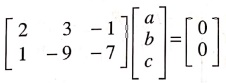
p(2) < 3 = number of unknown.
Infinite number of solution exists.
Leta = k, where k is arbitrary
2k+3b−c=0
c
= 2k+ 3b
k−9b−7(2k
+ 3b) = 0
k−9b−14k
– 21b=0
−
30b = 13k
b
= − 13/30 k
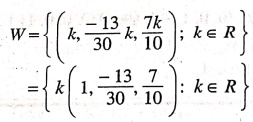
dim
(W) = 1.
Example 21
Determine the basis and
dimension of the solution space of the linear homogeneous system x+y−z=0; −2x−y
+ 2z = 0 ; −x +z = 0.
Solution:
From
the given system of linear equations
The
Augmented matrix is
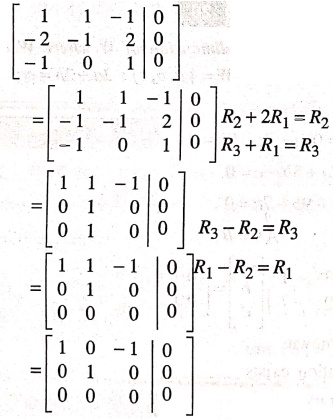
⇒ x−z=0 & y=0
x=z
& y=0
Put
x = t; x=t, y = 0, z=t.
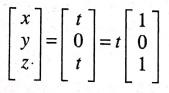
This
shows the vector v1=  span the solution space, since it is
linearly independent. It is a basis.
span the solution space, since it is
linearly independent. It is a basis.
The
solution space is 1−dimensional
Example 22
Let V = M2×2
(F) . W1 = {  ∈ V/a,b,c ∈F}. W2={
 ∈ V/a,b ∈F}.
(i) Prove that W1 is a subspace of V and find the dimension of W1.
(ii) Prove that W2 is a subspace of
V and find the dimension of W2.
(iii) Find the dimensions of W2+ W2
and W1 ∩ W2
Solution:
Let
V=M2×2 (F)
(i)
Given that
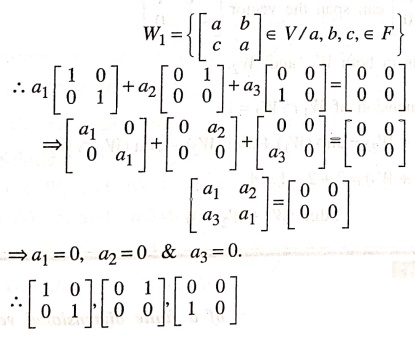
are
linearly independent.
These
vectors span W1.
Hence
W1 is a subspace of V
Here
dimension of W1 = 3.
(ii)
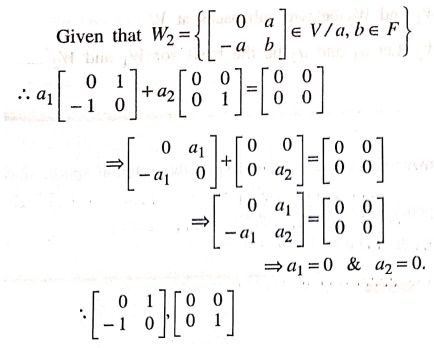
are
linearly independent.
These vectors span W2.
Hence
W2 is a subspace of V.
Here
the dimension of W2 =2.
(iii)
From (i) & (ii) Combining all the bases vectors of W1 and W2.
We
have

But
these vectors
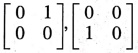 can
span the vector
can
span the vector 
is
in both W1 and W2.
Hence
the dimension of W1 ∩ W2 = 1.
Now
dim (W1+ W2) = dim (W1) + dim (W2) −
dim (W1 ∩ W2)
dim
(W1 + W2)=3+2−1=4
dim (W1 + W2)=4
Example 23
Let W1 and W2
be the subspaces of a finite dimensional vector space V. Write down the
necessary and sufficient conditions on W1 and W2 so that
dim (W1 ∩ W2) = dim (W1)
Solution:
Given
that W1 and W2 be two subspaces at V.
Then
W1<W2. Let a1
and a2 be the basis for W1 and W2 and they are
finite.
Let
us prove this by the method of contradiction.
Suppose
W1 is not a subspace of W2, then there will be no common
element. Since thee is no common element, the vector v ∈ V doesnot generate the
basis for W2.
The
set has dimension of W1 ∩ W2 is a subset of dim (W1).
(ie) dim (W ∩ W2)  dim (W1)
Now
conversely, let W1 is a subspace of W2 then
(W ∩ W2)=W1
and
W2
is the subspace of W1, then (W1 ∩ W2) = W2
W1
∩ W2 has same vectors as W1.
dim (W1
∩ W2) = dim (W1)
Thus
both W1 and W2 have same dimensions.
Example 24
Let W1 and W2
be the subspaces of a vector space V having dimensions, m and n respectively
where m≥n.
(i) Prove that dim (W
∩ W2) ≤ n
(ii) Prove that dim (W1+
W2) ≤m+n.
Solution:
Let
W1 and W2 be two subspaces of V, and it is given that dim
(W1) = m and dim (W2) = n.
(i)
Let (W1 ∩ W2)  W2
W2
Then
dim (W1 ∩ W2) ≤ dim (W2)
dim
(W1 ∩ W2) ≤ n
Hence
dim (W1 ∩ W2) ≤n.
(ii) dim (W1+ W2) = dim
(W1) + dim (W2) − dim (W1 ∩ W2)
=
m+n−dim (W1 ∩ W2)
But
dim (W1 ∩ W2) is non negative, then
dim
(W1 ∩ W2) ≤ m + n
.dim (W1+ W2) ≤ m+n
Example 25
Use Lagrange
interpolation formula to find the polynomial for the following points (−2, −6),
(1, 5), (1, 3)
Solution:
Let
us consider
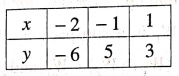
Here
x0 = −2, x1 = −
1, x2 = 1, y0 = −6, y1
= 5 and y2 = 3.
The
Lagrange's interpolation formula is
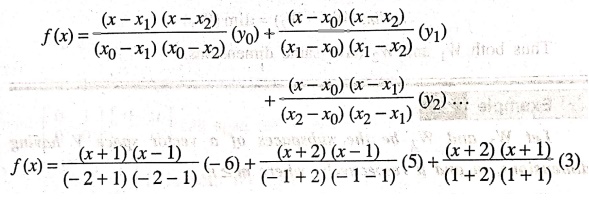
f
(x) = −2(x2 − 1) – 5/2 (x2
+x−2)+ 1/2(x2+3x+2)
f
(x) = ½ [ − 4 (x2 − 1) − 5 (x2 +x−2)+(x2+3x+2)]
=
½[−4x2+4−5x2−5x+10+x2+3x+2]
=
1/2 [−8x2 −2x+16]
f(x) =
−4x2−x+8
Linear Algebra: UNIT I: Vector Spaces : Tag: maths, mathematics : - Vector Spaces: Theorems Part 7 - Example Solved Problems
Linear Algebra: UNIT I: Vector Spaces
Under Subject
Linear Algebra
MA25C02 2nd Semester | 2025 Regulation
Related Subjects

English Essentials II
EN25C02 2nd Semester | 2025 Regulation | 2nd Semester 2025 Regulation

Tamils and Technology தமிழர்களும் தொழில்நுட்பமும்
UC25H02 2nd Semester | 2025 Regulation | 2nd Semester 2025 Regulation
Linear Algebra
MA25C02 2nd Semester | 2025 Regulation
Transforms and its Applications
MA25C03 2nd Semester EEE Dept | 2025 Regulation | 2nd Semester 2025 Regulation

Applied Physics (CE) II
PH25C02 2nd Semester Civil, Agri Depts | 2025 Regulation | 2nd Semester 2025 Regulation

Applied Physics (CSIE) II
PH25C03 2nd Semester AIDS, CSE, IT, CSE(CY) Dept | 2025 Regulation | 2nd Semester 2025 Regulation
Applied Physics (EE) II
PH25C04 2nd Semester EEE Dept | 2025 Regulation | 2nd Semester 2025 Regulation

Applied Physics (ME) II
PH25C05 2nd Semester Mechanical Dept | 2025 Regulation | 2nd Semester 2025 Regulation
Applied Chemistry (CE) II
CY25C02 2nd Semester Civil Dept | 2025 Regulation | 2nd Semester 2025 Regulation

Applied Chemistry (ME) II
CY25C03 2nd Semester Mechanical Dept | 2025 Regulation | 2nd Semester 2025 Regulation

Electron Devices
EC25C01 2nd Semester ECE Dept | 2025 Regulation | 2nd Semester 2025 Regulation

Digital Principles and Computer Organization
CS25C06 2nd Semester AIDS, CSE, IT, CSE(CY) Dept | 2025 Regulation | 2nd Semester 2025 Regulation

Basic Electrical and Electronics Engineering
EE25C01 2nd Semester | 2025 Regulation | 2nd Semester 2025 Regulation

Basic Civil and Mechanical Engineering
GE25C01 2nd Semester EEE Dept | 2025 Regulation | 2nd Semester 2025 Regulation
Data Structures using CPlusPlus
CS25C05 2nd Semester ECE Dept | 2025 Regulation | 2nd Semester 2025 Regulation
Engineering Drawing
ME25C01 EEE, Mech, Agri, EEE Depts | 2025 Regulation | 2nd Semester 2025 Regulation
Data Structures and Algorithms
CS25C04 2nd Semester EEE Dept | 2025 Regulation

Circuits and Network Analysis
EC25C02 2nd Semester ECE Dept | 2025 Regulation | 2nd Semester 2025 Regulation

Engineering Mechanics
ME25C02 2nd Semester Mech, Civil, Agri Depts | 2025 Regulation | 2nd Semester 2025 Regulation
Object Oriented Programming (OOPs)
CS25C07 2nd Semester CSE, CSE(CY) Depts | 2025 Regulation | 2nd Semester 2025 Regulation