Basic Electronics and Electrical Engineering: Chapter 5: Induction Motors
AC Series Motor or Universal Motor
Construction, Working Principle, Circuit Diagram, Characteristics, Applications
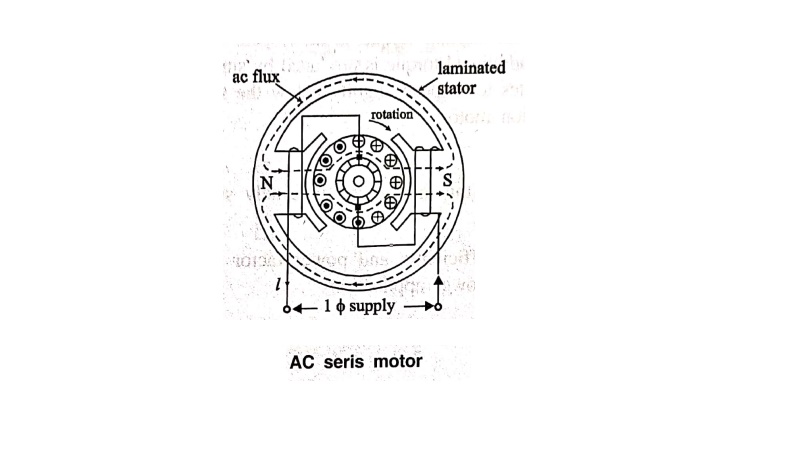
Construction, Working Principle, Circuit Diagram, Characteristics, Applications of AC Series Motor or Universal Motor
AC
SERIES MOTOR OR UNIVERSAL MOTOR
A dc series motor will
rotate in the same direction regardless of the polarity of the supply. One can
expect that a dc series motor would also operate on a single‒phase supply. It will
then be called as ac series motor. However, some changes must be made in a dc
motor that is to operate satisfactorily on ac supply. The changes effected are:
(i) The entire magnetic
circuit is laminated in order to reduce the eddy current loss. Hence an ac
series motor requires a more expensive construction than a dc series motor.
(ii) The series field
winding uses few turns as possible to reduce the reactance of the field winding
to a minimum. This reduces the voltage drop across the field winding.
(iii) A high field flux
is obtained by using a low‒reluctance magnetic circuit.
(iv) There is
considerable sparking between the brushes and the commutator when the motor is
used on ac supply. It is because the alternating flux establishes high currents
in the coils short‒circuited by the brushes. When the short‒circuited coils
break contact from the commutator, excessive sparking is produced. This can be
eliminated by using high‒resistance leads to connect the coils to the
commutator segments.
Construction
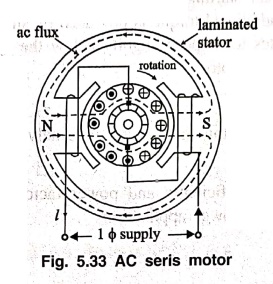
The construction of an
ac series motor is very similar to a dc series motor except the above
modifications (Ref Fig. 5.33). Such a motor can be operated either on ac or dc
supply and the resulting torque‒speed curve is the same in each case. For this
reason, it is some‒times called, a universal motor.
Operation
When the motor is
connected to an a.c. supply, the same alternating current flows through the
field and armature windings. The field winding produces an alternating flux ϕ that
reacts with the current flowing in the armature to produce a torque. Since with
armature current and flux reverse simultaneously, the torque always acts in the
same direction. It may be noted that no rotating flux is produced in this type
of machines and the principle of operation is the same as that of a dc series
motor.
Characteristics
The operating
characteristics of an ac series motor are similar to those of a dc series
motor.
(1) The speed increases
to a high value with a decrease in load. In very small series motors the losses
are usually large enough no load that limit the speed to a definite value (1500‒
15,000 rpm).
(ii) The motor torque
is high for large armature current, thus giving a high starting torque.
(iii) At full‒load, the
power factor is about 90%. However, at starting or when carrying an overload,
the power factor is lower.
Applications
The fractional
horsepower ac series motors have high‒speed (and corresponding small size) and
large torque. They can, therefore, be used to drive
(a) High‒speed vacuum
cleaners
(b) Sewing machines
(c) Electric shavers
(d) Drills
(e) Machine tools etc.
Basic Electronics and Electrical Engineering: Chapter 5: Induction Motors : Tag: Basic Engineering : Construction, Working Principle, Circuit Diagram, Characteristics, Applications - AC Series Motor or Universal Motor
Basic Electronics and Electrical Engineering: Chapter 5: Induction Motors
Under Subject

Basic Electronics and Electrical Engineering
EE25C04 1st Semester ECE Dept | 2025 Regulation | 2nd Semester 2025 Regulation
Related Subjects

English Essentials I
EN25C01 1st Semester | 2025 Regulation | 1st Semester 2025 Regulation

தமிழர் மரபு - Heritage of Tamils
UC25H01 1st Semester | 2025 Regulation | 1st Semester 2025 Regulation
Applied Calculus
MA25C01 Maths 1 M1 - 1st Semester | 2025 Regulation | 1st Semester 2025 Regulation
Applied Physics I
PH25C01 1st Semester | 2025 Regulation | 1st Semester 2025 Regulation

Applied Chemistry I
CY25C01 1st Semester | 2025 Regulation | 1st Semester 2025 Regulation
Makerspace
ME25C04 1st Semester | 2025 Regulation | 1st Semester 2025 Regulation
Computer Programming C
CS25C01 1st Semester | 2025 Regulation | 1st Semester 2025 Regulation
Computer Programming Python
CS25C02 1st Semester | 2025 Regulation | 1st Semester 2025 Regulation
Fundamentals of Electrical and Electronics Engineering
EE25C03 1st Semester | 2025 Regulation | 1st Semester 2025 Regulation
Introduction to Mechanical Engineering
ME25C03 1st Semester | 2025 Regulation | 1st Semester 2025 Regulation

Introduction to Civil Engineering
CE25C01 1st Semester Civil Department | 2025 Regulation | 1st Semester 2025 Regulation
Essentials of Computing
CS25C03 1st Semester - AID CSE IT Department | 2025 Regulation | 1st Semester 2025 Regulation

Applied Physics I Laboratory
PH25C01 1st Semester practical Laboratory Manual | 2025 Regulation | 1st Semester Laboratory 2025 Regulation

Applied Chemistry I Laboratory
CY25C01 1st Semester practical Laboratory Manual | 2025 Regulation | 1st Semester Laboratory 2025 Regulation

Computer Programming C Laboratory
CS25C01 1st Semester practical Laboratory Manual | 2025 Regulation | 1st Semester Laboratory 2025 Regulation

Computer Programming Python Laboratory
CS25C02 1st Semester practical Laboratory Manual | 2025 Regulation | 1st Semester Laboratory 2025 Regulation
Engineering Drawing
ME25C01 EEE Mech Dept | 2025 Regulation | 2nd Semester 2025 Regulation
Basic Electronics and Electrical Engineering
EE25C04 1st Semester ECE Dept | 2025 Regulation | 2nd Semester 2025 Regulation