Basic Electronics and Electrical Engineering: Chapter 5: Induction Motors
Shaded Pole Motor
Construction, Working Principle, Circuit Diagram, Characteristics, Applications
Construction, Working Principle, Circuit Diagram, Characteristics, Applications of Shaded Pole Motor
SHADED
POLE MOTOR
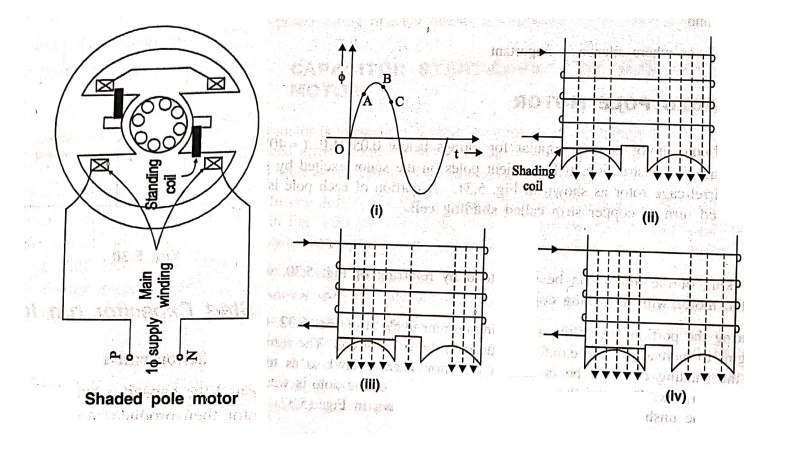
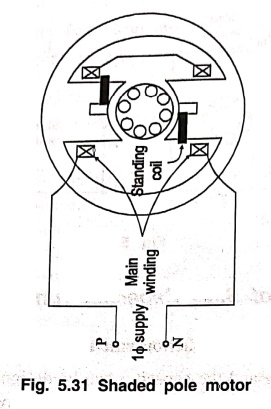
The shaded‒pole motor
is very popular for ratings below 0.05 H.P. (~40W) because of its extremely
simple construction. It has salient poles on the stator excited by single‒phase
supply and a squirrel‒cage rotor as shown in Fig. 5.31. A portion of each pole
is surrounded by a short‒circuited turn of copper strip called shading coil.
Working
The working of the
motor can be understood by referring of Fig. 5.30. which shows one pole of the
motor with a shading coil.
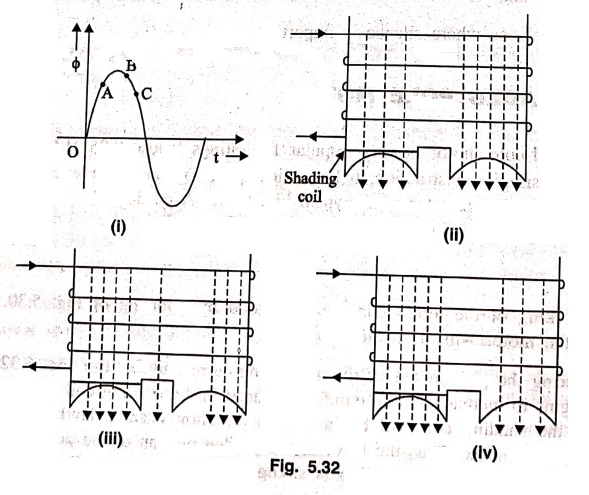
1. During the portion
OA of the alternating‒current cycle [Ref Fig. 5.32. (i)], the flux begins to
increase and an e.m.f. is induced in the shading coil. The resulting current in
the shading coil will be in such a direction (Lenz's law) so as to oppose the
change in flux. Thus the flux in the shaded portion of the pole is weakened
while that in the unshaded portion is strengthened as shown in Fig. (5.32)
(ii).
2. During the portions
AB of the alternating‒current cycle, the flux has reached almost maximum value
and is not changing. Consequently, the flux distribution across the pole is
uniform [Ref Fig. 5.32. (iii)] since no current is flowing in the shading coil.
As the flux decreases (portion BC of the alternating cycle), current is induced
in the shading coil so as to oppose the decrease in current. Thus the flux in
the shaded portion of the pole is strengthened while that in the unshaded
portion is weakened as shown in Fig. 5.32. (iv).
3. The effect of the
shading coil is to cause the field flux to shift across the pole face from the
unshaded to the shaded portion. This shifting flux is like a rotating weak
field moving in the direction from unshaded portion to the shaded portion of
the pole.
4. The rotor is of the
squirrel‒cage type and is under the influence of the moving field.
Consequently, a small starting torque is developed. As soon as this torque
starts to revolve the motor, additional torque is produced by single‒phase
induction motor action. The motor accelerates to a speed slightly below the
synchronous speed and runs as a single‒phase induction motor.
Characteristics
(i) The salient
features of this motor are extremely simple construction and absence of
centrifugal switch.
(ii) Since starting
torque, efficiently and power factor are very low, these motors are only
suitable for low power applications
Applications
• Small fans
• Toys
• Hair dryers
• Desk fans etc.
The power rating of
such motors is upto 30 W
Basic Electronics and Electrical Engineering: Chapter 5: Induction Motors : Tag: Basic Engineering : Construction, Working Principle, Circuit Diagram, Characteristics, Applications - Shaded Pole Motor
Basic Electronics and Electrical Engineering: Chapter 5: Induction Motors
Under Subject

Basic Electronics and Electrical Engineering
EE25C04 1st Semester ECE Dept | 2025 Regulation | 2nd Semester 2025 Regulation
Related Subjects

English Essentials I
EN25C01 1st Semester | 2025 Regulation | 1st Semester 2025 Regulation

தமிழர் மரபு - Heritage of Tamils
UC25H01 1st Semester | 2025 Regulation | 1st Semester 2025 Regulation
Applied Calculus
MA25C01 Maths 1 M1 - 1st Semester | 2025 Regulation | 1st Semester 2025 Regulation
Applied Physics I
PH25C01 1st Semester | 2025 Regulation | 1st Semester 2025 Regulation

Applied Chemistry I
CY25C01 1st Semester | 2025 Regulation | 1st Semester 2025 Regulation
Makerspace
ME25C04 1st Semester | 2025 Regulation | 1st Semester 2025 Regulation
Computer Programming C
CS25C01 1st Semester | 2025 Regulation | 1st Semester 2025 Regulation
Computer Programming Python
CS25C02 1st Semester | 2025 Regulation | 1st Semester 2025 Regulation
Fundamentals of Electrical and Electronics Engineering
EE25C03 1st Semester | 2025 Regulation | 1st Semester 2025 Regulation
Introduction to Mechanical Engineering
ME25C03 1st Semester | 2025 Regulation | 1st Semester 2025 Regulation

Introduction to Civil Engineering
CE25C01 1st Semester Civil Department | 2025 Regulation | 1st Semester 2025 Regulation
Essentials of Computing
CS25C03 1st Semester - AID CSE IT Department | 2025 Regulation | 1st Semester 2025 Regulation

Applied Physics I Laboratory
PH25C01 1st Semester practical Laboratory Manual | 2025 Regulation | 1st Semester Laboratory 2025 Regulation

Applied Chemistry I Laboratory
CY25C01 1st Semester practical Laboratory Manual | 2025 Regulation | 1st Semester Laboratory 2025 Regulation

Computer Programming C Laboratory
CS25C01 1st Semester practical Laboratory Manual | 2025 Regulation | 1st Semester Laboratory 2025 Regulation

Computer Programming Python Laboratory
CS25C02 1st Semester practical Laboratory Manual | 2025 Regulation | 1st Semester Laboratory 2025 Regulation
Engineering Drawing
ME25C01 EEE Mech Dept | 2025 Regulation | 2nd Semester 2025 Regulation
Basic Electronics and Electrical Engineering
EE25C04 1st Semester ECE Dept | 2025 Regulation | 2nd Semester 2025 Regulation