Basic Electronics and Electrical Engineering: Chapter 5: Induction Motors
Split Phase Induction Motor
Construction, Circuit Diagram, Characteristics, Applications
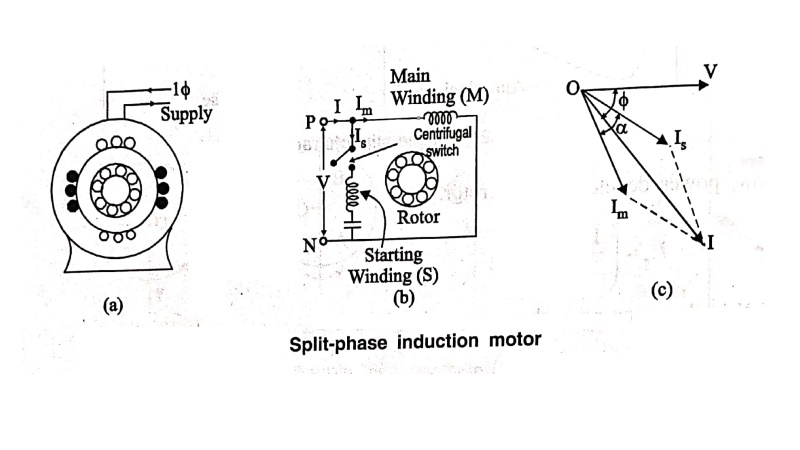
The stator of a split‒phase motor provided with an auxiliary or starting windings in addition to the main or running winding M.
SPLIT
PHASE INDUCTION MOTOR
The stator of a split‒phase
motor provided with an auxiliary or starting windings in addition to the main
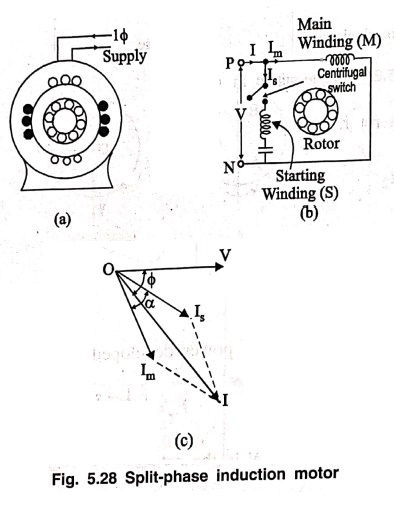
or running winding M. The starting winding is located 90° electrical from the
main winding [See Fig. 5.28] and operates only during the brief period when the
motor starts up. The two windings are so designed that the starting winding s
has a high resistance and relatively small reactance while the main winding M
has relatively low resistance and large reactance as shown in the schematic
connections in Fig. 5.28 (b) Consequently, the currents flowing in the two
windings have reasonable phase difference α (25° to 30°) as shown in the phasor
diagram in Fig. 5.28 (c).
This can be done by
having main winding of large diameter and number of turns while starting
winding of a fine wire of a small number of turns.
When the two stator
windings are energised from a single‒phase supply, the main winding carries
current Im while the starting winding carries current IS.
Since main winding is
made highly inductive and the starting winding highly resistive, the currents Im
and IS have a reasonable phase angle α (25° to 30°) between them as
shown in Fig. 5.28 (c) Consequently, a weak revolving field approximating to
that of a 2-phase machine is produced which starts the motor. The starting
torque is given by:
TS = kImIS
sin α …………(5.32)
Where, k is a constant whose magnitude depends
upon the design of the motor.
When the motor reaches
about 75% of synchronous speed, the centrifugal switch opens the circuit of the
starting winding. The motor then operates as a single‒phase induction motor and
continues to accelerate till it reaches the normal speed. The normal speed of
the motor is below the synchronous speed and depends upon the load on the
motor.
Characteristics of Split phase Induction motors
The important
characteristics of split‒phase induction motors are
1. The starting torque
is 1.5 to 2 times the full‒load torque and the starting current is 6 to 8 times
the full‒load current.
2. Due to their low
cost, split‒phase induction motors are the most popular single‒phase motors in
the market.
3. Since the starting
winding is made of fine wire, the current density is high and the winding heats
up quickly. If the starting period exceeds 5 seconds, the winding may burn out
unless the motor is protected by built‒in‒thermal relay. This motor is,
therefore, suitable where starting periods are not frequent.
Applications of Split phase Induction motors
These motors are
suitable where a moderate starting torque is required and where starting
periods are not frequent e.g., to drive:
• Fans
• Washing machines
• Oil burners
• Small machine tools
etc.
The power rating of
such motors generally lies between 60 W and 250 W.
Basic Electronics and Electrical Engineering: Chapter 5: Induction Motors : Tag: Basic Engineering : Construction, Circuit Diagram, Characteristics, Applications - Split Phase Induction Motor
Basic Electronics and Electrical Engineering: Chapter 5: Induction Motors
Under Subject

Basic Electronics and Electrical Engineering
EE25C04 1st Semester ECE Dept | 2025 Regulation | 2nd Semester 2025 Regulation
Related Subjects

English Essentials I
EN25C01 1st Semester | 2025 Regulation | 1st Semester 2025 Regulation

தமிழர் மரபு - Heritage of Tamils
UC25H01 1st Semester | 2025 Regulation | 1st Semester 2025 Regulation
Applied Calculus
MA25C01 Maths 1 M1 - 1st Semester | 2025 Regulation | 1st Semester 2025 Regulation
Applied Physics I
PH25C01 1st Semester | 2025 Regulation | 1st Semester 2025 Regulation

Applied Chemistry I
CY25C01 1st Semester | 2025 Regulation | 1st Semester 2025 Regulation
Makerspace
ME25C04 1st Semester | 2025 Regulation | 1st Semester 2025 Regulation
Computer Programming C
CS25C01 1st Semester | 2025 Regulation | 1st Semester 2025 Regulation
Computer Programming Python
CS25C02 1st Semester | 2025 Regulation | 1st Semester 2025 Regulation
Fundamentals of Electrical and Electronics Engineering
EE25C03 1st Semester | 2025 Regulation | 1st Semester 2025 Regulation
Introduction to Mechanical Engineering
ME25C03 1st Semester | 2025 Regulation | 1st Semester 2025 Regulation

Introduction to Civil Engineering
CE25C01 1st Semester Civil Department | 2025 Regulation | 1st Semester 2025 Regulation
Essentials of Computing
CS25C03 1st Semester - AID CSE IT Department | 2025 Regulation | 1st Semester 2025 Regulation

Applied Physics I Laboratory
PH25C01 1st Semester practical Laboratory Manual | 2025 Regulation | 1st Semester Laboratory 2025 Regulation

Applied Chemistry I Laboratory
CY25C01 1st Semester practical Laboratory Manual | 2025 Regulation | 1st Semester Laboratory 2025 Regulation

Computer Programming C Laboratory
CS25C01 1st Semester practical Laboratory Manual | 2025 Regulation | 1st Semester Laboratory 2025 Regulation

Computer Programming Python Laboratory
CS25C02 1st Semester practical Laboratory Manual | 2025 Regulation | 1st Semester Laboratory 2025 Regulation
Engineering Drawing
ME25C01 EEE Mech Dept | 2025 Regulation | 2nd Semester 2025 Regulation
Basic Electronics and Electrical Engineering
EE25C04 1st Semester ECE Dept | 2025 Regulation | 2nd Semester 2025 Regulation