Electron Devices: Chapter 4: Bipolar Junction Transistors
Bipolar Junction Transistors (BJT): Important Part B Questions
Electron Devices
Electron Devices: Chapter 4: Bipolar Junction Transistors : Anna University Part B Important Questions and Answers
Electron
Devices
Chapter 4: Bipolar
Junction Transistors
Important
Part B Questions
1.
What is transistor?
2.
Explain the word transistor.
3.
What are the types of transistors ?
4.
What are the types of BJT?
5.
State the advantages of a transistor.
6.
What is the major difference between a bipolar and unipolar device?
7.
Why collector region of a transistor is larger in area than emitter region?
8.
Explain the construction of n‒p‒n and p‒n‒p transistors.
9.
Why transistor can not be replaced by back to back diode connection?
10.
Explain the terms emitter, collector and base.
11.
Sketch the symbols of transistors.
12.
Explain various voltage components of transistor.
13.
Explain the various current components of the transistor.
14.
Write equations for collector current (IC) in terms of emitter current
(IE) and αdc, and in terms of base current (IB)
and αdc.
15.
Draw a sketch to show the various current components in a NPN transistor and
deduce the relation between various current components.
16.
Sketch the symbols of transistors and mark the current directions.
17.
Give the biasing arrangement for an NPN transistor to operate in the active
region.
18.
Sketch and explain the minority carrier electron concentration across the base
region of an npn bipolar transistor biased in the forward‒active mode.
19.
State expressions of IC, IE and IB.
20.
What is the need for biasing in the transistor?
21.
Describe the working of PNP transistor.
22.
Draw the neat circuit configuration of CB.
23.
Define IC(INJ) and ICBO.
24.
Define current amplification factor or current gain (αdc).
25.
Derive the expression for Iβ.
26.
Sketch and explain the input characteristics of transistor in CB configuration.
27.
What is early effect? How can it account for the CB input characteristics?
28.
Write a short note on early effect.
29.
With relevant expressions and figures, describe early effect.
30.
With a neat diagram explain the output characteristics of transistor in CB
configuration.
31.
Explain the transfer characteristics of CB configuration.
32.
Draw the neat circuit configuration of CE.
33.
Define βac.
34.
Derive the relationship between αdc and βac.
35.
Define reverse leakage current (ICEO) in CE configuration.
36.
Sketch and explain the input characteristics of transistor in CE configuration.
37.
With a neat diagram explain output characteristics of npn transistor in CE‒configuration.
38.
Draw and explain the characteristics of PNP transistor in CB configuration.
39.
Explain the transfer characteristics of CE configuration.
40.
Draw the neat circuit configuration of CC.
41.
Draw and explain the input characteristics of common collector configuration.
42.
Draw and explain the output characteristics of common collector configuration.
43.
Define current gain of CC configuration.
4.
Explain the transfer characteristics of CC configuration.
45.
Compare CB, CE and CC transistor configurations.
465.
Why CE configuration is widely used in amplifier circuits?
47.
Explain the characteristics of BJT in CC, CE, CB configurations compare the
performance of a transistor in different configurations.
48.
What is known as current amplification factor? Derive the relationship between
the amplification factor of CE, CB and CC configuration.
49.
Construct and demonstrate the working mechanism of CE configuration of BJT.
50.
Construct and demonstrate the working mechanism of CB configuration of BJT.
51.
Write a note on multi‒emitter transistor.
52.
What is the main advantage of multi‒emitter transistor?
53.
What is multiple emitter transistor? Draw the symbol of that.
54.
State the applications of multi‒emitter transistor.
Electron Devices: Chapter 4: Bipolar Junction Transistors : Tag: electronics : Electron Devices - Bipolar Junction Transistors (BJT): Important Part B Questions
Electron Devices: Chapter 4: Bipolar Junction Transistors
Under Subject

Electron Devices
EC25C01 2nd Semester ECE Dept | 2025 Regulation | 2nd Semester 2025 Regulation
Related Subjects

English Essentials II
EN25C02 2nd Semester | 2025 Regulation | 2nd Semester 2025 Regulation

Tamils and Technology தமிழர்களும் தொழில்நுட்பமும்
UC25H02 2nd Semester | 2025 Regulation | 2nd Semester 2025 Regulation
Linear Algebra
MA25C02 2nd Semester | 2025 Regulation
Electron Devices
EC25C01 2nd Semester ECE Dept | 2025 Regulation | 2nd Semester 2025 Regulation
Data Structures using CPlusPlus
CS25C05 2nd Semester ECE Dept | 2025 Regulation | 2nd Semester 2025 Regulation

Circuits and Network Analysis
EC25C02 2nd Semester ECE Dept | 2025 Regulation | 2nd Semester 2025 Regulation

Re-Engineering for Innovation
ME25C05 2nd Semester | 2025 Regulation | 2nd Semester 2025 Regulation
Engineering Drawing - Laboratory
ME25C01 2nd Semester | 2025 Regulation | 2nd Semester 2025 Regulation
Data Structures using CPlusPlus - Laboratory
CS25C05 2nd Semester ECE Dept | 2025 Regulation | 2nd Semester 2025 Regulation
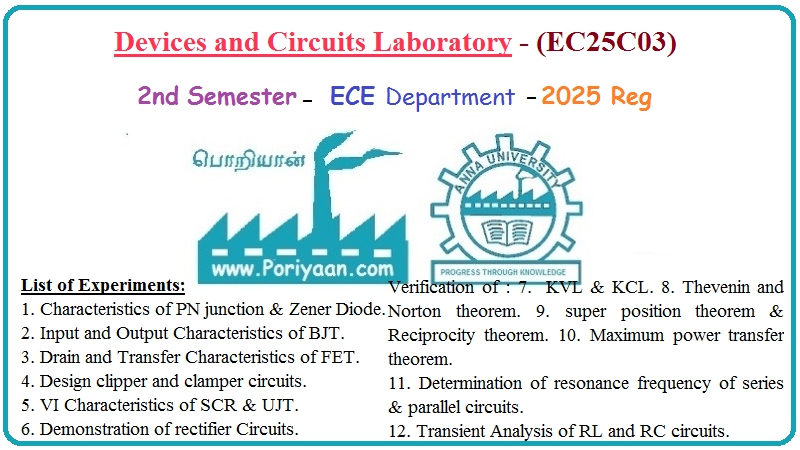
Devices and Circuits Laboratory
EC25C03 2nd Semester ECE Dept | 2025 Regulation | 2nd Semester 2025 Regulation