Transforms and its Applications: UNIT 3: Fourier Series
Conditions for a Fourier Expansion (Dirichlet's Conditions)
Fourier Series: Example Important Solved Problems with formula, steps, derivation and answer based on Conditions for a Fourier Expansion (Dirichlet's Conditions).
CONDITIONS FOR A FOURIER EXPANSION: [Dirichlet's Conditions]
Any function f(x) can be developed as a Fourier series a0/2 +  an cos nx + bn sin nx where a0, an, bn are constants, provided.
(i) f(x) is periodic, single‒valued and finite
(ii) f(x) has a finite number of finite discontinuities in any one period and has no infinite discontinuity.
(iii) f(x) has at the most a finite number of maxima and minima.
Note 1: Dirichlet's conditions are not necessary but only sufficient for the existence of Fourier series.
Note 2: Peter Gustav Lejenune Dirichlet (1805 - 1859), Great German Mathematician is known for his contributions to Fourier Series and Number Theory.
Note 3: tanx cannot be expanded as a Fourier series, since tanx has infinite number of infinite discontinuties, so Dirichlet's conditions are not satisfied.
Note 4: cosec x cannot be expanded as a Fourier series, since one of the Dirichlet's conditions is not satisfied.
Example 7: The function f(x) = 1/ x‒2 (0 ≤ x ≤ 3) cannot be expanded as a Fourier series. Explain why?
Solution: Given f(x) = (1 / x‒2) (0 ≤ x ≤3)
At x = 2, f(x) becomes infinity, it has an infinite discontinuity at x = 2.
So it does not satisfy one of the Dirichlet's conditions.
Hence it cannot be expanded as a Fourier series.
Example 8: Can you expand f(x)=(1 − x2 )/(1 + x2) as a Fourier series in any interval.
Solution:
Let f(x) = (1 − x2 )/(1 + x2)
This function is well defined in any finite interval in the range (‒∞, ∞) it has no discontinuities in the interval
Differentiate f '(x) = 
f(x) is maximum or minimum when f '(x) = 0
(i.e.,) when 4x = 0, (i.e.,) x = 0
So it has only one extreme value, and has
(i.e.,) a finite number of maxima and minima in the interval (‒∞, ∞)
Since it satisfies all the Dirichlet's conditions, it can be expanded in a Fourier Series in a specified interval in the range (‒∞, ∞).
Example 9: Examine whether the function sin(1/x) can be expanded in a Fourier series in ‒π ≤x≤ π.
Solution:
Consider the function f(x) = sin(1/x)
We know that sin θ = ±1
when θ = ± π/2, ± 3 π/2, ± 5 π/2, ….
(i.e.,) when θ = (2n − 1) π/2 when n is zero (or) any integer.
(i.e.,) sin θ attains its maximum value '+1' and minimum value '‒1' for the above values of θ. Hence the function f(x) = sin(1/x) attains its maximum and minimum values when
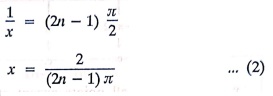
where n is zero or an integer.
For large values of n as n→∞, the values of x as given by (2) tend to become indefinitely small and to be crowded near to the value of x = 0.
Hence, the function (1) has an infinite number of maxima and minima near x = 0, so it does not satisfy one of the Dirichlet's conditions. It cannot be expanded in a Fourier series in the range ‒π ≤ x ≤ π in which the point x = 0 is included.
Transforms and its Applications: UNIT 3: Fourier Series : Tag: Engineering mathematics, Maths : - Conditions for a Fourier Expansion (Dirichlet's Conditions)
Transforms and its Applications: UNIT 3: Fourier Series
Under Subject
Transforms and its Applications
MA25C03 2nd Semester EEE Dept | 2025 Regulation | 2nd Semester 2025 Regulation
Related Subjects

English Essentials II
EN25C02 2nd Semester | 2025 Regulation | 2nd Semester 2025 Regulation

Tamils and Technology தமிழர்களும் தொழில்நுட்பமும்
UC25H02 2nd Semester | 2025 Regulation | 2nd Semester 2025 Regulation
Transforms and its Applications
MA25C03 2nd Semester EEE Dept | 2025 Regulation | 2nd Semester 2025 Regulation
Applied Physics (EE) II
PH25C04 2nd Semester EEE Dept | 2025 Regulation | 2nd Semester 2025 Regulation

Basic Civil and Mechanical Engineering
GE25C01 2nd Semester EEE Dept | 2025 Regulation | 2nd Semester 2025 Regulation
Engineering Drawing
ME25C01 EEE, Mech, Agri, EEE Depts | 2025 Regulation | 2nd Semester 2025 Regulation
Data Structures and Algorithms
CS25C04 2nd Semester EEE Dept | 2025 Regulation

Re-Engineering for Innovation
ME25C05 2nd Semester | 2025 Regulation | 2nd Semester 2025 Regulation
Engineering Drawing - Laboratory
ME25C01 2nd Semester | 2025 Regulation | 2nd Semester 2025 Regulation

Data Structures and Algorithms - Laboratory
CS25C04 2nd Semester EEE Dept | 2025 Regulation | 2nd Semester 2025 Regulation