Transforms and its Applications: UNIT 3: Fourier Series
Fourier Series: One Dimensional Equation of Heat Conduction - Steady state conditions and zero boundary conditions
Fourier Series: Example Important Solved Problems with formula, steps, derivation, answer and Exercise Problems based on One Dimensional Equation of Heat Conduction - Steady state conditions and zero boundary conditions (Fourier Series).
ONE DIMENSIONAL
EQUATION OF HEAT CONDUCTION: Steady state conditions and zero
boundary conditions:
Problems based on Steady state conditions and zero boundary conditions
Example 1: What is meant by steady state
condition in heat flow?
Solution:
Steady state condition in heat flow means that the temperature at any point in
the body does not vary with time.
i.e.,
it is independent of t, the time.
Example 2: In steady state conditions, derive
the solution of one dimensional heat flow?
Solution:
The p.d.e. of unsteady one dimensional heat flow is
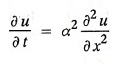 ................(1)
In
steady state condition, the temperature u depends only on x and not time t
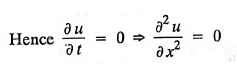
..
(1) reduces to ∂2u/∂x2. Since u depends only on x,
integrating w.r.to x twice, we get the general solution as u = ax + b where a,
b are arbitrary.
Example 3: What is the basic difference
between the solution of one dimensional wave equation and one dimensional heat
equation?
Solution:
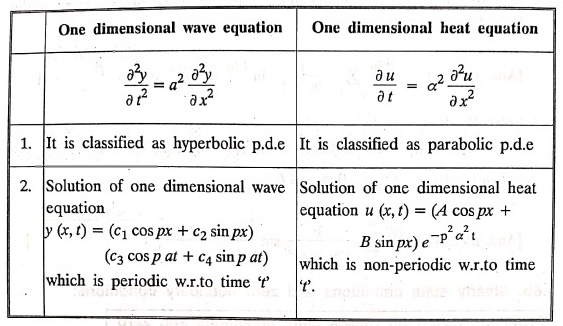
Example 4: Distinguish between steady and
unsteady states in heat conduction problems.
Solution:
In unsteady state, the temperature at any point of the body depends on the
position of the point and also the time t. In steady state, the temperature at
any point depends only on the position of the point and is independent of the
time t.
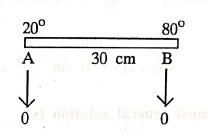
Example 5: A rod 30 cm long has its ends A
and B kept at 20° and 80° respectively until steady state conditions prevail.
The temperature at each end is then suddenly reduced to 0° C and kept so. Find
the resulting temperature function u(x, t) taking x = 0 at A.
Solution:
The
temperature function u(x, t) is the solution of the one dimensional heat
equation
......... (A)
when
the steady state condition prevails ∂u/∂t = 0 and hence we get
d2u/dx2 = 0
(A) reduces to d2u/dx2 =
0, on integration.
u(x) = ax + b ... (B)
when
x = 0, we get u(0) = b = 20
when
x = 30, we get u(30) = 30a + b
80
= 30a + 20
60
= 30a
a = 2
Thus
u(x, 0) = f (x) = 2x + 20 by (B)
Hence,
Boundary and initial conditions are
(i)
u (0, t) = 0 for all t≥ 0
(ii)
u (30, t) = 0 for all t≥0
(iii)
u (x, 0) = f(x) = 2x + 20
Now,
the suitable solution which satisfies our boundary conditions is given by
u (x, t) = (A cos px + B sin px)  …….(1)
Applying
condition (i) in (1), we get
u
(0, t) = A = 0
Here, ≠ 0 [it is defined for
all t]
A = 0
Substitute,
A = 0 in (1), we get
u(x, t) = B sin px ……..(2)
Now,
applying condition (ii) in equation (2), we get
u(30, t) = B sin 30p = 0
Here, ≠ 0
['. it is defined for all t]
B
≠ 0
['. If B = 0 already A = 0 then we
get a trivial solution]
sin
30p = 0
sin
30p = sin nπ
['. sin nπ = 0]
30p = nπ
p =
nπ / 30
Substitute,
p = nπ / 30 in equation (2), we get
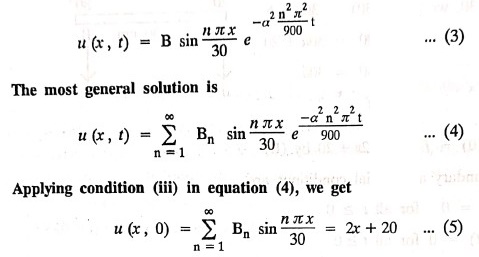
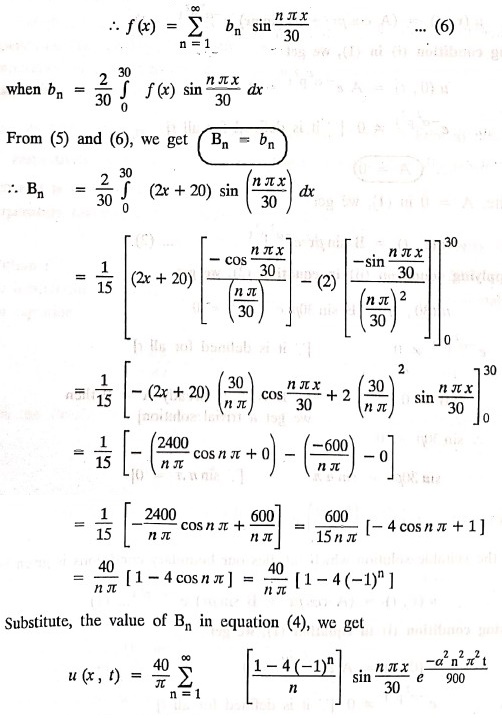
To find Bn
expand 2x + 20 in a half range Fourier sine series in the interval (0,30)
Example 6: An insulated rod of length l has its ends A and B kept at a°
celsius and b° celsius respectively until steady state conditions prevail. The
temperature at each end is suddenly reduced to zero degree celsius and kept so.
Find the resulting temperature at any point of the rod taking the end A as
origin.
Solution:
The temperature function u(x, t) is the solution of the one dimensional heat equation.
............(A)
when
the steady state condition prevails ∂u/∂t = 0 and
hence,
we get ∂2u/∂x2 = 0
..
(A) reduces to d2u/dx2 = 0
on
integration, we get u(x) = ax + b
when
x = 0, we get u(0)=b
(i.e.,) a0 = b
when
x = l we get u(l) = al + b
b°
= al + a0
(
b° ‒ a° ) / l = a
Hence,
u (x, 0) = f(x) = (b-a / l) x + a
The
boundary and initial conditions are
(i)
u (0, t) = 0 for all t≥ 0
(ii) u (l,
t) = 0 for all t≥ 0
(iii)
u (x, 0) = f(x) = (b-a / l) x + a
Now,
the suitable solution which satisfies our boundary conditions is given by
u(x, t) (A cos px + B sin px) ….(1)
Applying
condition (i) in equation (1), we get
u
(0, t) = A sin pl = 0
Here, ≠
0 [it is defined for all t]
A = 0
Substitute,
A = 0 in equation (1), we get
u(x,t) = B sin px …….(2)
Applying
condition (ii) in equation (2), we get
u(l, t) = B sin pl = 0
Here, ≠ 0 [it is defined for all t]
B
≠ 0 [ suppose B = 0 already A = 0 then
we get a trival solution]
sin pl
= 0
sin
pl = sinnπ
[sinnπ = 0]
pl = nπ
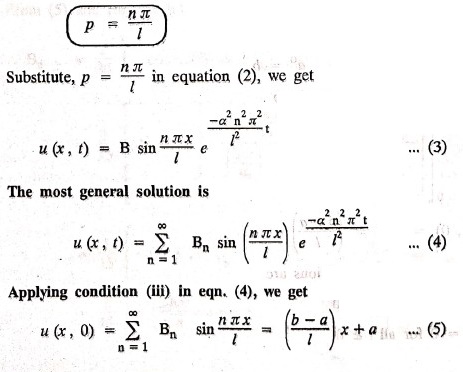
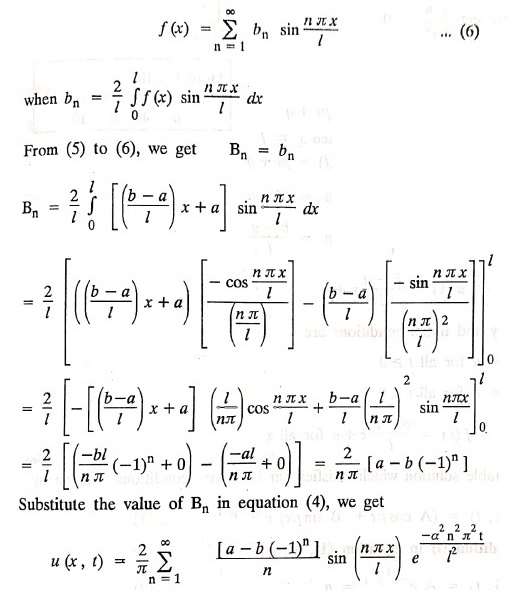
To find Bn
expand f(x) in a half range Fourier
sine series in the interval (0, l)
Transforms and its Applications: UNIT 3: Fourier Series : Tag: Engineering mathematics, Maths : - Fourier Series: One Dimensional Equation of Heat Conduction - Steady state conditions and zero boundary conditions
Transforms and its Applications: UNIT 3: Fourier Series
Under Subject

Transforms and its Applications
MA25C03 2nd Semester EEE Dept | 2025 Regulation | 2nd Semester 2025 Regulation
Related Subjects

English Essentials II
EN25C02 2nd Semester | 2025 Regulation | 2nd Semester 2025 Regulation

Tamils and Technology தமிழர்களும் தொழில்நுட்பமும்
UC25H02 2nd Semester | 2025 Regulation | 2nd Semester 2025 Regulation
Transforms and its Applications
MA25C03 2nd Semester EEE Dept | 2025 Regulation | 2nd Semester 2025 Regulation

Applied Physics (EE) II
PH25C04 2nd Semester EEE Dept | 2025 Regulation | 2nd Semester 2025 Regulation

Basic Civil and Mechanical Engineering
GE25C01 2nd Semester EEE Dept | 2025 Regulation | 2nd Semester 2025 Regulation
Engineering Drawing
ME25C01 EEE, Mech, Agri, EEE Depts | 2025 Regulation | 2nd Semester 2025 Regulation
Data Structures and Algorithms
CS25C04 2nd Semester EEE Dept | 2025 Regulation

Re-Engineering for Innovation
ME25C05 2nd Semester | 2025 Regulation | 2nd Semester 2025 Regulation
Engineering Drawing - Laboratory
ME25C01 2nd Semester | 2025 Regulation | 2nd Semester 2025 Regulation

Data Structures and Algorithms - Laboratory
CS25C04 2nd Semester EEE Dept | 2025 Regulation | 2nd Semester 2025 Regulation