Transforms and its Applications: UNIT 3: Fourier Series
Convergence Theorem on Fourier Series
Fourier Series: Statement, Important Formulae and Example Important Solved Problems with formula, steps, derivation and answer based on Convergence Theorem on Fourier Series.
Convergence Theorem on Fourier Series:
Statement :
If
f(x) is a periodic function with
period 2π and f(x) and f ‘(x) are piecewise continuous on [‒π, π],
then the Fourier series is convergent. The sum of the Fourier series is equal
to f(x) at all points of x where f(x) is continuous. At the points of x
where f(x) is discontinuous, the sum
of the Fourier series is the average of the right and left limits, that is 1/2
[f(x+) + f(x−)]
Note :
•
In the interval (0,2π) i.e., 0 < x < 2π
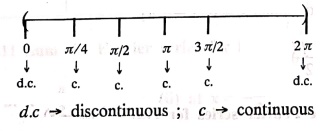
x continuous at all points except 0 and 2π
•
In the interval [0,2π] i.e., 0 ≤ x ≤ 2π
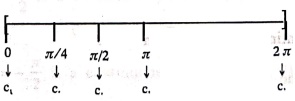
x continuous at all points including 0 and 2π
•
In the interval (‒π, π) i.е., ‒π < x < π
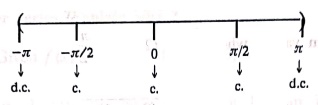
x continuous at all points except at ‒π and π.
•
In the interval [‒π, π] i.е., ‒π ≤ x ≤ π
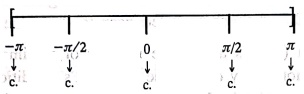
x continuous at all points including ‒π and π
•
In the interval (‒π, 0) and (0,π) i.e., −π < x < 0 and 0 <x<π
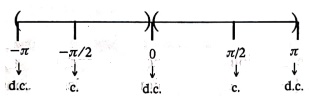
x continuous at all points except ‒π, π and 0.
Note:
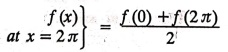
If f(x) is defined in the interval
(0, 2π), then
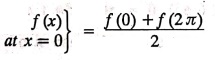
[the function f(x) may be continuous or discontinuous at the end points x = 0, x
= 2π]
Example 10: Sum the Fourier series for f(x) = ½ (π ‒ x)
(i)
in (0, 2π) at x= π/2
(ii)
in (0, 2π) at x= π
Solution:
(i)
Here f(x) is a continuous at x = π/2 in
(0,2π),
so
we substitute the value directly
sum = ½ (π ‒π/2) = ½ (π/2) = π/4
(ii)
Here f(x) is a continuous at x=π in
(0, 2 π),
so
we substitute the value directly
sum
= 1/2 (π ‒ π) = 0
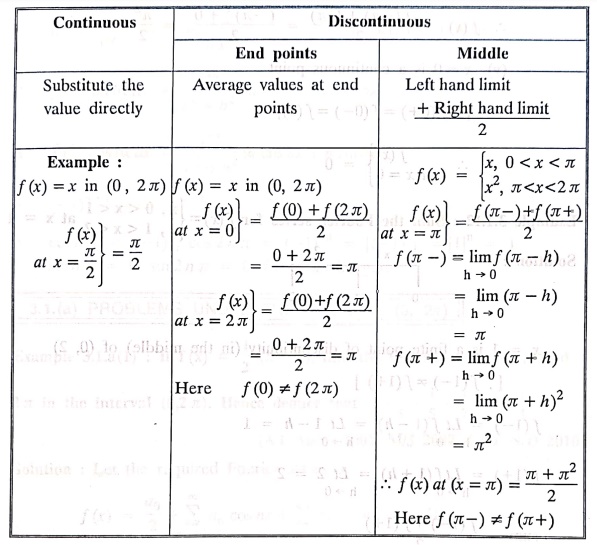
Example 11: Sum the Fourier series for f(x) = 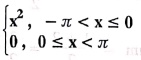
(i) at x = π/2 (ii) at x = π/2 (iii) at x= ‒ π (iv) at x=π (v) at x = 0
Solution:
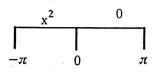
(i)
x = π /2 is a continuous point in (0, π)
f(x)
= 0
(ii)
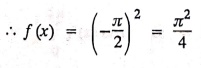
x = ‒ π/2 is a continuous point in (‒π, 0)
(iii)
x = ‒π is a discontinuous point in the extremum

(iv)
x = π is a discontinuous point in the extremity.

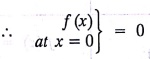
(v)
x=0 is a continuous point.
[f(0+) = f(0−) = f(0)]
Example 12: Sum the Fourier series for f(x) = 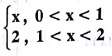 at x = 1
Solution:
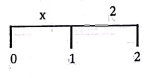
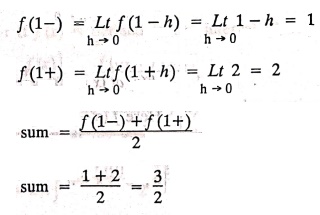
x = 1 is a finite point of discontinuity (in
the middle) of(0, 2)
[f
(1−) ≠ f (1+)]
Example 13: Sum the Fourier series for
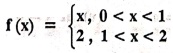
Solution:
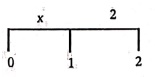
x
=0 is a point of discontinuity in the extreme of the given interval. [ f(0) ≠ f(2) ])
Sum
= average of the extremes of the discontinuity
Sum
= [ f(0) +f(2) ] / 2 = (0+2)/2 = 1
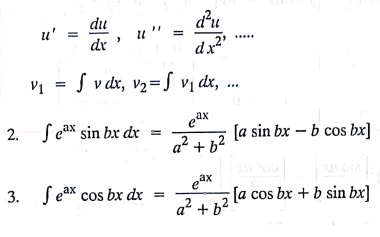
IMPORTANT FORMULAE
Note:
1.
Bernoulli's formula: ʃuv dx = uv1
‒ u'v2 + u"v3 ‒, …. Where u and v are functions of x.
4.
(‒1)n+1 = (‒1)n‒1
5.
cos nπ = (−1)n, cos 2nπ = (−1)2n = [(−1)2]n
= [1]n = 1
sin
nπ = 0, sin 2nπ = 0 if n is an integer.
Transforms and its Applications: UNIT 3: Fourier Series : Tag: Engineering mathematics, Maths : - Convergence Theorem on Fourier Series
Transforms and its Applications: UNIT 3: Fourier Series
Under Subject

Transforms and its Applications
MA25C03 2nd Semester EEE Dept | 2025 Regulation | 2nd Semester 2025 Regulation
Related Subjects

English Essentials II
EN25C02 2nd Semester | 2025 Regulation | 2nd Semester 2025 Regulation

Tamils and Technology தமிழர்களும் தொழில்நுட்பமும்
UC25H02 2nd Semester | 2025 Regulation | 2nd Semester 2025 Regulation
Transforms and its Applications
MA25C03 2nd Semester EEE Dept | 2025 Regulation | 2nd Semester 2025 Regulation

Applied Physics (EE) II
PH25C04 2nd Semester EEE Dept | 2025 Regulation | 2nd Semester 2025 Regulation

Basic Civil and Mechanical Engineering
GE25C01 2nd Semester EEE Dept | 2025 Regulation | 2nd Semester 2025 Regulation

Engineering Drawing
ME25C01 EEE, Mech, Agri, EEE Depts | 2025 Regulation | 2nd Semester 2025 Regulation
Data Structures and Algorithms
CS25C04 2nd Semester EEE Dept | 2025 Regulation

Re-Engineering for Innovation
ME25C05 2nd Semester | 2025 Regulation | 2nd Semester 2025 Regulation

Engineering Drawing - Laboratory
ME25C01 2nd Semester | 2025 Regulation | 2nd Semester 2025 Regulation

Data Structures and Algorithms - Laboratory
CS25C04 2nd Semester EEE Dept | 2025 Regulation | 2nd Semester 2025 Regulation