Transforms and its Applications: UNIT 3: Fourier Series
Fourier Series: Solutions of One Dimensional Wave Equation - Vibrating String with Zero Initial Velocity
Fourier Series: Example Important Solved Problems with formula, steps, derivation, answer and Exercise Problems based on Fourier Series: Solutions of One Dimensional Wave Equation - Vibrating String with Zero Initial Velocity.
ONE
DIMENSIONAL WAVE EQUATION: VIBRATING STRING WITH ZERO INITIAL VELOCITY
Problem on vibrating string with zero initial velocity.
Type 1. Vibrating string with zero initial velocity :
The
boundary and initial conditions of the deflection y (x, t) are
(i)
y (0, t) = 0 [boundary condition]
(ii)
y (l, t) = 0 [boundary condition]
(iii)
∂y/∂t (x, 0) = 0 [initial condition]
(iv)
y (x, 0) = f(x) [initial condition]
The
suitable solution is
y(x, t) = (c1 cos px + c2
sin px) (c3 cos p at + c4 sin p at) ... (1)
Apply
condition (i), we get c1 = 0
Apply
condition (ii), we get p = nπ/l
Apply
condition (iii), we get c4 = 0
The
most general solution is

Apply
condition (iv), we get
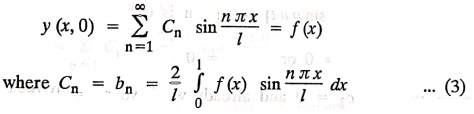
Substitute,
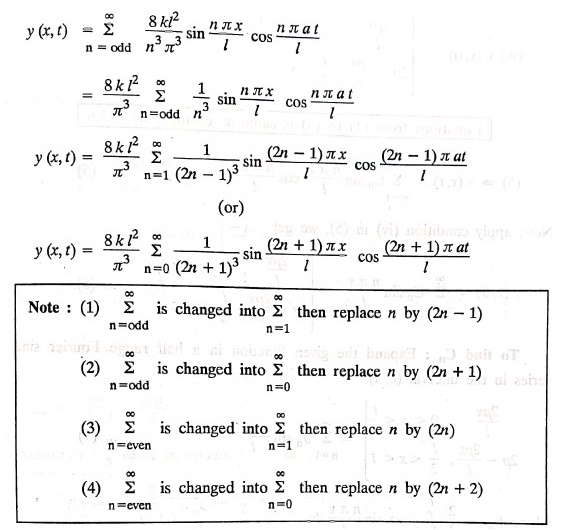
Cn in (2) we get the general solution.
Example 6: A string is stretched and fastened
to two points x = 0 and x= l apart.
Motion is started by displacing the string into the form y= k(lx ‒ x2) from which it is
released at time t = 0. Find the displacement of any point on the string at a
distance of x from one end at time t.
Solution:
The wave equation is
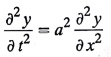
From
the given problem, we get the following boundary & initial conditions.
(i)
y (0, t) = 0 for all t > 0 [B.C]
(ii)
y (l,t) = 0 for all t> 0 [B.C]
(iii)
(∂y/∂t)(x,0) = 0, 0 < x < l
[I.C]
(iv)
y(x, 0) = k (lx = x2), 0 < x < l [I.C]
Now,
the suitable solution which satisfies our boundary conditions is given by
y
(x, t) = (c1cos px + c2sin px) (c3 cos p at +
c4 sin p a t) ... (1)
Applying condition (i)
in equation (1), we get
y(0, t) = (c1+0) (c3 cos
p at + c4 sin p at) = 0
Here,
[c3 cos p at + c4 sin pat] ≠ 0 [ It is defined for all t]
Therefore,
we get c1 = 0
Substitute,
c1 = 0 in equation (1), we get
y
(x, t) = c2 sin px (c3 cos p at + c4 sin pat) ... (2)
Applying condition (ii)
in equation (2), we get
y(l,
t) = c2 sin pl (c3
cos pa t + c4 sin pat) = 0
Here,
[c3 cos p at + c4 sin pa t] ≠ 0 [. it is defined for all t]
Therefore,
either c2 = 0 or sin pl =
0
Suppose,
we take c2 = 0 and already we have c1 = 0 then we get a trivial
solution.
Therefore,
we consider c2≠ 0 and
sin pl =
0
pl =
nπ
[sin
nπ = 0]
p
= nπ / l
[n being an integer]
Now,
substituting p = nπ / l in equation
(2), we get

Before
applying condition (iii), diff. (3) p.w.r.to 't', we get

Now
applying condition (iii), we get
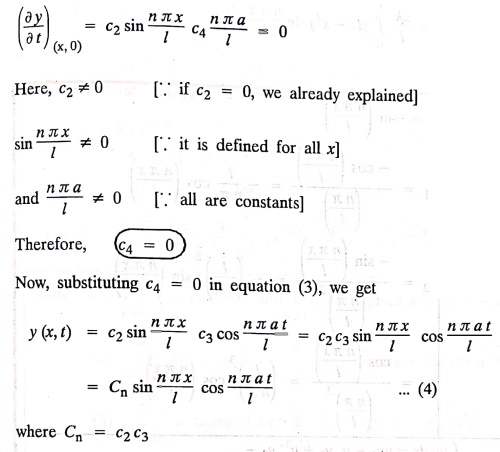
The
most general solution is

Applying
the condition (iv) in equation (5), we get

To find Cn:
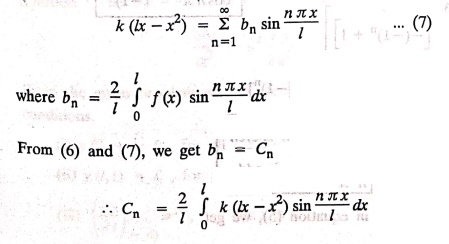
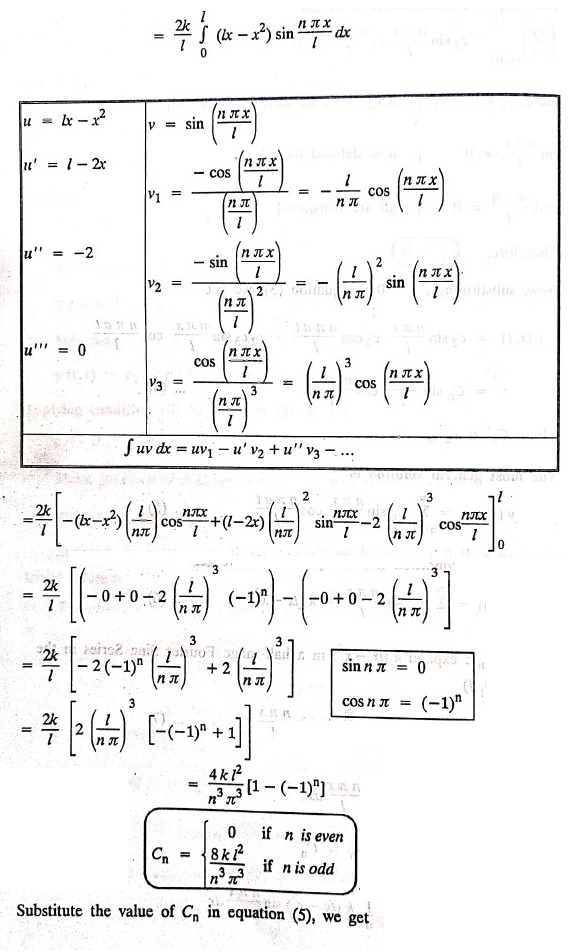
expand k(lx − x2) in a half‒range Fourier Sine Series in the interval
(0, l)
Example 7: Find the displacement of a string
of length 'l' vibrating between fixed
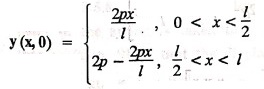
end points with initial velocity zero and initial displacement is given by
Solution:
The wave equation is
From
the given problem we get the following boundary and initial conditions.
(i)
y (0, t) = 0, for all t ≥ 0
(ii)
y (l,t) = 0, for all t ≥ 0
(iii)
(∂y/∂t)(x, 0) = 0, 0 ≤ x ≤ l
(iv)
Equations
from (1) to (5) is same as example no. 3
(5) ⇒
y (x, t) = 
Now,
apply condition (iv) in (5), we get
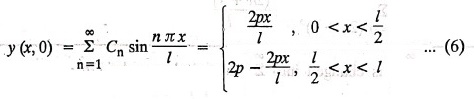
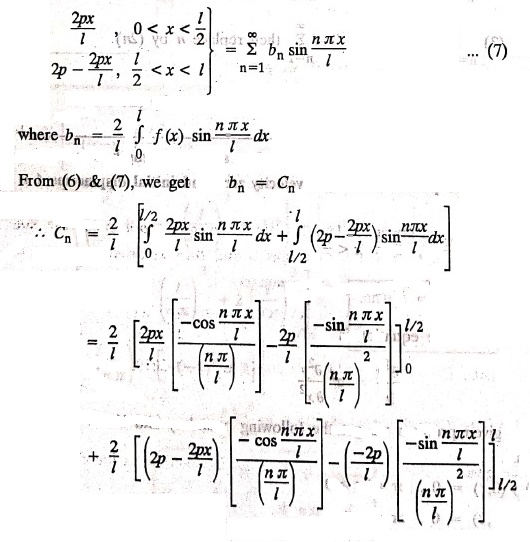
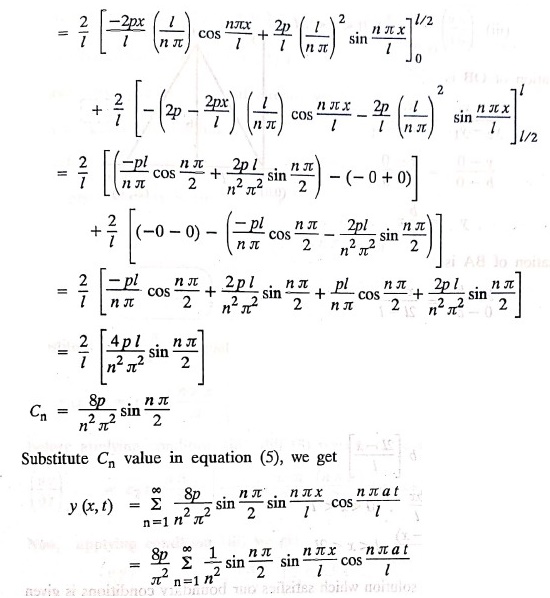
To find Cn:
Expand the given function in a half range Fourier sine series in the interval
(0,l)
Example 8: A string of length 2l is fastened at both ends. The mid
point of the string is taken to a height b and then released from rest in that
position. Show that the displacement is

Solution:
The
wave equation is ∂2y/∂t2 = a2 ∂2y/∂x2
From the given problem, we get the following
boundary and initial conditions.
(i)
y (0, t) = 0 for all t ≥ 0
(ii)
y (2l, t) = 0 for all t ≥ 0
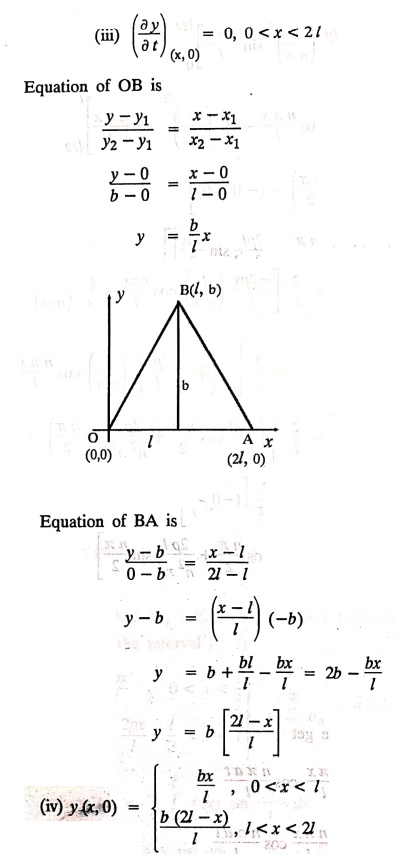
Now,
the suitable solution which satisfies our boundary conditions is given by
y(x,t) = (c1 cos px + c2
sin px) (c3 cos p at + c4 sin p at) ……(1)
Applying condition (i)
in equation (1), we get
y (0, t) = c1 (c3 cos p
at + c4 sin p at) = 0
Here,
c3 cos p at + c4 sin p at ≠ 0 [it is defined for all t]
Therefore,
c1 = 0
Substitute
c1 = 0 in equation (1), we get
y(x, t) = c2 sin px (c3
cos p at + c4 sin p at)
……..(2)
Applying condition (ii)
in equation (2), we get
y(2l, t) = c2 sin 2lp (c3 cos p at + c4
sin pat) = 0
Here,
c3 cosp at + c4 sin p at ≠ 0 [ it is defined for all t]
Therefore,
either c2 = 0 or sin 2 pl = 0
Suppose,
we take c2 = 0 and already we have c1 = 0
then
we get a trivial solution,
Therefore,
c2
≠ 0
The
only possibility is sin 2 pl = 0
i.c.,
2pl = n π
[ sinn π = 0]
P = nπ / 2l
Substitute,
P = nπ / 2l in equation (2), we get
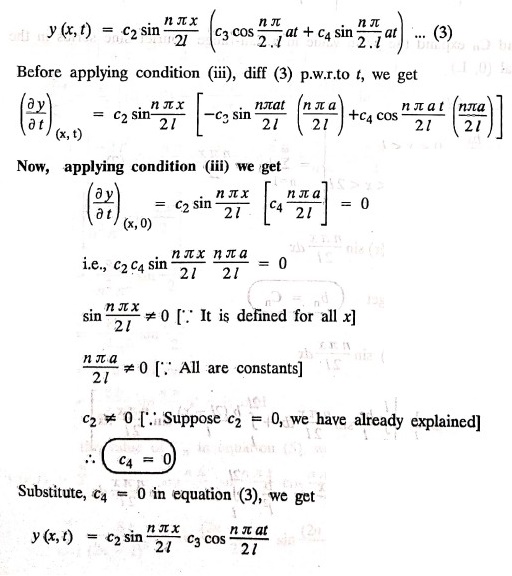
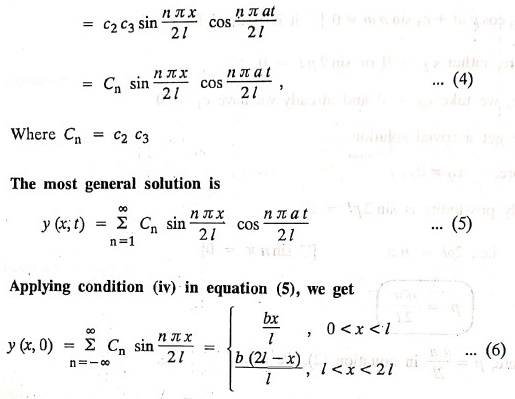
To find Cn
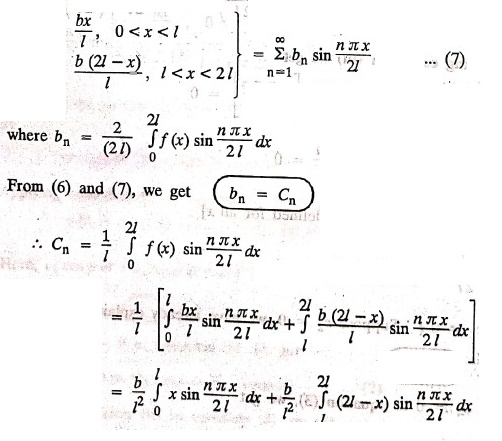
expand the given value in a half‒range Fourier sine series in the interval (0,
L)
Here,
L = 2l
Substitute
the value of cn in equation (5), we get
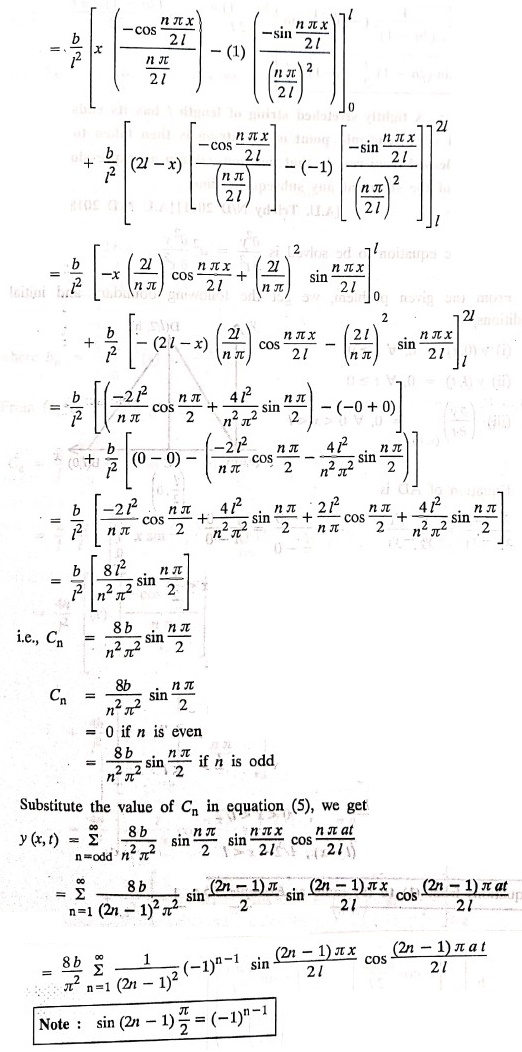
Note:
sin (2n‒1) π/2 = (−1)n−1
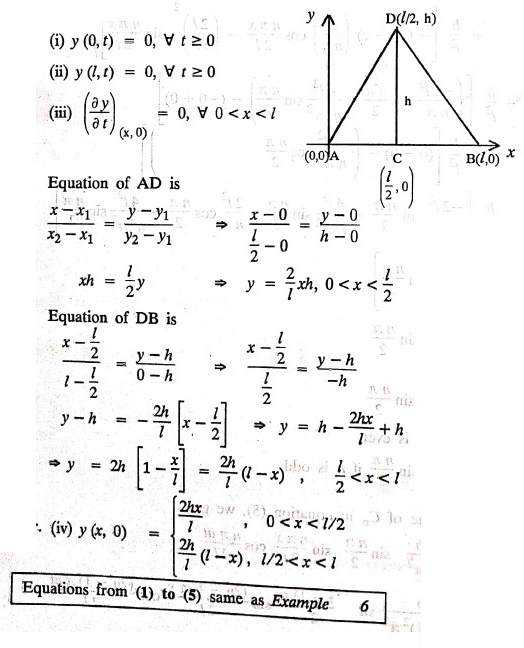
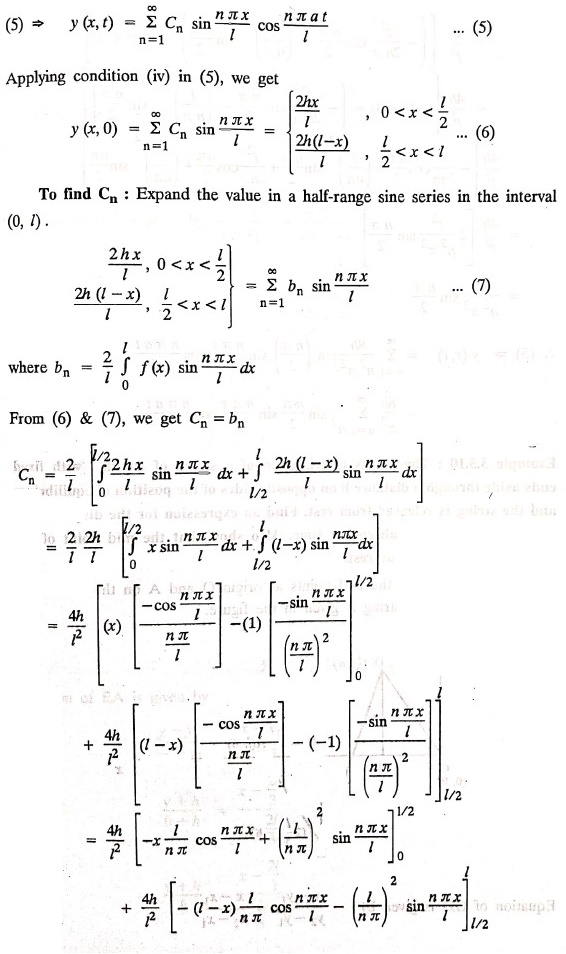
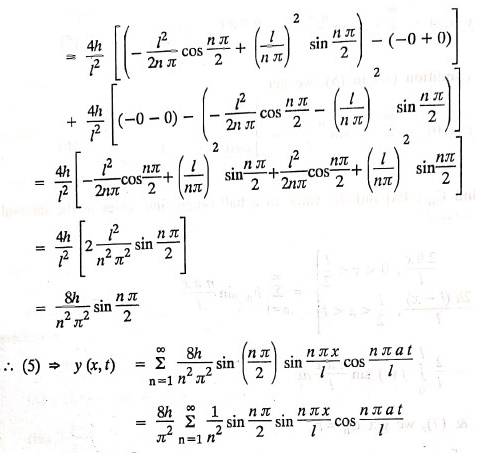
Example 9: A tightly stretched string of
length l has its ends fastened at x =
0 and x = l. The mid point of the
string is then taken to a height h and then released from rest in that
position. Obtain an expression for the displacement of the string at any
subsequent time.
Solution:
The equation to be solved is ∂2y/∂t2 = a2 ∂2y/∂x2
From
the given problem, we get the following boundary and initial conditions,
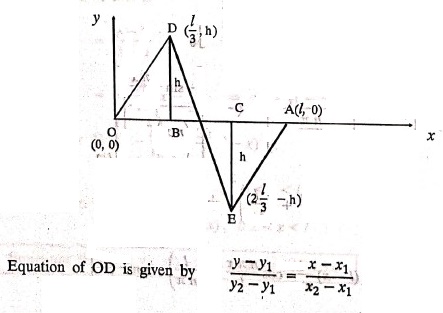
Example 10: The points of trisection of a
string of length l with fixed ends
aside through a distance h on opposite sides of the position of equilibrium and
the string is released from rest. Find an expression for the displacement of the
string at any subsequent time. Also show that the mid point of the time. Also
show that t string always remains at rest.
Solution:
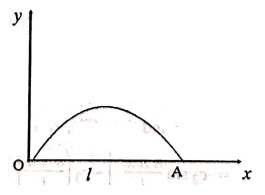
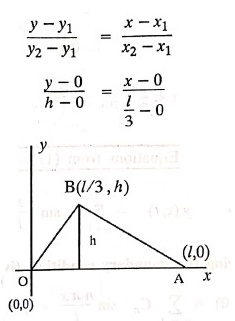
Taking the end points as origin O and A on the x axis, the initial position of
the string is given in the figure.
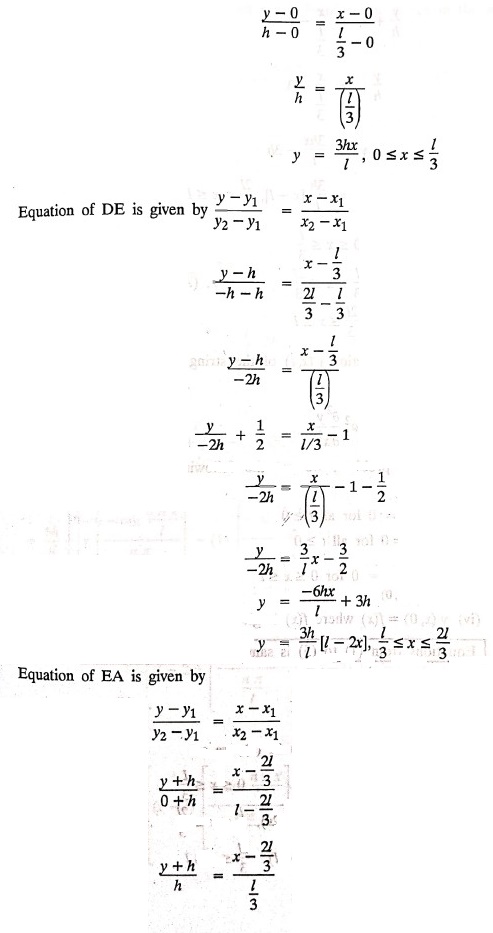
The
displacement function y(x, t) of the string is the solution of wave equation.
∂2y/∂t2 = a2 ∂2y/∂x2
From
the given problem, we get the following boundary and initial conditions,
(i)
y (0,t) = 0 for all t≥0
(ii)
y (l,t) = 0 for all t ≥ 0
(iii)
(∂y/∂t)(x, 0) = 0 for 0 ≤ x ≤ l
(iv)
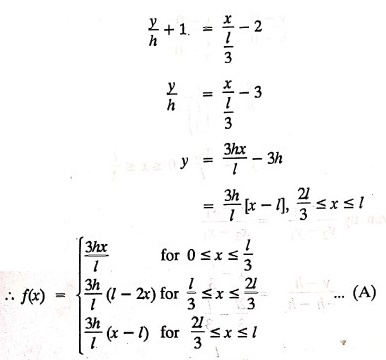
y (x, 0) = f(x) where f(x) is given in (A)
Equations
from (1) to (5) is same as Example no. 6

Applying the boundary
condition (iv) in (5), we get
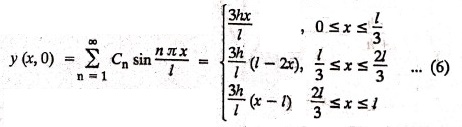
To
find Cn expand f (x) in a
half range Fourier sine series in the intervel (0, l)
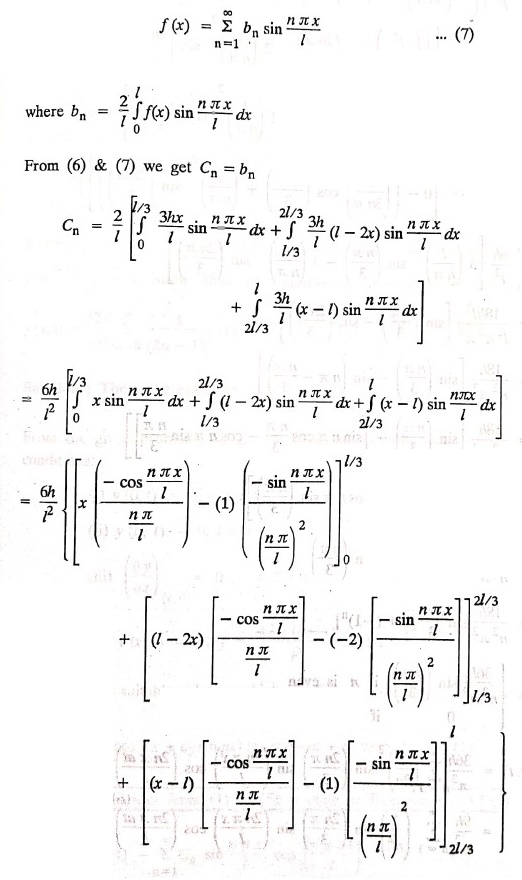
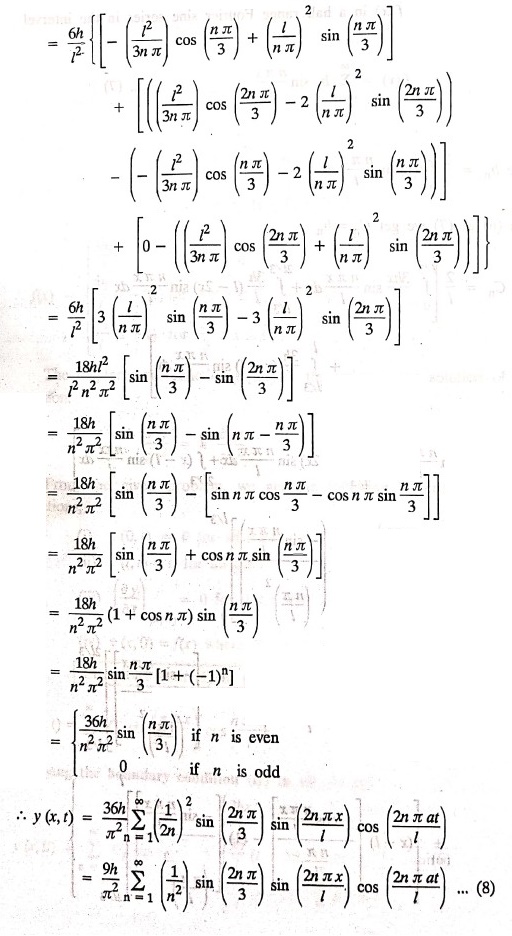
The
displacement at the mid point is got by substituting
x = l/2 in (8)
when
x = l/2 sin (2nπx / l) = sin nπ = 0 for all integral values
of n
y
(l/2 , t) = 0.
Hence,
there is no displacement at x = l/2
for
all values of t.
The mid
point of string is at rest.
Example 11: If a string of length l is released from rest in the position
y = 4λx(1−x) / l2. Show
that the motion is described by the equation.

Solution:
The
wave equation is
∂2y/∂t2 = a2 ∂2y/∂x2
From
the given problem, we get the following boundary and initial conditions,
(i)
y (0,t) = 0 for all t≥0
(ii)
y (l,t) = 0 for all t ≥ 0
(iii)
(∂y/∂t)(x, 0) = 0, 0 ≤ x ≤ l
(iv)
y (x, 0) = f(x) where f(x) = 4λx(1−x) / l2, 0 ≤ x ≤ l
Now,
the suitable solution which satisfies our boundary conditions is given by
y
(x, t) = (c1 cos px + c2 sin px) (c3 cos p at
+ c4 sin p at) ……..(1)
Equations
from (1) to (5) is same as Example no. 6

Applying
condition (iv) in equation (5), we getsim

To find Cn:
Expand 4λx(1−x) / l2 in a
half range Fourier sine series in the interval (0, 1)
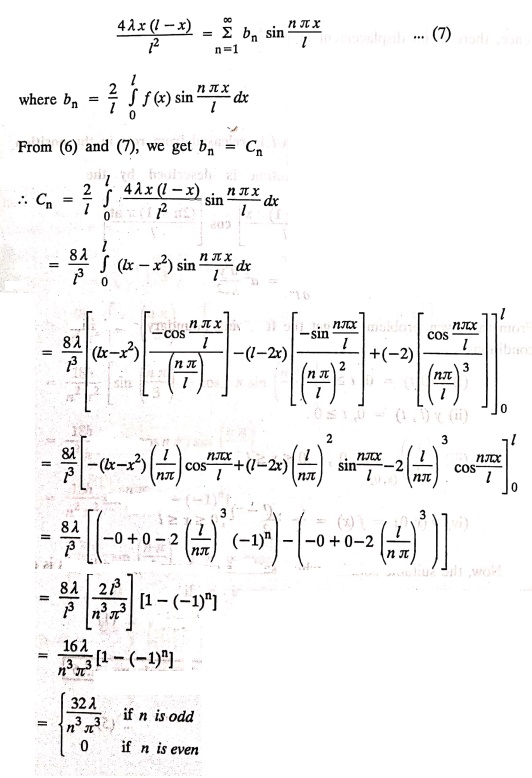
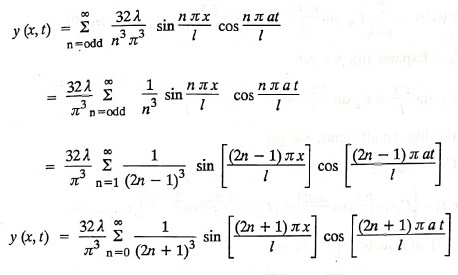
Substitute
the value of Cn in (5), we get
Example 12: A tightly stretched string with
fixed end points x=0 and x = l initially
displaced in a sinusoidal arc of length y0 and then released from
rest. Find the displacement y at any distance x from one end at time t.
Solution:
The wave equation is
∂2y/∂t2
= a2 ∂2y/∂x2
From
the given problem, we get the following boundary and initial conditions,
(i)
y (0,t) = 0 for all t≥0
(ii)
y (l,t) = 0 for all t ≥ 0
(iii)
(∂y/∂t)(x, 0) = 0, 0 ≤ x ≤ l
(iv)
y (x, 0) = f(x) where f(x) =
y0 sin(πx/l), 0 ≤ x
≤ l
Now,
the suitable solution which satisfies our boundary conditions is given by
y (x, t) = (c1 cospx + c2
sin px) (c3 cos p at + c4 sin p at) …….(1)
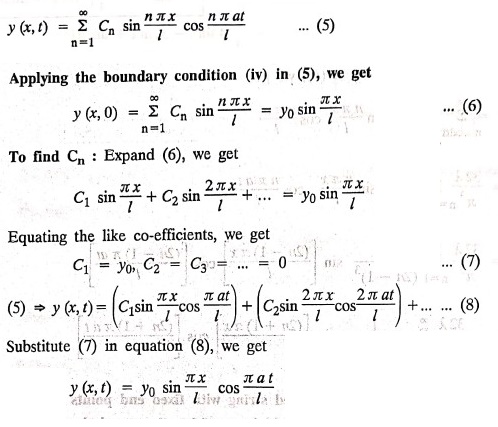
Equations
from (1) to (5) is same as Example no. 6
Example 13: An elastic string is stretched between
two points at a distance π apart. In its equilibrium position the string is in
the shape of the curve f(x) = k (sin
x − sin3x). Obtain y(x, t) the vertical displacement if y satisfies
the equation ∂2y/∂t2 = ∂2y/∂x2.
Solution: The wave
equation is
∂2y/∂t2 = ∂2y/∂x2
The
boundary & initial conditions are,
(i)
y (0,t) = 0
(ii)
y (π,t) = 0
(iii)
(∂y/∂t)(x, 0) = 0, 0 ≤ x ≤ π
(iv)
y (x, 0) = k(sin x − sin3x), 0 ≤ x ≤ π
= k[ sin x – 1/4(3sinx‒ sin3x)]
sin3θ = 3sinθ ‒ 4sin3θ
sin3θ = ¼ [3sinθ ‒ sin3θ]
=
k/4 [ 4sinx ‒ 3sinx + sin3x ]
=
k/4 [ sinx + sin3x ]
=
k/4 sinx + k/4 sin3x
Equations
from (1) to (5) is same as Example no. 6
(5)
= y (x, t) ⇒ ∞Σn=1
Cn sin nx cos nt ……….
(5)
Applying
condition (iv) in (5), we get
y
(x, 0) = ∞Σn=1
Cn sin nx = k/4 sinx + k/4
sin3x
i.e.,
C1
sin x + C2 sin 2x + C3 sin 3x + C4 sin 4x + ….
=
k/4 sinx + k/4 sin3x ………(6)
Equating
like coefficients on both sides of (6), we get
C1
= k/4
C2
= 0,
C3
= k/4
C4
= C5 = 0 ...
Substituting
these values in (5), we get
y (x, t) = [ k/4 sin x cost ] + [ k/4 sin 3x
cos 3t ]
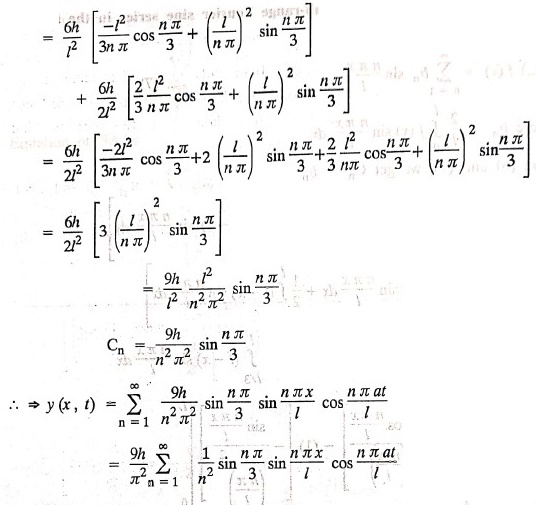
Example 14: A string of length l has its ends x = 0, x = l fixed. The point where x = l/3 is drawn aside a small distance h,
the displacement y(x, t) satisfies ∂2y/∂t2 = a2
∂2y/∂x2. Find y(x, t) at any time t.
Solution:
The wave equation is ∂2y/∂t2 = a2 ∂2y/∂x2
From
the given problem, we get the following boundary and initial conditions
(i)
y (0, t) = 0 for all t ≥ 0
(ii)
y (l, t) = 0 for all t ≥ 0
(iii)
(∂y/∂t)(x, 0) = 0 for 0 < x < l
Equation
of OB is
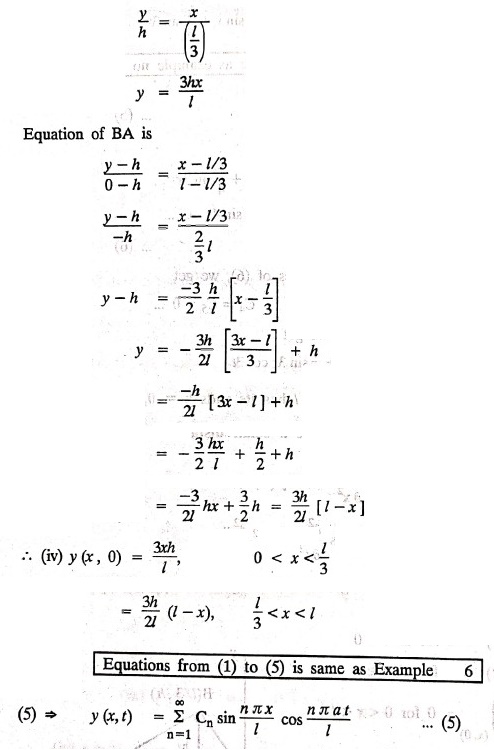
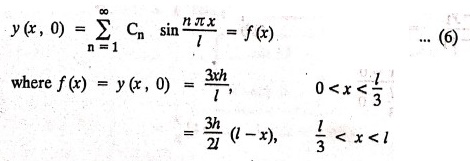
Applying the boundary
condition (iv) in equation (5), we get
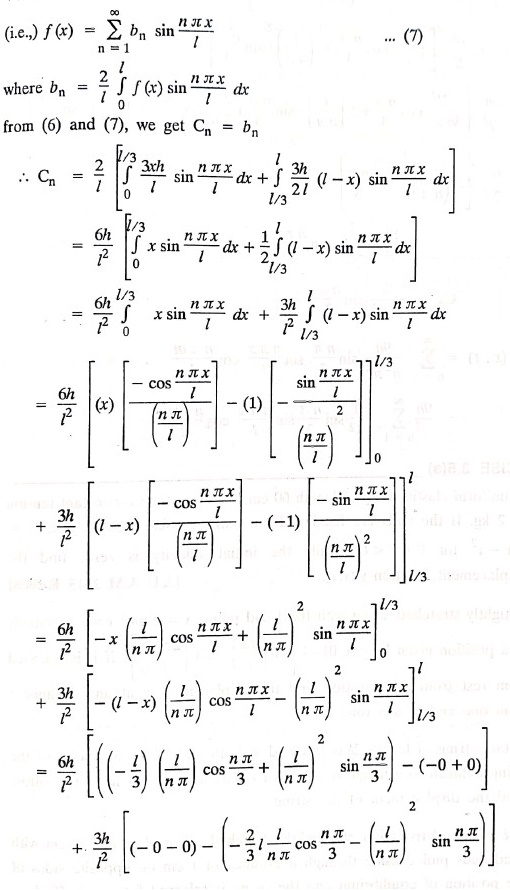
To find Cn
expand f(x) in a half‒range Fourier
sine series in the interval (0, l)
EXERCISE
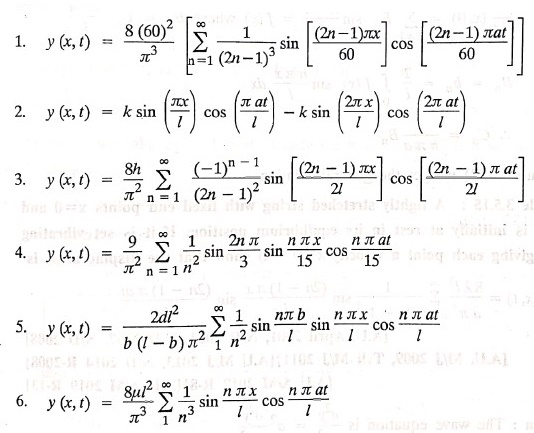
1.
A uniform elastic string of length 60 cm is subjected to a constant tension of
2 kg. If the ends are fixed and the initial displacement is y(x, 0) = 60x‒x2
for 0 < x < 60 while the initial velocity is zero, find the displacement
function y (x, t).
2.
A tightly stretched string with fixed end points x = 0 and x = l is initially in a position given by y
(x, 0) = k[sin(πx/l) ‒ sin(2πx/l)]. If it is released from rest from
this position find the displacement y at any distance x from one end at any
time t.
3.
A taut string of length 2l is
fastened at both ends. The mid point of the string is taken to a height h and
then released from rest in that position. Find the displacement of the string.
4.
The points of trisection of a tightly stretched string of length 30 cm with
fixed ends pulled aside through a distance of 1 cm on opposite sides of the
position of equilibrium and the string is released from rest. Find an expression
for the displacement of the string at any subsequent time, also show that the
mid points of the string remains always at rest.
5.
A string of length l is fastened at
both ends. One end is taken as the origin and at a distance b from this end,
the string is displaced a distance d transversely and is released from rest
when it is in this position. Find the equation of the sub‒sequent motion.
6.
A tightly stretched flexible string has its ends fixed at x=0 and x = l. At time t = 0 the string is given a
shape defined by f(x) = μx(1 − x)
where μ is a constant and then released. Find the displacement of the string at
any time t'.
ANSWERS
Transforms and its Applications: UNIT 3: Fourier Series : Tag: Engineering mathematics, Maths : - Fourier Series: Solutions of One Dimensional Wave Equation - Vibrating String with Zero Initial Velocity
Transforms and its Applications: UNIT 3: Fourier Series
Under Subject

Transforms and its Applications
MA25C03 2nd Semester EEE Dept | 2025 Regulation | 2nd Semester 2025 Regulation
Related Subjects

English Essentials II
EN25C02 2nd Semester | 2025 Regulation | 2nd Semester 2025 Regulation

Tamils and Technology தமிழர்களும் தொழில்நுட்பமும்
UC25H02 2nd Semester | 2025 Regulation | 2nd Semester 2025 Regulation
Transforms and its Applications
MA25C03 2nd Semester EEE Dept | 2025 Regulation | 2nd Semester 2025 Regulation

Applied Physics (EE) II
PH25C04 2nd Semester EEE Dept | 2025 Regulation | 2nd Semester 2025 Regulation

Basic Civil and Mechanical Engineering
GE25C01 2nd Semester EEE Dept | 2025 Regulation | 2nd Semester 2025 Regulation
Engineering Drawing
ME25C01 EEE, Mech, Agri, EEE Depts | 2025 Regulation | 2nd Semester 2025 Regulation

Data Structures and Algorithms
CS25C04 2nd Semester EEE Dept | 2025 Regulation

Re-Engineering for Innovation
ME25C05 2nd Semester | 2025 Regulation | 2nd Semester 2025 Regulation
Engineering Drawing - Laboratory
ME25C01 2nd Semester | 2025 Regulation | 2nd Semester 2025 Regulation

Data Structures and Algorithms - Laboratory
CS25C04 2nd Semester EEE Dept | 2025 Regulation | 2nd Semester 2025 Regulation