Transforms and its Applications: UNIT 3: Fourier Series
Use, Advantages, Periodic Function of Fourier Series
Use and Advantages of Fourier Series, Definition and Examples of Periodic Function.
UNIT ‒
III
FOURIER
SERIES
INTRODUCTION
Fourier
series, is named after the French Mathematician cum physicist Jean‒Baptiste
Joseph Fourier (1768 ‒ 1830). He introduced Fourier Series in 1822, while he
was investigating the problem of heat conduction. The series of sines and
cosines are known after him.
Fourier
Series are series of cosine and sine terms and arise in the important practical
task of representing general periodic functions. They constitute a very
important tool in solving problems that involve ordinary and partial
differential equations.
Use of Fourier Series:
Fourier
series are particularly suitable for expansion of periodic functions. We come
across many periodic functions in voltage, current, flux, density, applied
force, potential and electromagnetic force in electricity. Hence, Fourier
Series are very useful in electrical engineering problems.
PERIODIC FUNCTION:
Definition : Periodic Function
A
function f(x) is said to be periodic,
if and only if f(x + p) = f(x) is true for some value of p and
every value of x. The smallest value of P for which this equation is true for
every value of x will be called the period of the function f(x).
Example:
1.
sin x = sin (x + 2π) = sin (x+4π) = ….
So
sinx is a periodic function with the period 2π. This is also called Sinusoidal
periodic function.
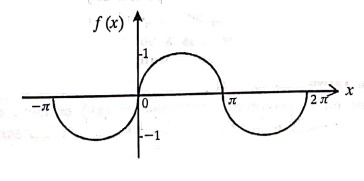
2.
The trignometric functions sinx and
cosx are periodic functions with
functions fundamental (primitive) period 2π.
3.
sin 2x and cos 2v are also periodic functions with fundamental period π.
4.
tanx is a periodic function with
period π.
5.
Find the period of sinnx where n is a
positive integer
Solution
Let
f(x) = sin nx = sin (nx + 2π)
= sin n ( x + 2π/n ) = f(x + 2π/n)
Therefore,
2π/n is the period of sin nx, 2π/n is the period of cos nx
π/n is the period of tan nx
6.
Show that a constant has any positive number as period.
Solution:
Let
f(x) = c, where c is a constant.
then
f(x+k) = c, k being any positive
number
that
is f(x + k) = f(x)
So
f(x) is periodic with period k.
Note:
Since, there is no least value of k, we say that f(x) = c has no fundamental period.
7.
Let f : R → R be the function defined
by
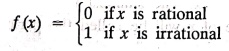
Let
p be any rational number. If x is rational, then x + p is also rational and if
x is irrational, then x + p is also irrational.
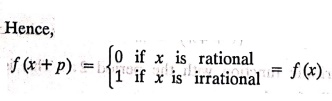
Hence,
every rational number is a period of f
and f has no fundamental period.
8.
Let f and g be periodic functions
with period p and let a and b be real numbers. Prove that af + bg is also a periodic function with period p.
Solution:
Since, f and g are periodic with
period p
f(x+p)
= f(x) ……..(1),
g (x + p) = g(x) ……….(2)
Now
(af+bg) (x +p) = af(x+p) + bg(x +p)
=
af(x) + bg(x) by (1) and (2)
=
(af + bg) (x)
Hence,
af + bg is periodic with period p.
9.
If p is a period of f(x), show that
np is also a period where n is any integer (positive or negative)
Solution:
Since
f(x) = f(x+p) = f (x + 2p) =
…. = f[x
+ (n‒1)p] = f (x + np) it follows
that np is period of f.
10.
Draw the graph of y = |x| in ‒1≤x≤1
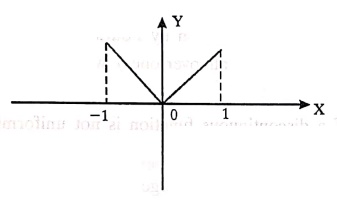
Note:
|x| = ‒x, x ≤ 0
=
x, x≥0
CONTINUITY OF A FUNCTION :
The
left hand limit of f(x) at x = a is
defined as x approaches a from the
left and is denoted by f(a −).
f(a
‒) = Lth→0 f(a − h) as h→0
through positive values.
The
right hand limit of f(x) at x = a is
defined as x approaches a from the right and is denoted by f(a +)
f(a
+) = Lth→0 f (a + h)
A
function f(x) is said to be
continuous at x=a if f(a+) = f(a) = f(a−)
Note:
1.
f(a) is different from f(a +) and f(a −), f(a) means the
value of f(x) at x = a.
2.
If there is a finite jump in the graph of y = f(x) at x=a, the function is not continuous at x = a. (i.e.,) The function is not defined
at x = a.
In
such cases, both right hand and left hand limits are not equal. The function f(x) is piecewise continuous in an
interval (a, b) means that f(x) is
continuous at all, but a finite number of points in (a, b).
Example:
f(x) = 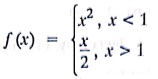
Here
x = 1 is a point of finite discontinuity for f(x).
[ f
(1−) ≠ f(1+) since f(1‒) = 1, f(1+) = ½ ]
ADVANTAGES OF FOURIER SERIES:
1.
Discontinuous function can be represented by Fourier series, although
derivatives of the discontinuous functions do not exist. (This is not true for
Taylor's series).
2.
The Fourier series is useful in expanding the periodic functions, since outside
the closed interval, there exists a periodic extension of the function.
3.
Expansion of an oscillating function by Fourier series gives all modes of
oscillation (fundamental and all overtones) which is extremely useful in
physics.
4.
Fourier series of a discontinuous function is not uniformly convergent at all
points.
5.
Term by term integration of a convergent Fourier series is always valid, and it
may not be valid if the series is not convergent. However, term by term,
differentiation of a Fourier series is not valid if the series is not
convergent.
Transforms and its Applications: UNIT 3: Fourier Series : Tag: Engineering mathematics, Maths : - Use, Advantages, Periodic Function of Fourier Series
Transforms and its Applications: UNIT 3: Fourier Series
Under Subject
Transforms and its Applications
MA25C03 2nd Semester EEE Dept | 2025 Regulation | 2nd Semester 2025 Regulation
Related Subjects

English Essentials II
EN25C02 2nd Semester | 2025 Regulation | 2nd Semester 2025 Regulation

Tamils and Technology தமிழர்களும் தொழில்நுட்பமும்
UC25H02 2nd Semester | 2025 Regulation | 2nd Semester 2025 Regulation
Transforms and its Applications
MA25C03 2nd Semester EEE Dept | 2025 Regulation | 2nd Semester 2025 Regulation

Applied Physics (EE) II
PH25C04 2nd Semester EEE Dept | 2025 Regulation | 2nd Semester 2025 Regulation

Basic Civil and Mechanical Engineering
GE25C01 2nd Semester EEE Dept | 2025 Regulation | 2nd Semester 2025 Regulation
Engineering Drawing
ME25C01 EEE, Mech, Agri, EEE Depts | 2025 Regulation | 2nd Semester 2025 Regulation
Data Structures and Algorithms
CS25C04 2nd Semester EEE Dept | 2025 Regulation

Re-Engineering for Innovation
ME25C05 2nd Semester | 2025 Regulation | 2nd Semester 2025 Regulation
Engineering Drawing - Laboratory
ME25C01 2nd Semester | 2025 Regulation | 2nd Semester 2025 Regulation

Data Structures and Algorithms - Laboratory
CS25C04 2nd Semester EEE Dept | 2025 Regulation | 2nd Semester 2025 Regulation