Transforms and its Applications: UNIT 3: Fourier Series
Fourier Series: Two Marks Important Questions and Answers
Transforms and its Applications
Transforms and its Applications: UNIT 3: Fourier Series : Anna University Part A Two Marks Important Questions and Answers
Fourier
Series:
2 Marks Important Questions with Answer
PART‒A QUESTIONS AND ANSWERS
I. Problems under (0, 2π), (0, 2l), (−π, π), (−l, l)
1. When does a function
possess a Fourier series expansion in terms of trignometric terms?
(or) State the
conditions for f(x) to have Fourier
series expansion.
(or) Explain
Dirichlet's conditions.
Solution:
the
function f(x) = sin(1/x) attains its maximum and minimum values when 1/x =
x=
2/ (2n-1)π …..(1)
where
n is zero or an integer.
For
large values of n as n→∞, the values of x as given by (2) tend to become
indefinitely small and to be crowded near to the value of x = 0.
Hence,
the function has an infinite number of maxima and minima near x = 0, so it does
not satisfy one of the Dirichlet's conditions. It cannot be expanded in a
Fourier series in the range -π ≤ x ≤π in which the point x = 0 is included.
2. State whether y =
tan x can be expanded as a Fourier series. If so how? If not why?
Solution:
tanx cannot be expanded as a Fourier
series. Since, tanx does not satisfy
Dirichlet's conditions.
[tanx
has infinite number of infinite discontinuities.]
3. Find the sum of the
Fourier series for
f(x) = x 0 < x < 1
= 2 1 < x < 2
at x = 1.
Solution:
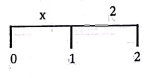
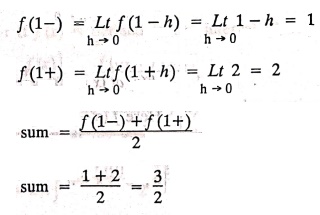
x = 1 is a finite point of discontinuity (in the middle) of(0, 2)
[f (1−) ≠ f (1+)]
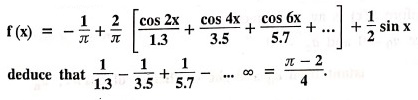
4. If the Fourier
series for the function
f(x) =
x 0 < x < π
=
sin x ; π < x < 2π is
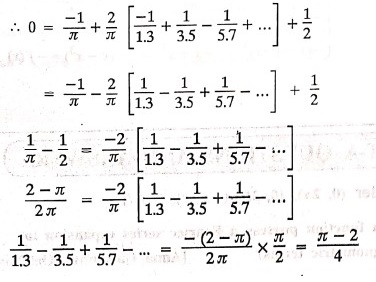
Solution:
Put x = π/2 is a point of continuity.
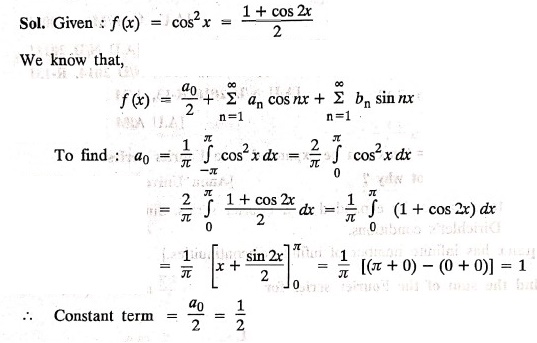
5. Find the constant
term in the Fourier series corresponding to f(x)
= cos2 x expressed in the interval (‒π, π).
Solution:
6. Write a0,
an in the expansion of x + x3 as a Fourier series in (‒
π, π).
Solution:
Let
f(x) = x+x3
f
(−x) = (‒x)+(‒x)3
=
‒x‒x3 = (x+x3) = ‒ f(x)
Therefore
f(x) is an odd function.
Hence
a0=0 and an = 0
7. What are the
constant term a0 and the coefficient of cos nx, an in the
Fourier series expansion of f(x) = x
− x3 in (−π, π) ?
Solution:
f(x) = x‒x3
f(‒x) = (‒x)‒(‒x)3 = −x+x3 = − (x − x3)
= −f(x)
f(x)
is an odd function.
Hence,
in the Fourier series a0 = 0 and an = 0
8. In the Fourier
expansion of f(x) = 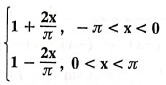
in (−π, π), find the
value of bn, the coefficient of sin nx.
Solution:
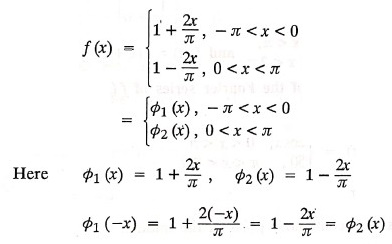
Given function is an even function.
Hence,
the value of bn = 0
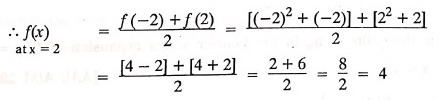
9. If f(x) = x2 + x is expressed as
a Fourier series in the interval (‒2, 2) to which value this series converges
at x = 2?
Solution:
x=2 is a point of discontinuity in the
extremum.
10. Find bn
in the expansion of x2 as a Fourier Series in (‒ π, π).
Solution:
Given
f(x) = x2 is an even
function in the interval (‒ π, π)
bn
= 0
11. If f(x) is an odd function defined in (‒l, l),
what are the values of a0 and an ?
Solution:
Given
f(x) is an odd function in the
interval (−l, l)
a0=
0, an = 0
12. Find the Fourier
constants bn for x sin x in (‒π, π).
Solution:
Given
f(x) = x sinx in (‒π, π)
f(‒x)
= (‒x)sin (‒x) = (‒x) [‒ sin x]
=
x sin x = f(x)
f(x)
is an even function
Hence
bn = 0
13. If f(x) = 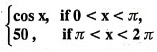 and f(x) = f(x + 2 π) for all x, find the sum of the Fourier series of f(x) at x = π.
Solution:
Given:
f(x) =
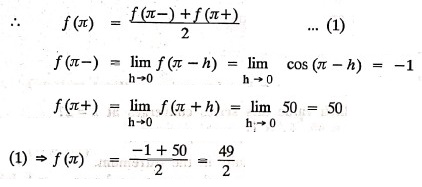
To find
f(x) at x = π
x = π is a discontinuous point in the middle.
14. Determine the value
of an in the Fourier series expansion of f(x)=x3 in ‒π
< x < π.
Solution:
Let
f(x)
= x3
f(‒x)
= (‒x)3 = ‒x3 = ‒f(x)
Therefore
f(x) is an odd function.
Hence
a0 = 0 and an = 0
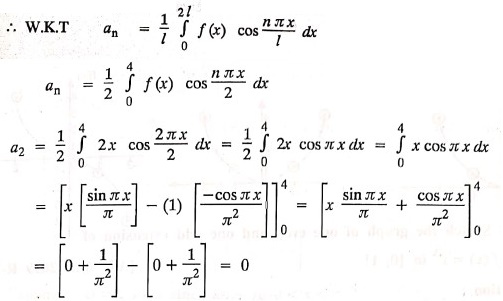
15. If f(x) = 2x in the interval (0, 4), then
find the value of a2 in the Fourier series expansion.
Solution:
Here 2l = 4; l = 2
II. Problems under Half range series
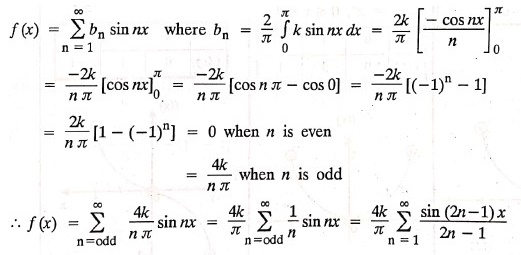
1. Find half range sine
series for, f(x) = k in 0 < x <
π.
Solution:
The sine series of f(x) in (0,π) is
given by
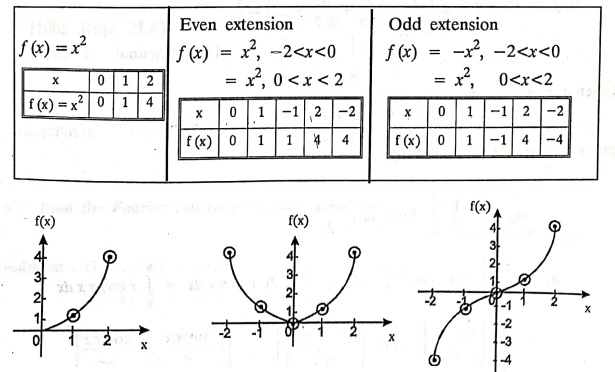
2.(a) Sketch the even
and odd extension of the periodic function
f(x) = x2 for 0 < x <
2
Solution:
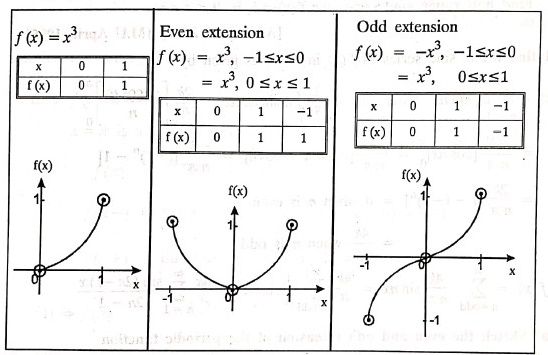
2.(b) Sketch the graph
of one even and one odd extension of
f(x)=x3 in [0, 1]
Solution:
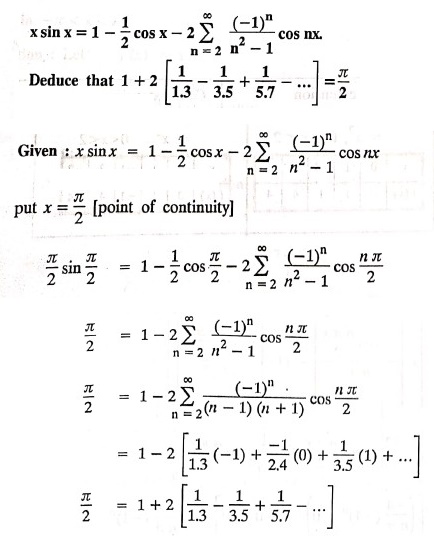
3. The cosine series
for f(x) = x sin x for 0 < x <π
is given as
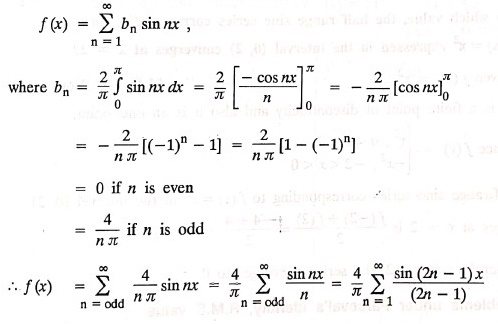
4. Expand f(x) = 1 in a sine series in 0 < x
<π.
Solution:
The sine series of f(x) in (0,π) is
given by
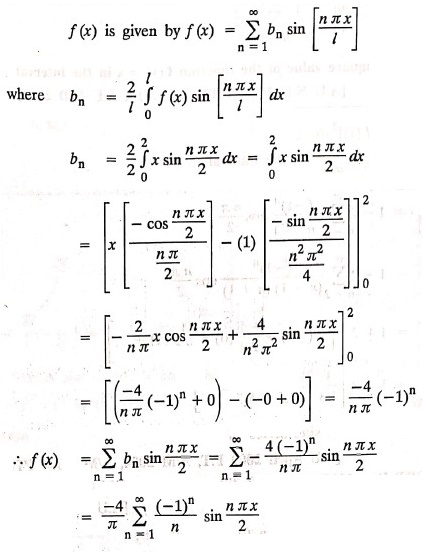
5. Find the Fourier
sine series of f(x) = x in 0 < x
< 2.
Solution:
In the interval 0 < x < 2 the half range sine series for
6. To which value, the
half range sine series corresponding to f(x)
= x2 expressed in the interval (0, 2) converges at x = 2?
Solution:
Given f(x) = x2
x
= 2 is a finite point of discontinuity and also it is an end point.
Since
f(x) = 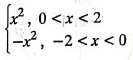
the
half‒range sine series corresponding to f(x)
= x2 in the intervel (0, 2) converges at x = 2 is
[f (−2) + f (2)] /2 = [‒4 + 4]/2 = 0
Therefore
at x=2, the series converges to 0.
III. Problems under Parseval's identity, R.M.S value
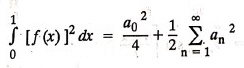
1. State Parseval's
identity for the half‒range cosine expansion of f(x) in (0, 1).
Solution:
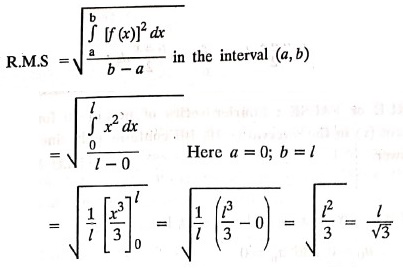
2. Find the root mean
square value of the function f(x) = x
in the interval (0, l).
Solution:
3. Define root mean
square value of a function f(x) in a
< x < b.
Solution:
Let f(x) be a function defined in an
interval (a, b) then
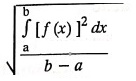
is
called the root mean square (or) effective value of f(x) and is denoted by  .
.
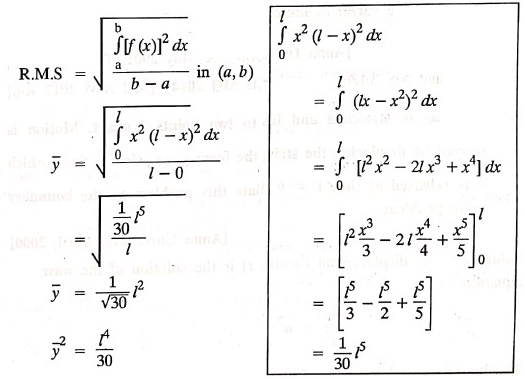
4. Find the root mean
square value of f(x) = x (l‒x) in 0 ≤ x ≤ l.
Solution:
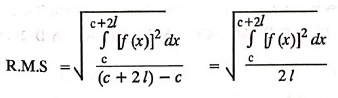
5. Define R.M.S value
of a function f(x) in c < x <c
+ 2l.
Solution:
6. State TRUE or FALSE:
Fourier series of period 20 for the function f(x) = x cos (x) in the interval (‒10, 10) contains only sine
terms. Justify your answer.
Solution:
TRUE.
f(x) = x cos x is odd in (‒10, 10)
a0=0 and an = 0
So,
we get only sine terms.
IV. Problems under Solution of one‒dimensional wave equation and One‒dimensional equation of Heat conduction.
1. What conditions are
assumed in deriving the one dimensional wave equation?
The
wave equation is 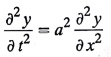
This
gives y (x, t), the transverse vibration of a string stretched to a constant
tension T. In deriving this equation, we make the following assumptions.
1.
The motion takes place entirely in one plane i.e., xy plane.
2.
We consider only transverse vibrations, the horizontal displacement of the
particles of the string is negligible.
3.
The tension T is constant at all times and at all points of the deflected
string.
4.
T is considered to be so large compared with the weight of the string and hence
the force of gravity is negligible.
5.
The effect of friction is negligible.
6.
The string is perfectly flexible, i.e., it can transmit tension but not bending
or shearing forces.
7.
The slope of the deflection curve at all points and at all instants is so small
that sina can be replaced by a, where a is the inclination of the tangent to the deflection curve,
2. What are the various
solutions of ?
Thus
the various possible solutions of the wave equations are
y(x,
t) = (A1ePx + A2e‒px) (A3
ecpt + A4 e‒cpt)
y(x,
t) = (A5 cos px + A6 sin px) (A7 cos cpt + A8
sin cpt)
y(x, t) = (A9x+A10) (A11t
+ A12)
3. A string is
stretched and fastened to two points l
apart. Motion is started by displacing the string into the form y = y0
sin(πx / l) from which it is released
at time t = 0. Formulate this problem as the boundary value problem.
Solution:
The
displacement function y (x, t) is the solution of the wave equation.
The
boundary and initial conditions are
(i)
y (0, t) = 0 for all t≥0
(ii)
y (l,t) = 0 for all t≥0
(iii)
(∂y/∂t)(x,0) = 0
(iv)
y (x, 0) = f(x) = y0 sin
(πx/l)
4. A string of length 2
l stretched to a constant tension T,
is fastened at both the ends and hence fixed. The mid point of the string is
taken to a height b and then released from rest in that position. It is desired
to solve for transverse vibrations of the string. Write the governing equation
and the corresponding conditions.
Solution:
The
wave equation is ∂2y/∂t2 = a2 ∂2y/∂x2
From
the given problem, we get the following boundary and initial conditions.
(i)
y (0, t) = 0 for all t ≥ 0
(ii)
y (2l, t) = 0 for all t ≥ 0
(iii)
(∂y/∂t)(x, 0) = 0, 0 ≤ x ≤ l
5. What is the constant
a2 in the wave equation
utt = a2 uxx ?
(OR)
In the wave equation what does c2 stand for?
Solution:
a2 (or) c2 = T/m = Tension / mass per unit length of the
string
6. State the suitable
solution of the one dimensional heat equation
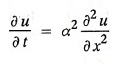
Solution:
u(x, t) = (A cos px + B sin px) 
7. State the governing
equation for one dimensional heat equation and necessary conditions to solve
the problem.
Solution:
The one dimensional heat equation is
where
u(x, t) is the temperature at time t at a point distant x from the left end of
the rod.
The
boundary conditions are
(i)
u (0, t) = k1°C for all t≥0
(ii)
u (l,t) = k2° C for all t≥
0
( l being
the length of the one dimensional rod)
The
initial condition is
(iii) u (x, 0) = f(x), 0 < x < l
8. Write all variable
separable solution of the one dimensional heat equation ut = a2uxx.
u(x,
t) = (A1eλx + B1e−λx) C1 
u(x,
t) = (A2 cos λx + B2 sin λx) C2
u(x, t) = (A3x + B3) C3
9. Write down the
diffusion problem in one‒dimension as a boundary value problem in two different
forms.
Solution:
one
dimensional heat flow.
Here
a2 = k/ρc is called the diffusivity.
In
the steady state ∂2u/∂x2 = 0
10. State any two laws
which are assumed to derive one dimensional heat equation.
Solution:
(i)
Heat flows from higher to lower temperature.
(ii)
The rate at which heat flows across any area is proportional to the area and to
the temperature gradient normal to the curve. This constant of proportionality
is known as the thermal conductivity (k) of the material. It is known as
Fourier law of heat conduction.
11. In steady state
conditions, derive the solution of one dimensional heat flow equation.
Solution:
The p.d.e. of unsteady one dimensional heat flow is
……(2)
In
steady state condition, the temperature u depends only on x and not on time t
Hence
∂u/∂x = 0
(1) reduces to d2u/dx2
= 0
……(2)
The
general solution is u = ax + b where a, b are arbitrary.
12. Write the boundary
conditions and initial conditions for solving the vibration of string equation,
if the string is subjected to initial displacement f(x) and initial velocity g(x).
Solution:
The wave equation is 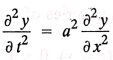
(a) y
(0, t) = 0
(b) y (l,t)
= 0
(c) (∂y/∂t)(x,0) = g(x)
(d) y(x, 0) = f(x)
13. The ends A and B of
a rod of length 10 cm have their temperature kept at 20°C and 70°C. Find the
steady state temperature distribution on the rod.
Solution:
The steady state temperature distribution on the rod
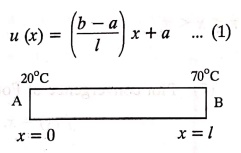
Here,
a: Temperature at end x = 0, i.e., a = 20°C
b: Temperature at end x = l, i.e., b = 70°C
l:
Length of the rod, i.e., l = 10 cm
(1) ⇒ u (x) = ( (70‒20)/10 )x
+ 20 = 5x + 20
14. Explain the various
variables dominating the wave equation.
Solution:
The wave equation is
y
→ displacement
x
→ distance of the point on the string from fixed point along x direction
t
→ time
Transforms and its Applications: UNIT 3: Fourier Series : Tag: Engineering mathematics, Maths : Transforms and its Applications - Fourier Series: Two Marks Important Questions and Answers
Transforms and its Applications: UNIT 3: Fourier Series
Under Subject

Transforms and its Applications
MA25C03 2nd Semester EEE Dept | 2025 Regulation | 2nd Semester 2025 Regulation
Related Subjects

English Essentials II
EN25C02 2nd Semester | 2025 Regulation | 2nd Semester 2025 Regulation

Tamils and Technology தமிழர்களும் தொழில்நுட்பமும்
UC25H02 2nd Semester | 2025 Regulation | 2nd Semester 2025 Regulation
Transforms and its Applications
MA25C03 2nd Semester EEE Dept | 2025 Regulation | 2nd Semester 2025 Regulation

Applied Physics (EE) II
PH25C04 2nd Semester EEE Dept | 2025 Regulation | 2nd Semester 2025 Regulation

Basic Civil and Mechanical Engineering
GE25C01 2nd Semester EEE Dept | 2025 Regulation | 2nd Semester 2025 Regulation

Engineering Drawing
ME25C01 EEE, Mech, Agri, EEE Depts | 2025 Regulation | 2nd Semester 2025 Regulation

Data Structures and Algorithms
CS25C04 2nd Semester EEE Dept | 2025 Regulation

Re-Engineering for Innovation
ME25C05 2nd Semester | 2025 Regulation | 2nd Semester 2025 Regulation

Engineering Drawing - Laboratory
ME25C01 2nd Semester | 2025 Regulation | 2nd Semester 2025 Regulation

Data Structures and Algorithms - Laboratory
CS25C04 2nd Semester EEE Dept | 2025 Regulation | 2nd Semester 2025 Regulation