Transforms and its Applications: UNIT 3: Fourier Series
Fourier Series: Solutions of One Dimensional Wave Equation
Fourier Series: Example Important Solved Problems with formula, steps, derivation, answer based on Fourier Series - Solutions of One Dimensional Wave Equation.
SOLUTIONS
OF ONE DIMENSIONAL WAVE EQUATION
Equation of a vibrating
string :‒ One
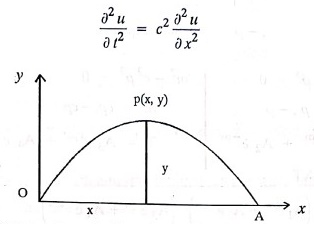
dimensional wave equation: Consider an elastic string tightly stretched
between two points O and A. Let O be the origin and OA as x‒axis. On giving a
small displacement to the string, perpendicular to its length (parallel to the
y‒axis). Let y be the displacement at the point P (x, y) at any time. The wave
equation is
Example 1: Obtain the solution of one
dimensional wave equation:
Solution:
One
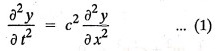
dimensional wave equation is
Solve
this by using method of separation of variables.
Let
y = XT ………….(2)
where
X is a function of x alone and T is a function of t alone.
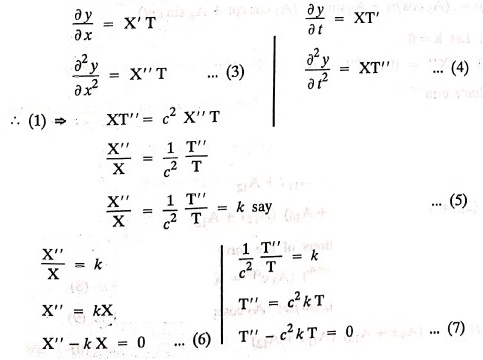
differentiate (2) partially, we get
The
nature of the solutions of (6) & (7) depends on the value of k.
Case (i) Let k be
positive say k = p2
(6)
⇒ X" ‒ p2X
= 0
(7)
⇒ T" ‒ c2p2T
= 0
Now,
we get two ordinary diff. equations.
The
auxiliary equations are
m2
‒ p2 = 0
m
= p, ‒p
So, X = A1epx + A2e‒px
m2
‒ c2p2 = 0
m
= cp, −cp
T
= A3 ecpt + A4 e‒cpt
(2)
⇒ y = XT
y = (A1epx + A2e‒px
)( A3 ecpt + A4 e‒cpt )
Case (ii) Let k be
negative say k = −p2
(6)
& (7) = X" + p2X = 0 and T" + c2p2T
= 0
The
auxiliary equations are
m2
+ p2 = 0
m
= ± pi
So,
X = (A5 cos px + A6 sin px),
m2
+ c2p2 = 0
m
= ± cpi
So,
T = (A7 cos cpt + A8 sin cpt),
(2) ⇒
y = XT
Y(x,t) = (A5 cos px + A6
sin px) (A7 cos cpt + A8 sin cpt)
Case (iii) Let k = 0
(6) & (7) ⇒ X'' = 0 & T'' = 0
The
auxiliary equations are
m2
= 0,
m
= 0,0
X
= A9x + A10,
m2
= 0
m
= 0, 0
T
= A11t + A12
equation (2) ⇒ y(x,t) = (A9x + A10)
(A11t + A12)
Thus the various
possible solutions of the wave equations are
y(x,
t) = (A1ePx + A2e‒px) (A3
ecpt + A4 e‒cpt) ……..(8)
y(x,
t) = (A5 cos px + A6 sin px) (A7 cos cpt + A8
sin cpt) ……..(9)
y(x, t) = (A9x+A10) (A11t
+ A12) ……..(10)
Out
of the three mathematically possible solutions derived, we have to choose the
solution which is consistent with the physical nature of the problem and the
given boundary conditions. In the case of vibration of an elastic string, y (x,
t) representing the displacement of the string at any point x, y must be
periodic in t. Hence solution (9), which consists of periodic functions in t is
the suitable solution of the problems on vibration of strings. The arbitrary
constants in the suitable solution are found out by using the boundary
conditions of the problem.
In
problems, we directly assume that (9) is the suitable solution of vibration of
string problems.
The
suitable solution (9) which is periodic in 't' is incidentally periodic in 'x'
also.
Example 2: Derive D' Alembert's solution of
the wave equation:
Solution:
Consider the one dimensional wave equation
Let D = ∂/∂t and D' = ∂/∂x
Hence,
(1) can be written as (D2 ‒ c2D'2)y = 0
The
auxiliary equation is
m2 ‒ c2 = 0
The
general solution of the wave equation is
y = f(x + ct) + g(x − ct) …….(2)
where
f and g are arbitrary functions
Suppose,
initially y(x, 0) = ϕ(x) and ∂y/∂t(x, 0) = 0
From
(2), y(x, 0) = f(x) + g(x) = ϕ(x)
i.e., ϕ(x) = f(x)
+ g(x) …………(3)
From
(2), ∂y/∂t (x,t) = c [f ' (x + ct) − g'
(x ‒ ct)]
∂y/∂t (x,0) = 0
c [f
'(x) − g '(x)] = 0
f '(x) − g '(x) = 0
Integrating,
we get_f(x) − g(x) = k ………(4)
From
(3) & (4), we get
f(x) = (ϕ(x) + k) / 2
and
g (x) = (ϕ(x) ‒ k) / 2
(2) can be written as
y (x, t) = 1/2 [ϕ (x + ct) + k] + 1⁄2 [ϕ (x −
ct) − k]
=
1/2 [ ϕ(x − ct) + ϕ(x+ct) ]
This
solution is called D' Alemberts solution of the one dimensional wave equation.
Example 3: State the assumptions made in the
derivation of one dimensional wave equation.
Solution:
The wave equation is 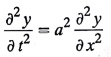
This
gives y (x, t), the transverse vibration of a string stretched to a constant
tension T. In deriving this equation, we make the following assumptions.
1.
The motion takes place entirely in one plane i.e., xy plane.
2.
We consider only transverse vibrations, the horizontal displacement of the
particles of the string is negligible.
3.
The tension T is constant at all times and at all points of the deflected
string.
4.
T is considered to be so large compared with the weight of the string and hence
the force of gravity is negligible.
5.
The effect of friction is negligible.
6.
The string is perfectly flexible, i.e., it can transmit tension but not bending
or shearing forces.
7.
The slope of the deflection curve at all points and at all instants is so small
that sina can be replaced by a, where a is the inclination of the tangent to the deflection curve,
Example 4: Derive one dimensional wave
equation :
Solution:
Consider a tightly stretched elastic string of length l with its end points fixed. Let the string be released from rest
and allowed to vibrate.
The
problem is to determine the deflection y (x, t) at any point x and at any time
t > 0.
For
deriving the p.d.e. we make the following assumption.
See
Example 3.
To obtain the
differential equation
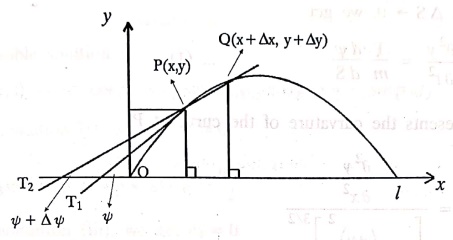
Take
one end of the string as origin O and take X‒axis along the string.
We
assume that the motion takes place entirely in the XY plane.
Consider
the forces acting on a small portion PQ of the string where P is (x, y) and Q
is (x + Δx, y + Δy)
By
assumption, the string does not offer resistance to bending and shearing hence
the tension at each point of the string is tangential to the curve of the
string.
Let
T1 and T2 be the tensions at the points P and Q.
Let
ᴪ and ᴪ+Δᴪ be the angles made by the tangents at P and Q respectively with the
X axis.
Let
m be the mass per unit length of the string
Since,
there is no motion in the horizontal portion of the string the tension must be
constant.
T1 cos ᴪ = T2 cos (ᴪ + Δᴪ)
which is a constant.
Since
ᴪ is small, cos ᴪ and cos (ᴪ+Δᴪ) are approximately equal to 1.
Thus,
T1 = T2 = T, a constant.
The
vertical component of the force acting on the element PQ is Tsin(ᴪ + Δᴪ) ‒ Tsinᴪ
= T
T(ᴪ
+ Δᴪ) ‒ Tᴪ
=
TΔᴪ
['. sin ᴪ = ᴪ where ᴪ is small]
The
acceleration of the element in the y direction is ∂2y/∂t2.
Hence,
by Newton's second law of motion,
mΔS ∂2y/∂t2 = T Δ Ψ where
m is the mass per unit length of the string as ΔS is the length of the element
PQ.
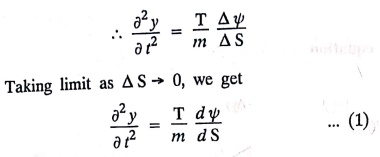
Now,
dᴪ / dS represents the curvature of the curve at P.
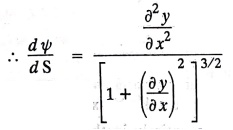
=
∂2y/∂x2
[∂y/∂x
is very small and (∂y/∂x)2 is negligible]
using
this in (1), we get ∂2y/∂t2 = T/m . ∂2y/∂x2
∂2y/∂x2
= a2 ∂2y/∂x2
where
a2 = T/m
This
partial differential equation is known as the one dimensional wave equation. It
is a homogeneous of second order.
Example 5a: The p.d.e. of a vibrating string
is what is a2?
Solution:
a2 = T/m = Tension / mass per unit length
of the string
Example 5b: Explain why a2 (instead
of a) is used in the p.d.e. of the vibrating
string .
Solution:
a2 = T/m = Tension / mass per unit length of the string = + ve
As
T/m is positive, it is denoted by a2 (and not by a).
Transforms and its Applications: UNIT 3: Fourier Series : Tag: Engineering mathematics, Maths : - Fourier Series: Solutions of One Dimensional Wave Equation
Transforms and its Applications: UNIT 3: Fourier Series
Under Subject
Transforms and its Applications
MA25C03 2nd Semester EEE Dept | 2025 Regulation | 2nd Semester 2025 Regulation
Related Subjects

English Essentials II
EN25C02 2nd Semester | 2025 Regulation | 2nd Semester 2025 Regulation

Tamils and Technology தமிழர்களும் தொழில்நுட்பமும்
UC25H02 2nd Semester | 2025 Regulation | 2nd Semester 2025 Regulation
Transforms and its Applications
MA25C03 2nd Semester EEE Dept | 2025 Regulation | 2nd Semester 2025 Regulation
Applied Physics (EE) II
PH25C04 2nd Semester EEE Dept | 2025 Regulation | 2nd Semester 2025 Regulation

Basic Civil and Mechanical Engineering
GE25C01 2nd Semester EEE Dept | 2025 Regulation | 2nd Semester 2025 Regulation
Engineering Drawing
ME25C01 EEE, Mech, Agri, EEE Depts | 2025 Regulation | 2nd Semester 2025 Regulation
Data Structures and Algorithms
CS25C04 2nd Semester EEE Dept | 2025 Regulation

Re-Engineering for Innovation
ME25C05 2nd Semester | 2025 Regulation | 2nd Semester 2025 Regulation
Engineering Drawing - Laboratory
ME25C01 2nd Semester | 2025 Regulation | 2nd Semester 2025 Regulation

Data Structures and Algorithms - Laboratory
CS25C04 2nd Semester EEE Dept | 2025 Regulation | 2nd Semester 2025 Regulation