Transforms and its Applications: UNIT 3: Fourier Series
Fourier Series: Solutions of One Dimensional Wave Equation - Vibrating String with Non Zero Initial Velocity
Fourier Series: Example Important Solved Problems with formula, steps, derivation, answer and Exercise Problems based on Fourier Series: Solutions of One Dimensional Wave Equation - Vibrating String with Non Zero Initial Velocity.
ONE
DIMENSIONAL WAVE EQUATION: VIBRATING STRING WITH NON-ZERO INITIAL VELOCITY
Problems on vibrating string with non‒zero initial velocity.
Type 2. Vibrating string with non‒zero initial velocity :
The
boundary and initial conditions of the deflection y (x, t) are
(i)
y (0,t) = 0
(ii)
y (l,t) = 0
(iii)
y (x, 0) = 0
(iv)
∂y/∂t (x, 0) = f(x)
The
suitable solution is
y (x, t) = (c1 cos px + c2
sin px) (c3 cos p at + c4 sin p at) ….. (1)
Apply
condition (i), we get c1 = 0
Apply
condition (ii), we get p = nπ / l
Apply
condition (iii), we get c3 = 0
The
most general solution is at

Apply
condition (iv), we get
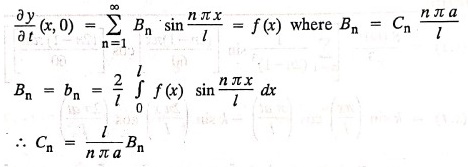
Substitute
in (2) we get the general solution.
Example 15: A tightly stretched string with
fixed end points x=0 and x = l is
initially at rest in its equilibrium position. If it is set vibrating string
giving each point a velocity λx (l‒x)
show that the displacement is

Solution:
The wave equation is 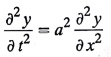
From
the given problem we get the following boundary and initial conditions,
(i)
y (0, t) 0 for all t > 0
(ii)
y (l, t) = 0 for all t > 0
(iii)
y (x, 0) = 0, 0 <x< l
(iv)
( ∂y/∂t )(x, 0) = λx (l −
x), 0 < x < l
Now,
the suitable solution which satisfies our boundary conditions is gien by
y
(x, t) = (c1 cospx + c2sin
px) (c3 cos p at + c4 sin p at) ... (1)
Applying condition (i)
in equation (1), we get
y (0, t) = c1 (c3 cos p
at + c4 sin pat) = 0
Here,
c3 cosp at + c4 sin p at ≠ 0 [ It is defined for all t]
Therefore,
we get
c1 = 0
Substitute
c1 = 0 in (1), we get
y
(x, t) = c2 sin px (c3 cos p at + c4 sin p at)
... (2)
Applying condition (ii)
in equation (2), we get
y (l, t) = c2 sin pl (c3
cos pa t + c4 sin p at) = 0
Here,
(c3 cos p at + c4 sin p at) ≠ 0 [. It is defined for all t]
Therefore,
either c2 = 0 or sin pl =
0
Suppose,
we take c2 = 0 and already we have c1 = 0 then we get a trivial
solution.
Therefore,
we consider c2≠ 0 and sinpl
= 0
sin pl
= 0
pl =
nπ
['. sin nπ =0]
P
= nπ / l
[n being an integer]
Now, substituting p = nπ / l in equation (2), we get

Applying condition
(iii) in equation (3), we get
y (x, 0) = c2 sinn(xnπ/l)
c3 = 0
c2 c3 sin (xnπ/l) = 0
Here,
sin (xnπ/l) ≠ 0 ['. It
is defined for all x]
c2 ≠ 0 ['. If c2 = 0 we already
explained]
Therefore,
c3 = 0
Substitute
c3 = 0 in equation (3), we get
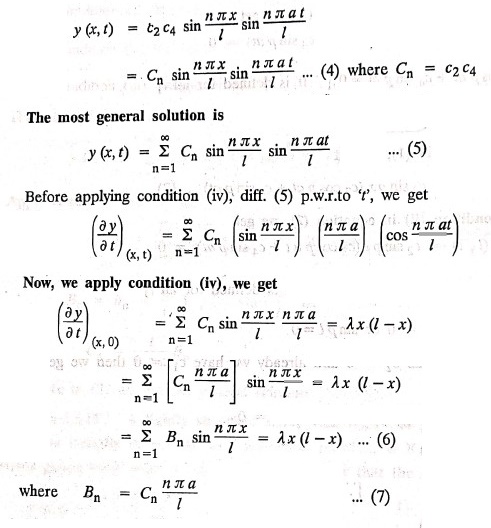
To find Bn:
Expand λx(1‒x) in a half range Fourier sine series in the interval (0, l)
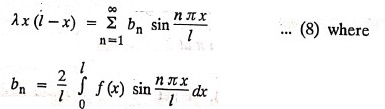
From
(6) and (8), we get bn = Bn
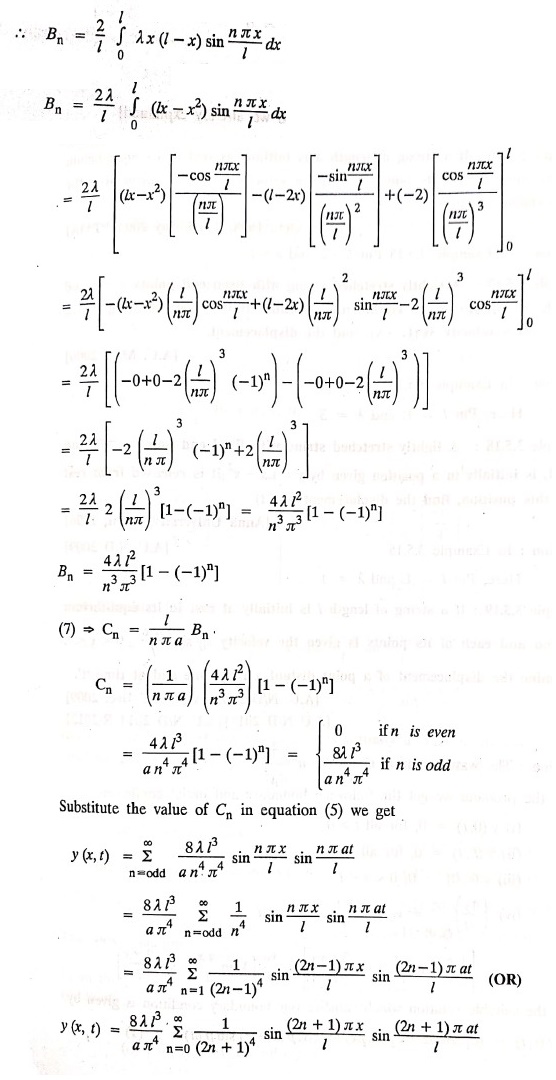
Example 16: If a string of length a is
initially at rest in its equilibrium position and each of its points is given a
velocity kx (a‒x), determine the displacement function.
Solution:
In Example 15 Put l=a and λ = k
Example 17: A tightly stretched string with
fixed end points x = 0 and x = L, is initially in its equilibrium position. If
it is set vibrating giving each point a velocity 3x (L x), find the
displacement.
Solution:
In Example 15
Here,
Put l = L and λ=3
Example 18: A tightly stretched string with
fixed end points x=0, and x = L is initially in a position given by y = Lx‒x2
it is released from rest from this position, find the displacement y(x, t)
Solution:
In Example 15
Here,
Put l = L and λ=1
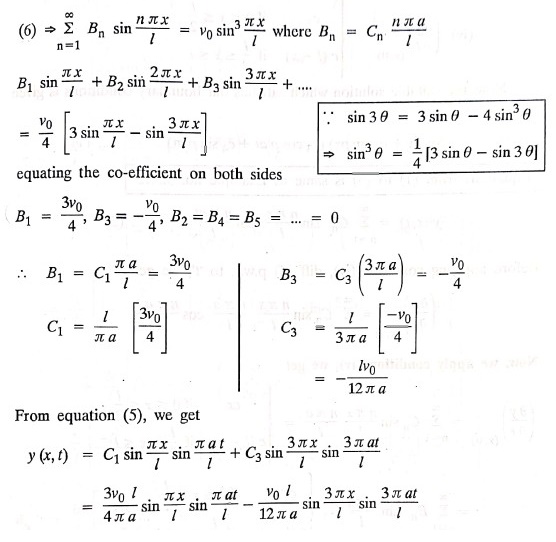
Example 19: If a string of length l is initially at rest in its
equilibrium position and each of its points is given the velocity v0
sin3 πx/l, 0 < x <l, determine the displacement of a point
distant x from one end at time 't'.
Solution:
The wave equation is
From
the problem we get the following boundary and initial conditions
(i)
y (0, t) = 0, for all t > 0
(ii)
y (l, t) = 0, for all t > 0
(iii)
y (x, 0) = 0, 0 < x < 1
(iv)
( ∂y/∂t )(x, 0) = v0 sin3 πx/l , 0 < x < l

Now,
the suitable solution which satisfies our boundary condition is given by
y
(x, t) = (c1 cos px + c2 sin px) (c3 cos p at
+ c4 sin p at) …….. (1)
Equations
from (1) to (6) is same as Example 15
Example 20: A string of length l is initially at rest in its
equilibrium position and motion is started by giving each of its points a
velocity given by v 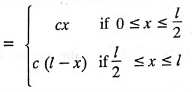
Find the displacement
function y (x, t).
Solution:
The
wave equation is
From
the given problem we get the following boundary and initial conditions,
(i)
y (0, t) for all t ≥ 0
(ii)
y (l, t) = 0, for all t ≥ 0
(iii)
y (x, 0) = 0
(iv)
( ∂y/∂t )(x, 0)
Now,
the suitable solution which satisfics our boundary conditions is given by
y(x, t) = (c1 cos px + c2
sin px) (c3 cos p at + c4 sin p at) ………… (1)
Equations
from (1) to (5) is same as Example no. 15
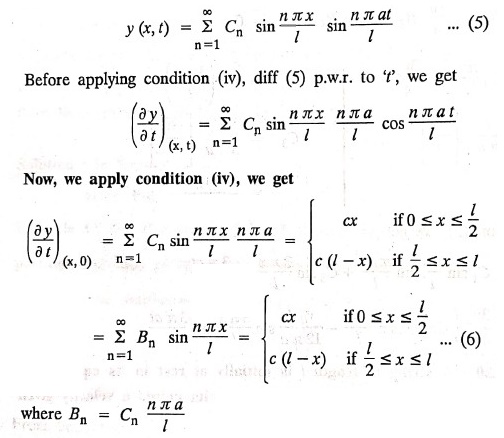
To find Bn:
Expand f(x) in a half range Fourier
sine series in the interval (0, 1)
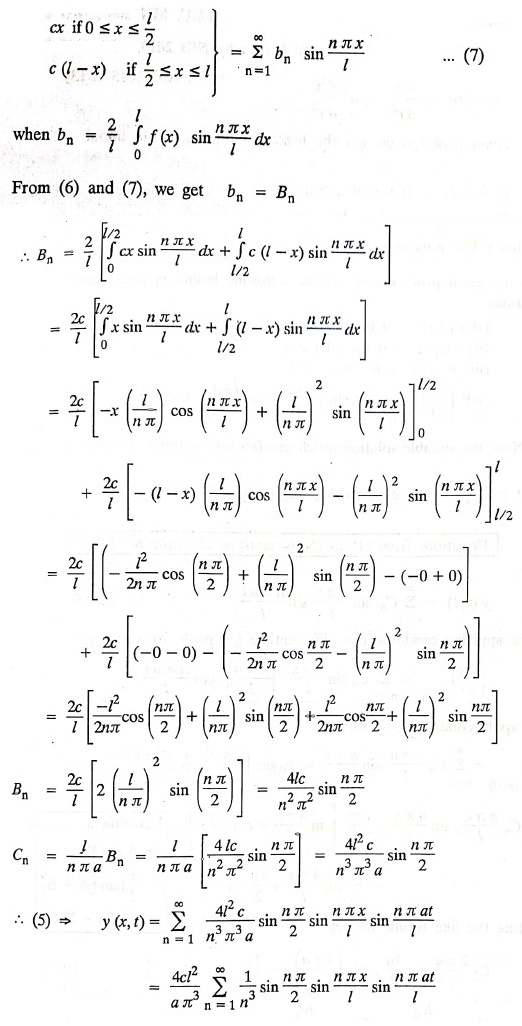
Example 21: If the string of length l is initially at rest in equilibrium position
and each of its points is given the velocity 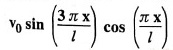 where 0 < x < 1
at t = 0, determine the displacement function y(x, t)
where 0 < x < 1
at t = 0, determine the displacement function y(x, t)
Solution:
The wave equation is
From
the given problem, we get the following boundary and initial conditions,
(i)
y (0, t) = 0 for all t≥0
(ii)
y (l, t) = 0 for all t≥0
(iii)
y (x, 0) = 0, for all t ≥ 0
(iv)
( ∂y/∂t )(x, 0) = , 0 < x < l
Now,
the suitable solution which satisfies our boundary conditions is given by
y (x, t) = (c1 cos px + c2
sin px) (c3 cos p at + c4 sin p at) ………..(1)
Equations
from (1) to (5) is same as Example no. 15
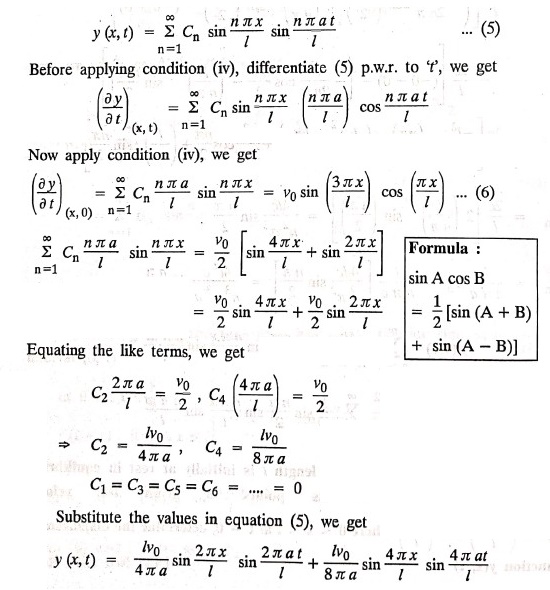
Example 22: A string is stretched between two
fixed points at a distance 2l apart
and the points of the string are given initial velocities v where
v = cx/l
in 0 < x <l
= c/l (2l‒x) in l<x<2l
x being the distance from one end point. Find
the displacement of the string at any subsequent time.
Solution:
The wave equation is
From
the given problem, we get the following boundary and initial conditions,
(i)
y (0, t) = 0 for all t≥ 0
(ii)
y (2l, t) = 0 for all t≥0
(iii)
y (x, 0) = 0
(iv)
( ∂y/∂t )(x, 0) 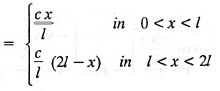
Equations
from (1) to (5) is same as Example 15
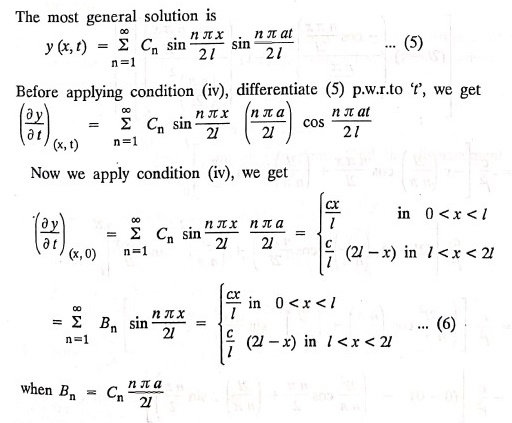
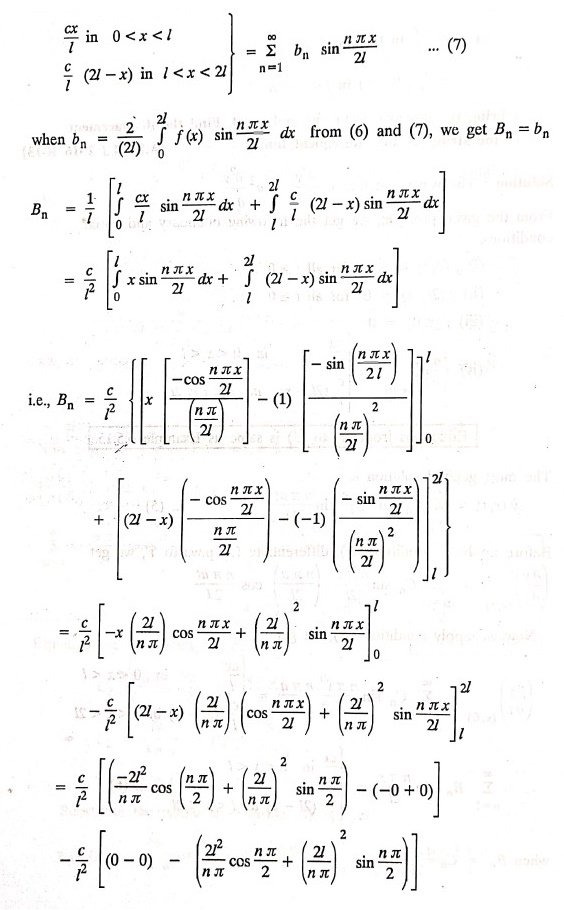
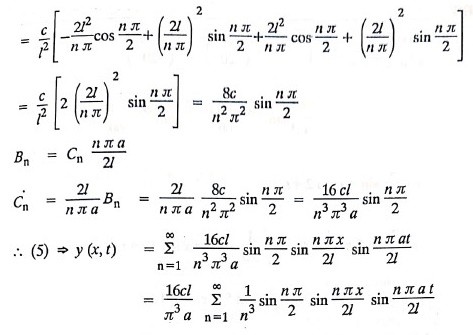
To
find Bn expand f(x) in a
Half range Fourier sine series in the interval (0, 21)
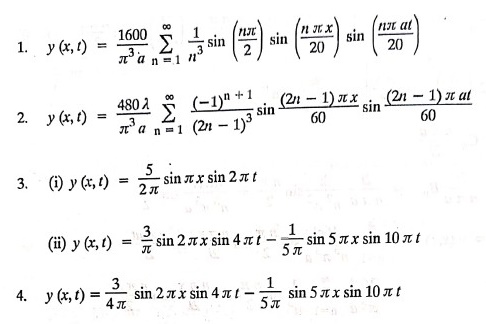
EXERCISE
1.
A taut string of length 20 cm fastened at both ends is displaced from its
position of equilibrium by imparting to each of its points an initial velocity
given by
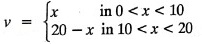
x being the distance from one end. Determine
the displacement at any subsequent time.
2.
A string is stretched between two fixed points at a distance of 60 cm and the
points of the string are given initial velocities v, where
u
= λx/30, in 0 < x < 30
=
λ/30 (60‒x), in 30 < x < 60
x being the distance from an end point. Find
the displacement of the string at any time.
3.
Solve the boundary value problem 
y (0,t) = y (5, t) = 0,
y (x, 0) =0,
(
∂y/∂t )t=0 = f(x)
If
(i) f(x) = 5 sin πx (i) f(x) = 3 sin 2πx ‒ 2 sin 5 πx
4.
Solve ∂2y/∂t2 = 4 ∂2y/∂x2 , y(0,t)
= y(5,t) = 0, y (x, 0) = 0,
∂y/∂t (x, 0) = 3 sin 2πx ‒ 2 sin 5πx
ANSWERS
Transforms and its Applications: UNIT 3: Fourier Series : Tag: Engineering mathematics, Maths : - Fourier Series: Solutions of One Dimensional Wave Equation - Vibrating String with Non Zero Initial Velocity
Transforms and its Applications: UNIT 3: Fourier Series
Under Subject

Transforms and its Applications
MA25C03 2nd Semester EEE Dept | 2025 Regulation | 2nd Semester 2025 Regulation
Related Subjects

English Essentials II
EN25C02 2nd Semester | 2025 Regulation | 2nd Semester 2025 Regulation

Tamils and Technology தமிழர்களும் தொழில்நுட்பமும்
UC25H02 2nd Semester | 2025 Regulation | 2nd Semester 2025 Regulation
Transforms and its Applications
MA25C03 2nd Semester EEE Dept | 2025 Regulation | 2nd Semester 2025 Regulation

Applied Physics (EE) II
PH25C04 2nd Semester EEE Dept | 2025 Regulation | 2nd Semester 2025 Regulation

Basic Civil and Mechanical Engineering
GE25C01 2nd Semester EEE Dept | 2025 Regulation | 2nd Semester 2025 Regulation
Engineering Drawing
ME25C01 EEE, Mech, Agri, EEE Depts | 2025 Regulation | 2nd Semester 2025 Regulation
Data Structures and Algorithms
CS25C04 2nd Semester EEE Dept | 2025 Regulation

Re-Engineering for Innovation
ME25C05 2nd Semester | 2025 Regulation | 2nd Semester 2025 Regulation
Engineering Drawing - Laboratory
ME25C01 2nd Semester | 2025 Regulation | 2nd Semester 2025 Regulation

Data Structures and Algorithms - Laboratory
CS25C04 2nd Semester EEE Dept | 2025 Regulation | 2nd Semester 2025 Regulation