Electron Devices: Chapter 1: Semiconductor
Continuity Equation
Semiconductor
Questions: 1. State and explain the continuity equation. 2. Important Example Solved Problems
Continuity Equation
•
The carrier concentration in the body of a semiconductor is a function of time
and distance.
•
Mathematically, a partial differential equation governs this functional
relationship between carrier concentration, time and distance. Such an equation
is called continuity equation.
•
The equation is based on the fact that charge can neither be created nor
destroyed.
•
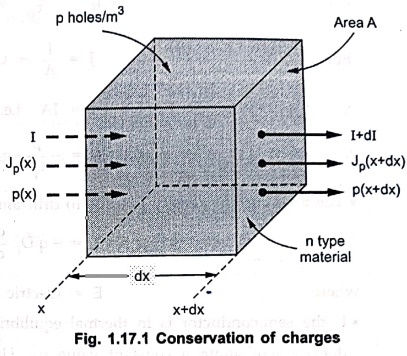
Consider the infinitesimal n type element of volume of area A and length dx as
shown in Fig. 1.17.1.
•
The average hole concentration is p/m3.
•
The current entering the volume at x is I and leaving at x + dx is I + dI. This
change in current is because of diffusion.
•
Now due to diffusion the concentration of charge carriers decreases
exponentially with the distance.
Hence,
dI = Number of coulombs per second decreased
within the volume
……... (1.17.1)
•
Now if τp is the mean life time of the holes then, Р/τp =
Holes per second lost by recombination per unit volume.
•
Due to recombination, number of coulombs per second decreased within the given
volume is,
= (Charge on hole) × (Holes/sec per unit
volume) × (Volume)
= q × P/τP × (Adx) = qA dx × P/τP
……... (1.17.2)
•
While let g is the rate at which electron hole pairs are generated by thermal
generation per unit volume. Due to this, number of coulombs per second
increases with the volume
= (Charges on hole) × (Rate of a generation) ×
(Volume) = q g A dx
……… (1.17.3)
•
Thus the total change in number of coulombs per second is because of three
factors as indicated by the equations (1.17.1), (1.17.2) and (1.17.3).
•
Total change in holes per unit volume per second is dp/dt. Hence the total
change in coulombs per second within the given volume
= q dp/dt (Volume) = q A dx dp/dt
….. (1.17.4)
•
According to law of conservation of charges,
q A dx dp/dt = ‒ q A dx P/τP + qgAdx
‒ dI
……... (1.17.5)
Key
Point: The negative sign indicates decrease while
positive indicates increase in number of coulombs per second.
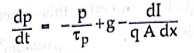
J = I/A = Current density
I = JA
i.e.
dI = AdJ as A is constant.
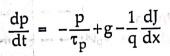
………..(1.17.7)
•
The total current density J is due to drift and diffusion current.
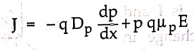
J = −qDp dp/dx + pqμPE = Diffusion
+ Drift
……… (1.17.8)
where
E
= Electric field intensity within the volume
•
If the semiconductor is in thermal equilibrium and subjected to no external
electric field then hole density will attain a constant value P0.
Under this condition I = 0 i.e. J = 0 and dp/dt = 0 due to equilibrium. Using
in (1.17.7),
0 = ‒P0/τP + g ‒ 0
i.e. g = Р0 / τр
………. (1.17.9)
•
The equation (1.17.9) indicates the thermal equilibrium i.e. the rate at which
holes are thermally generated just equal to the rate at which holes are lost
due to the recombination.
•
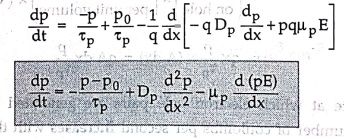
Using (1.17.8) and (1.17.9) in (1.17.7),
………. (1.17.10)
•
This is called equation of conservation of charge or the continuity equation.
•
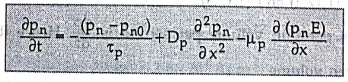
As holes in n type material are considered, let us use the suffix n. And as
concentration is a function of both time t and distance x, let us use partial
differentiation, Hence the final continuity equation takes the form as,
•
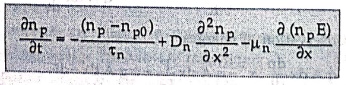
Similarly the continuity equation for the electrons in p type material can be
written as,
Let
us see the special cases for continuity equation under the condition of zero
electric field.
1. Concentration Independent of Distance and E = 0
•
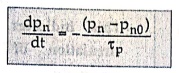
As concentration is not dependent on x and E = 0, the last two terms on right
hand side of the continuity equation become zero. Hence equation reduces as,
•
This is a differential equation interms of pn and the solution of
this equation is,
Pn‒Pn0 = Kq‒t/τp
where
K = Constant
•
τp is mean life time but also time constant of the above equation.
Key
Point: Thus τp can be defined as the time
taken by the injected concentration to fall to 36.78 % of its initial value.
2. Concentration Independent of Time and E = 0
•
As concentration is not dependent on t and E = 0, the left hand side of
continuity equation is zero and last term on right hand side is zero.
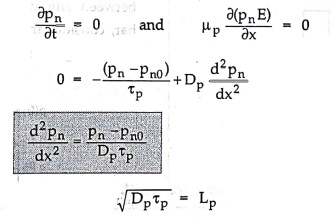
………. (1.17.14)
But
√[DPτP] = LP
= Diffusion length of holes
•
Hence the solution of the equation (1.17.14) takes the form,
Pn ‒ Pn0 = K1q‒x/LP
+ K2q‒x/LP
where
K1, K2 = Constantsis
3. Concentration Varies Sinusoidally with Time and E = 0
•
The injected concentration varies sinusoidally with an angular frequency of ω.
The sinusoidal variation is indicated in phasor form as,
Pn(x,
t) = Pn(x) qjwt
•
Substituting in continuity equation with E = 0,
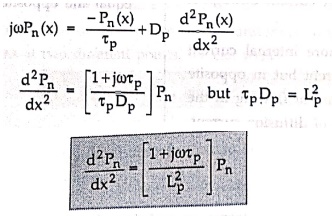
•
For zero frequency (ω = 0), the equation takes the form as obtained for special
case discussed in 1.17.2.
•
Hence a.c. solution for w ≠ 0 can be obtained from d.c. solution by replacing Lp
by Lp/√[1+jωτp]⋅
•
Thus continuity equation is the fundamental law governing the flow of charge.
Review
Question
1. State and explain the continuity equation.
Electron Devices: Chapter 1: Semiconductor : Tag: electronics : Semiconductor - Continuity Equation
Electron Devices: Chapter 1: Semiconductor
Under Subject

Electron Devices
EC25C01 2nd Semester ECE Dept | 2025 Regulation | 2nd Semester 2025 Regulation
Related Subjects

English Essentials II
EN25C02 2nd Semester | 2025 Regulation | 2nd Semester 2025 Regulation

Tamils and Technology தமிழர்களும் தொழில்நுட்பமும்
UC25H02 2nd Semester | 2025 Regulation | 2nd Semester 2025 Regulation

Linear Algebra
MA25C02 2nd Semester | 2025 Regulation
Electron Devices
EC25C01 2nd Semester ECE Dept | 2025 Regulation | 2nd Semester 2025 Regulation
Data Structures using CPlusPlus
CS25C05 2nd Semester ECE Dept | 2025 Regulation | 2nd Semester 2025 Regulation

Circuits and Network Analysis
EC25C02 2nd Semester ECE Dept | 2025 Regulation | 2nd Semester 2025 Regulation

Re-Engineering for Innovation
ME25C05 2nd Semester | 2025 Regulation | 2nd Semester 2025 Regulation
Engineering Drawing - Laboratory
ME25C01 2nd Semester | 2025 Regulation | 2nd Semester 2025 Regulation
Data Structures using CPlusPlus - Laboratory
CS25C05 2nd Semester ECE Dept | 2025 Regulation | 2nd Semester 2025 Regulation
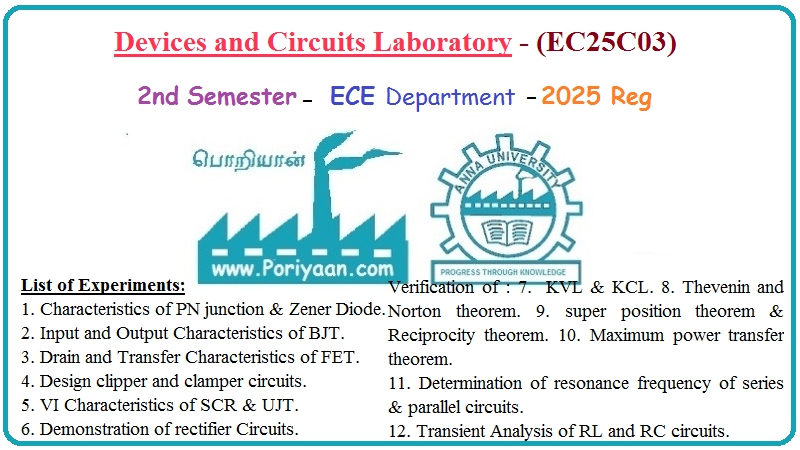
Devices and Circuits Laboratory
EC25C03 2nd Semester ECE Dept | 2025 Regulation | 2nd Semester 2025 Regulation