Electron Devices: Chapter 1: Semiconductor
Electron Hole Pairs
Semiconductor
Explain the concept of hole current.
Electron‒Hole
Pairs
•
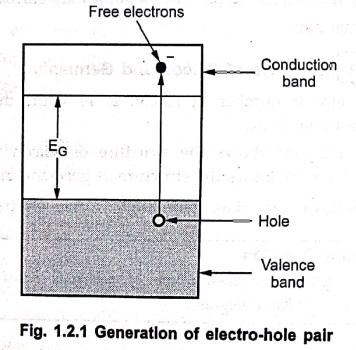
When a valence electron absorbs the energy, it becomes free electorn.
•
Thus a valence electron leaves the valence band and enters the conduction band.
•
When a valence electron drifts from the valence band, a vacancy is created in
the valence band. Such a vacancy is called a hole. As negative charged electron
leaves behind a hole, the hole is treated as positively charged.
•
Whenever an electron becomes free, a hole gets genereted in valence band.
•
Fig. 1.2.1 shows a formation of electro‒hole pair.
•
Such a generation of electro‒hole pairs due temperature is called thermal
thermal generation in semiconductors.
Concept of Hole Current
•
When a battery is connected to a semiconductor, free electrons move towards
positive of battery and constitute a current called an electron current. The
free electrons move in conduction band.
•
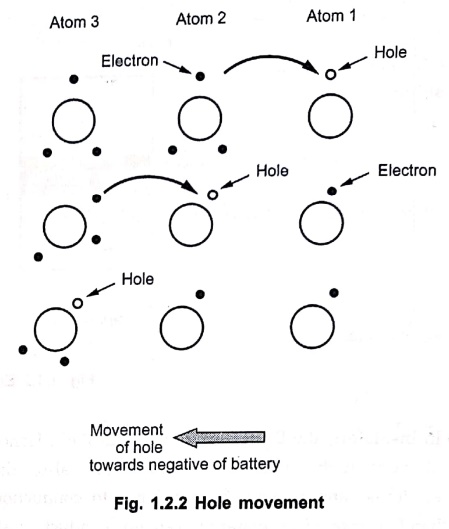
Consider three atoms as shown in Fig. 1.2.2.
•
There is a hole in atom 1. When battery is applied, electron from atom 2 shifts
into hole of atom 1, creating hole in atom 2.
• Then electron from atom 3 shifts into hole of atom 2 creating hole in atom 3.
•
Thus hole moves from atom 1 to atom 3 and like this it gets attracted towards
negative of battery.
•
As holes are positively charged, movement of hole constitutes a current called
hole current. The holes always move in valence band.
•
In semiconductors, the total current is combination of electron current and
hole current.
•
The direction of conventional current is always opposite to the direction of
free electrons i.e. from positive to negative of battery, external to the
battery.
Review Question
1. Explain the concept of hole current.
Electron Devices: Chapter 1: Semiconductor : Tag: electronics : Semiconductor - Electron Hole Pairs
Electron Devices: Chapter 1: Semiconductor
Under Subject

Electron Devices
EC25C01 2nd Semester ECE Dept | 2025 Regulation | 2nd Semester 2025 Regulation
Related Subjects
English Essentials II
EN25C02 2nd Semester | 2025 Regulation | 2nd Semester 2025 Regulation
Tamils and Technology தமிழர்களும் தொழில்நுட்பமும்
UC25H02 2nd Semester | 2025 Regulation | 2nd Semester 2025 Regulation
Linear Algebra
MA25C02 2nd Semester | 2025 Regulation
Electron Devices
EC25C01 2nd Semester ECE Dept | 2025 Regulation | 2nd Semester 2025 Regulation
Data Structures using CPlusPlus
CS25C05 2nd Semester ECE Dept | 2025 Regulation | 2nd Semester 2025 Regulation

Circuits and Network Analysis
EC25C02 2nd Semester ECE Dept | 2025 Regulation | 2nd Semester 2025 Regulation

Re-Engineering for Innovation
ME25C05 2nd Semester | 2025 Regulation | 2nd Semester 2025 Regulation
Engineering Drawing - Laboratory
ME25C01 2nd Semester | 2025 Regulation | 2nd Semester 2025 Regulation
Data Structures using CPlusPlus - Laboratory
CS25C05 2nd Semester ECE Dept | 2025 Regulation | 2nd Semester 2025 Regulation
Devices and Circuits Laboratory
EC25C03 2nd Semester ECE Dept | 2025 Regulation | 2nd Semester 2025 Regulation