Electron Devices: Chapter 1: Semiconductor
Drift Current and Diffusion Current
Semiconductor
Draw a diagram to illustrate drift current and diffusion current in a semiconductor material. Briefly explain.
Drift
Current and Diffusion Current
•
In a semiconductor the flow of current is due to two actions namely drift and
diffusion.
Drift Current
•
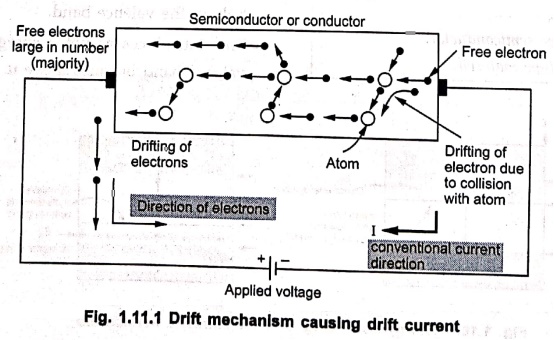
When a voltage is applied to a semiconductor, the free electrons try to move in
a straight line towards the positive terminal of the battery.
•
The electrons, moving towards positive terminal collide with the atoms of
semiconductor and connecting wires, along its way. Each time the electron
strikes an atom, it rebounds in a random direction.
•
But still the applied voltage make the electrons drift towards the positive
terminal. This drift causes current to flow in a semiconductor, under the
influence of the applied voltage.
• This current produced due to drifting of free electrons is called drift current and the velocity with which electrons drift is called drift velocity.
•
Thus drift current means the flow of current due to bouncing of electrons from
one atom to another, travelling from negative terminal to positive terminal of
the applied voltage.
Key
Point: The direction of conventional current is always
opposite to the direction of drifting te to the electrons.
•
This is shown in Fig. 1.11.1.
Diffusion Current
•
This is the current which is due to the transport of charges occurring because
of nonuniform concentration of charged particles in a semiconductor.
•
Consider a piece of semiconductor which is nonuniformly doped. Due doped. Due
to such nonuniform doping, one type of charge carriers occur at one end of a
piece of semiconductor.
•
The charge carriers are either electrons or holes, of one type depending upon
the impurity used.
•
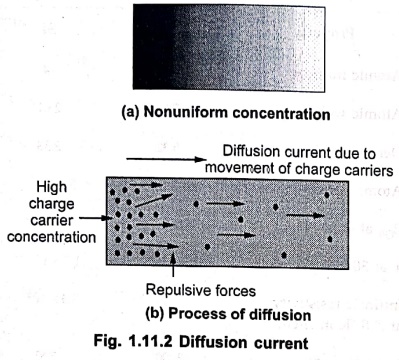
They have the same polarity and hence experience a force of repulsion between
them.
• The result is that there is a tendency of the charge carriers to move gradually i.e. to diffuse from the region of high carrier density to the low carrier density. This process is called diffusion.
•
This movement of charge carriers under the process of diffusion constitutes a
current called diffusion current. This is shown in Fig. 1.11.2.
•
The diffusion current continues till all the carriers are evenly distributed
throughout the material.
•
A diffusion current is possible only in case of nonuniformly doped
semiconductors while drift current is possible in semiconductors as well as
conductors.
Key
Point: The diffusion current exists without external
voltage applied while drift current can not exist without an external voltage
applied.
Review Question
1. Draw a diagram to illustrate drift current and diffusion
current in a semiconductor material. Briefly explain.
Electron Devices: Chapter 1: Semiconductor : Tag: electronics : Semiconductor - Drift Current and Diffusion Current
Electron Devices: Chapter 1: Semiconductor
Under Subject

Electron Devices
EC25C01 2nd Semester ECE Dept | 2025 Regulation | 2nd Semester 2025 Regulation
Related Subjects

English Essentials II
EN25C02 2nd Semester | 2025 Regulation | 2nd Semester 2025 Regulation

Tamils and Technology தமிழர்களும் தொழில்நுட்பமும்
UC25H02 2nd Semester | 2025 Regulation | 2nd Semester 2025 Regulation

Linear Algebra
MA25C02 2nd Semester | 2025 Regulation
Electron Devices
EC25C01 2nd Semester ECE Dept | 2025 Regulation | 2nd Semester 2025 Regulation
Data Structures using CPlusPlus
CS25C05 2nd Semester ECE Dept | 2025 Regulation | 2nd Semester 2025 Regulation

Circuits and Network Analysis
EC25C02 2nd Semester ECE Dept | 2025 Regulation | 2nd Semester 2025 Regulation

Re-Engineering for Innovation
ME25C05 2nd Semester | 2025 Regulation | 2nd Semester 2025 Regulation
Engineering Drawing - Laboratory
ME25C01 2nd Semester | 2025 Regulation | 2nd Semester 2025 Regulation
Data Structures using CPlusPlus - Laboratory
CS25C05 2nd Semester ECE Dept | 2025 Regulation | 2nd Semester 2025 Regulation
Devices and Circuits Laboratory
EC25C03 2nd Semester ECE Dept | 2025 Regulation | 2nd Semester 2025 Regulation