Computer Organization and Architecture: Chapter 3: Processor Design
Handling Data Hazards
Processor Design
Questions: 1. Describe the methods for dealing with data hazards. 2. Explain the ways and means of handling data hazard. 3. List the conditions to overcome data hazard. 4. What is a data hazard? How do you overcome it? And discuss its side effects. 5. Explain data hazard in detail. 6. Describe operand forwarding in a pipeline processor with a diagram. 7. Discuss the modified data path to accommodate pipelined executions with a diagram.
Handling
Data Hazards
1. Operand Forwarding
•
A simple hardware technique which can handle data hazard is called operand forwarding or register by passing.
•
In this technique, ALU results are fed back as ALU inputs. When the forwarding
logic detects the previous ALU operation has the operand for current
instruction, it forwards ALU output instead of register file.
•
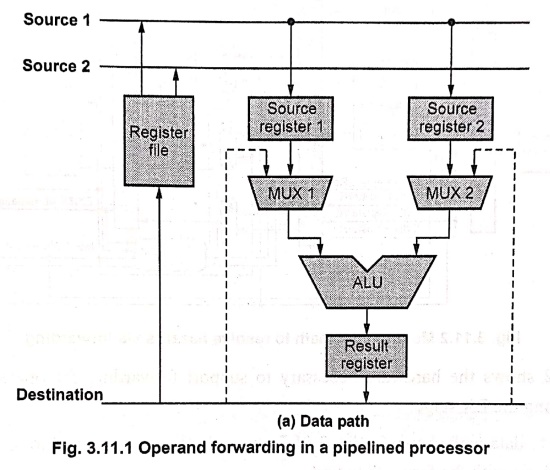
This is illustrated in Fig. 3.11.1. Fig. 3.11.1 (a) shows a portion of the
processor datapath involving the ALU and the register file.
•
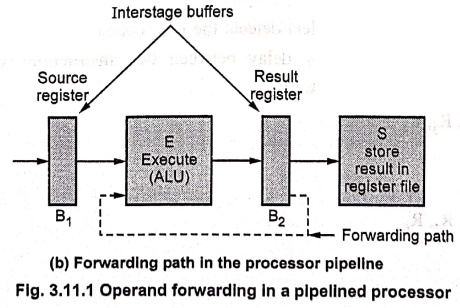
The source and result register constitute the interstage buffers needed for
pipelined operation, as shown in Fig. 3.11.1 (b).
•
The data forwarding mechanism is indicated by dashed lines.
•
The two multiplexers select the data for ALU either from destination bus or
from source 1 and source 2 registers.
•
When the forwarding logic detects data dependency, it forwards ALU output
available in the result register using data forwarding path to the ALU for the
next operation. Hence the execution of next (dependent) instruction proceeds
without interruption.
•
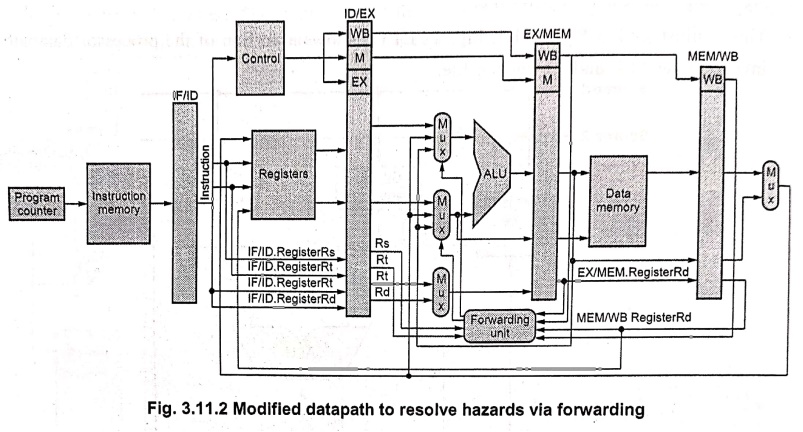
Fig. 3.11.2 shows the hardware necessary to support forwarding for operations
that use results during the EX stage.
•
Compared to data path shown in Fig. 3.11.7, the multiplexers are added to
provide inputs to the ALU along with the forwarding unit.
2. Handling Data Hazards in Software
•
In this approach, software (compiler) detects the data dependencies. If data
dependencies are found it introduces necessary delay between two instructions
by inserting NOP (no‒operation) instructions as follows:
I1
: MUL R2, R3, R4
NOP
NOP
ADD
R4, R5, R6
Disadvantages of adding NOP instructions
■
It leads to larger code size.
■
A given processor may have several hardware implementations. NOP instructions
inserted to satisfy the requirements of one implementation may not be needed
and hence would lead to reduce performance on a different implementation.
•
To achieve better performance, the compilers are designed such that they can
reorder instructions to perform useful task in the NOP slots.
Example: 1
Convert the following
code segment in C to MIPS instructions, assuming all variables are in memory
and are addressable as offsets from $t0 :
a = b+e ;
c = b+f ;
Solution :
lw
$t1, 0($t0)
lw
$t2, 4($t0)
add
$t3, $t1,$t2
sw
$t3, 12($t0)
lw
$t4, 8($t0)
add
$t5, $t1,$t4
sw
$t5, 16($t0)
Example: 2
Find the hazards in the
code segment of the previous example and reorder the instructions to avoid any
pipeline stalls.
Solution:
Both add instructions have a hazard because
of their respective dependence on the immediately preceding lw instruction. It is important to note
that bypassing eliminates several other potential hazards, including the
dependence of the first add on the
first lw and any hazards for store
instructions. Moving up the third lw instruction to become the third
instruction eliminates both hazards:
lw
$t1, 0($t0)
lw
$t2, 4($t0)
lw
$t4, 8($t0)
add
$t3, $t1,$t2
sw
$t3, 12($t0)
add
$t5, $t1,$t4
sw
$t5, 16($t0)
3. Side Effects
•
When destination register of the current instruction is the source register of
the next instruction there is a data dependency. Such data dependency is
explicit and it is identified by register name. There are some instruction that
change the contents of a register other than the one named as the destination.
For example, instruction (stack instructions: push or pop) that uses an
autoincrement or autodecrement addressing mode.
•
In autoincrement or autodecrement addressing mode, the instruction changes the
contents of a source register used to access one of its operands. In such
cases, we need to check data dependencies for registers affected by an
autoincrement or autodecrement operation along with the destination register.
•
When a location other than one explicitly named in an instruction as a destination
operand is affected, the instruction is said to have a side effect.
•
Another possible side effect involves the condition code flags, which are used
by instructions such as conditional branches and add‒with‒carry. Let us assume
that, R1 and R2 holds a double‒precision integer number
and R3 and R4 holds another double‒precision integer
number.
•
The addition of these two numbers may be accomplished as follows:
ADD
R1, R3
ADD
with Carry R2, R4
•
Even though register names are different, the dependency (implicit) exists
between these two instructions through the carry flag. This flag is Set/Reset
by the first instruction and used in the second instruction, which performs the
operation
R4
← [R2] + [R4] + Carry
Important Note
•
Instructions that have side effects give rise to multiple data dependencies,
which lead to a substantial increase in the complexity of the hardware or
software needed to resolve them. For this reason, instructions designed for
execution on pipelined hardware should have less side effects.
Example: 3
The following sequence
of instructions are executed in the basic 5 ‒ stage pipelined processor.
or rl, r2, r3
or r2, rl, r4
or rl, rl, r2
a) Indicate dependences
and their type.
b) Assume there is no
forwarding in this pipelined processor. Indicate hazards and add NOP
instructions to eliminate them.
c) Assume there is full
forwarding. Indicate hazards and add NOP instructions to eliminate them.
Solution:
a) Dependences and
their type
•
Read After Write (RAW) dependency in rl between Instructions 1, 2 and 3.
•
Read After Write (RAW) dependency in r2 between Instructions 2 and 3.
•
Write After Read (WAR) in r2 from Instruction 1 to 2.
•
Write After Read (WAR) in rl from Instruction 2 to 3.
•
Write After Read (WAR) in rl from Instruction 1 to 3.
b)
No hazards from write after read and write after write, since there are 5 stages.
Read after writes cause data hazards.
or
rl, r2, r3
NOP
NOP
or
r2, r1, r4
NOP
NOP
or
rl, rl, r2
c)
In full forwarding the data hazards above are eliminated, thus there is no need
for NOP instructions.
Review Questions
1. Describe the
methods for dealing with data hazards.
2. Explain the ways
and means of handling data hazard.
3. List the conditions
to overcome data hazard.
4. What is a data
hazard? How do you overcome it? And discuss its side effects.
5. Explain data hazard
in detail.
6. Describe operand
forwarding in a pipeline processor with a diagram.
7. Discuss the
modified data path to accommodate pipelined executions with a diagram.
Computer Organization and Architecture: Chapter 3: Processor Design : Tag: Computer : Processor Design - Handling Data Hazards
Computer Organization and Architecture: Chapter 3: Processor Design
Under Subject
Computer Organization and Architecture
CW25201 3rd Semester IT department. | 2025 Regulation | 3rd Semester 2025 Regulation
Related Subjects
Discrete Mathematics
MA25C14 3rd Semester CSE,IT,CY,AIDS departments. | 2025 Regulation | 3rd Semester 2025 Regulation
Data Structures
CS25C08 3rd Semester CSE,IT,CY,AIDS departments. | 2025 Regulation | 3rd Semester 2025 Regulation
Computer Organization and Architecture
CW25201 3rd Semester IT department. | 2025 Regulation | 3rd Semester 2025 Regulation
Object Oriented Programming
CS25C07 3rd Semester IT department. | 2025 Regulation | 3rd Semester 2025 Regulation
Web Technologies
IT25301 3rd Semester IT department. | 2025 Regulation | 3rd Semester 2025 Regulation
English Communication Skills Laboratory I
EN25C03 3rd Semester all department. | 2025 Regulation | 3rd Semester 2025 Regulation
Skill Development Course I
3rd Semester all department. | 2025 Regulation | 3rd Semester 2025 Regulation