Computer Organization and Architecture: Chapter 3: Processor Design
Processor Design: Two Marks Important Questions and Answers
Computer Organization and Architecture
Computer Organization and Architecture: Chapter 3: Processor Design: Anna University Part A Two Marks Important Questions and Answers
Computer Organization and Architecture
Chapter 3: Processor Design
Two Marks Questions with Answers
1. What
do you mean by asserted and deasserted?
Answer: Asserted word is
used to indicate a signal that is logically high and assert word specifies that
a signal should be driven logically high, and deassert or deasserted is used to
represent logically low.
2. What
is clocking methodology?
Answer: It is the
approach used to determine when data is valid and stable relative to the clock.
3. Define
control signal and data signal.
Answer: A signal used
for multiplexor selection or for directing the operation of a functional unit
is called control signal. On the other hand, the signal which contains
information that is operated on by a functional unit is called data signal.
4. Define
datapath.
Answer: Datapath is an unit
used to operate on or hold data within a processor. Its elements include the
instruction and data memories, the register file, the ALU and adders.
5. Define
register file.
Answer: All general
purpose registers are combined into a single block called the register file.
6. Draw
the datapath segment for arithmetic‒logic instructions.
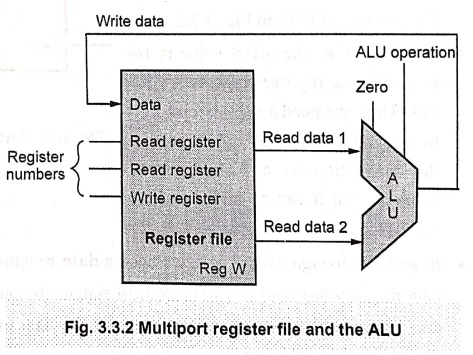
7. Draw
the datapth segment for computation of branch target address.
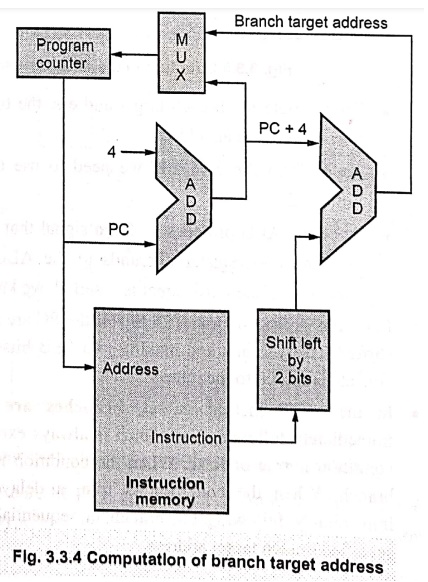
8. What
do you mean by delayed branch?
Answer: In the MIPS
instruction set, branches are delayed,
meaning that the instruction immediately following the branch is always
executed, independent of whether the branch condition is true or false. When
the condition is false, the execution looks like a normal branch. When the
condition is true, a delayed branch first executes the instruction immediately
following the branch in sequential instruction order before jumping to the
specified branch target address.
9. State
the adrantages of using multiple levels of decoding.
Answer: It reduces the
size of the main control unit.
Use
of several smaller control units may also potentially increase the speed of the
control unit.
10. Draw
the format of R‒type and branch instructions.
0000 ‒ AND
0001 ‒ OR
0010
‒
Add
0110 ‒ Subtract
0111 ‒ Set
on less than
1100 ‒ NOR
11. Draw
the format of load or store instruction.
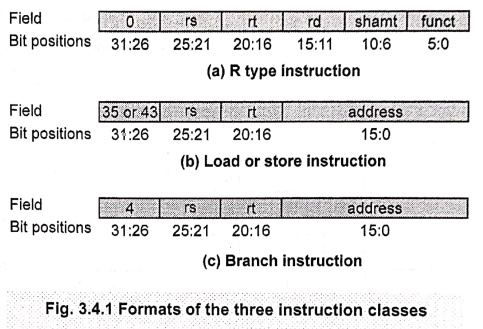
12. Draw
the format of jump instruction.
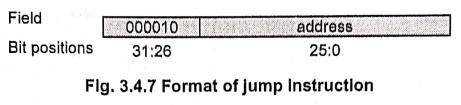
13. State
resons for not using single cycle implementation.
1.
It is inefficient. Because the longest possible path in the processor
determines the clock cycle. Remember that the clock cycle must have the same
length for every instruction in single‒cycle design.
2.
The overall performance of a single‒cycle implementation is likely to be poor,
since the clock cycle is too long.
3.
The penalty for using the single‒cycle design with a fixed clock cycle is
significant. Single‒cycle designs for floating‒point unit or an instruction set
with more complex instructions do not work well at all.
4. It do not improve the worst‒case cycle time. Thus it violates the great idea of making the common case fast.
14. What
is control store?
Answer: The
microroutines for all instructions in the instruction set of a computer are
stored in a special memory called the control store.
15. State
the advantages of hardwired control unit.
Answer:
•
Hardwired control unit is fast because control signals are generated by
combinational circuits.
•
The delay in generation of control signals depends upon the number of gates.
•
It has greater chip area efficiency since its uses less area on‒chip.
16. State
the disadvantages of hardwired control unit.
Answer:
•
More the control signals required by CPU; more complex will be the design of
control unit.
•
Modifications in control signal are very difficult. That means it requires
rearranging of wires in the hardware circuit.
•
It is difficult to correct mistake in original design or adding new feature in
existing design of control unit.
17. What
is microprogramming?
Answer: Microprogramming
is a method of control unit design in which the control signal selection and
sequencing information is stored in a ROM or RAM called a control memory CM.
18. What
is control memory?
Answer: A memory that is
part of a control unit is referred to as a control
memory. It stores the sequences of micro‒operations to be performed to
execute microinstructions.
19. Give
full form of CAR.
Answer: CAR stands for
Control Address Register.
20. What
is microprogram sequencing?
Answer: Determining the
address of the next microinstruction to be executed using microprogram
sequencer is called microprogram sequencing.
21. What
is address sequencing?
Answer: Each computer
instruction has its own microprogram routine in control memory to generate the
micro‒operations that execute the instruction. To execute a particular computer
instruction, accessing a corresponding microinstruction routine, sequencing the
microinstructions within the routine and if necessary branching from one
routine to another is known as address
sequencing.
22. What
is microinstruction?
Answer: Each word in the
control memory is a microinstruction which specifies the control signals to be
activated to perform one or more micro‒operations.
23. What
is microcode ?
Answer: The translation
of symbolic microprogram to binary produces a binary microprogram called microcode.
24. What
is microprogram ?
Answer: A sequence of
one or more micro‒operations designed to perform specific operation, such as
addition, multiplication is called a microprogram.
25. What
is Instruction‒Level Parallelism (ILP) ?
Answer: Instruction‒Level
Parallelism (ILP) is a technique that allows multiple independent instructions
from a single program to be executed simultaneously to improve processor
performance. It increases instruction throughput by overlapping or
parallelizing instruction execution.
26. What
is the main goal of ILP ?
Answer: The main goal of
ILP is to improve the speed and efficiency of program execution by identifying
and executing independent instructions in parallel rather than sequentially.
27. State
any two benefits of ILP.
Answer:
1.
Increases instruction throughput ‒ more instructions are completed per unit
time.
2.
Reduces overall program execution time by overlapping instruction execution.
28. What
are the challenges in implementing ILP ?
Answer:
• Instruction
dependencies : Some instructions depend on results of
previous ones. Resource
• limitations :
Limited number of functional units to execute instructions.
• Control complexity :
Managing dependencies and execution order increases hardware complexity.
29. List
and briefly explain two techniques used to achieve ILP.
Answer:
1. Pipelining: Divides
instruction execution into stages so multiple instructions can be processed
simultaneously in different stages.
2. Out‒of‒order
execution : Allows instructions to execute as soon
as their operands are ready, regardless of original program order.
30. What
is the difference between pipelining and superscalar execution?
Answer:
• Pipelining
overlaps stages of multiple instructions within a single pipeline.
•
Superscalar execution uses multiple
pipelines or execution units to execute multiple instructions in the same clock
cycle.
31. What
is data forwarding in ILP ?
Answer: Data forwarding
(also called bypassing) is a technique that allows the result of one
instruction to be used directly by the next instruction without waiting for it
to be written back to a register, reducing execution delays.
32. What
is pipeline register?
Answer: The control data
register holds the present microinstruction while the next address is computed
and read from memory. This data register is sometimes called a pipeline register. It allows the
execution of micro‒operations specified by the control word and the generation
of the next microinstruction simultaneously.
33. Define
pipelining.
Answer: Pipelining is a
technique of decomposing a sequential process into sub operations with each sub
process being executed in a special dedicated segment that operates
concurrently with all other segments.
34. Mention
the various types of pipelining.
Answer: Types of
pipelining are : Instruction pipelining and arithmetic pipelining.
35. What
is instruction pipelining?
Answer: Performing
fetch, decode and execute cycles for several instructions simultaneously to
reduce overall processing time is referred to as instruction pipelining.
36. List
the four stages in the instruction pipelining.
OR
Mention
the various phases in executing an instruction.
Answer: The four stages
in the instruction pipelining are:
S1 ‒Fetch
(F) : Read instruction from the memory.
S2 ‒ Decode
(D) : Décode the opcode and fetch source operand (s) if
necessary.
S3 ‒Execute
(E) : Perform the operation specified by the instruction.
S4 ‒Store
(S) : Store the result in the destination.
37. What
is the ideal speed‒up expected in a pipelined architecture with 'n' stages ?
Justify your answer. (Refer example 3.9.2)
38. What
is meant by hazard in pipelining?
Answer: Any reason that
causes the pipeline to stall is called a hazard.
39. List
the different types of hazards.
Answer: The different
types of instruction hazards are:
1.
Structural hazards.
2.
Data or data dependent hazards.
3.
Instruction or control hazards.
40. What is structural hazard ?
Answer: The hazard that
exist because of conflicts due to insufficient resources when even with all
possible combination, it may not be possible to overlap the operation is called
structural hazard. 41. What is instruction or control hazard?
Answer: The hazard due
to pipelining branch and other instructions that change the contents of program
counter is called instruction or control hazard.
42. What
is pipeline scheduling ?
Answer: Rather than
allowing the pipeline to stall, the compiler can rearrange instructions to
avoid data hazard. It is called pipeline
scheduling.
43. What
is delayed load and delayed slot ?
Answer: A load which
requires that the following instruction do not use its result is said to be delayed load and the pipeline slot
after load instruction is called delayed
slot.
44. How
addressing modes affect the instruction pipelining?
Answer: Degradation of
performance is an instruction pipeline may be due to address dependency where
operand address cannot be calculated without available information needed by
addressing mode for e.g. an instructions with register indirect mode cannot
proceed to fetch the operand if the previous instructions is loading the
address into the register. Hence operand access is delayed degrading the
performance of pipeline.
45. How
compiler is used in pipelining?
Answer: A compiler
translates a high level language program into a sequence of machine
instructions. The number of cycles required to execute program is dependent not
only on the choice of instruction, but also on the order in which they appear
in the program. The compiler may rearrange program instruction to achieve
better performance of course, such changes must not affect of the result of the
computation.
46. What
is loop buffer?
Answer: A loop buffer is
a small very high speed memory. It is used to store recently prefetched
instructions in sequence. If conditional branch is valid, the hardware first
checks whether the branch target is within the loop buffer. If so, the next
instructions are fetched from the buffer, instead of memory avoiding memory
access.
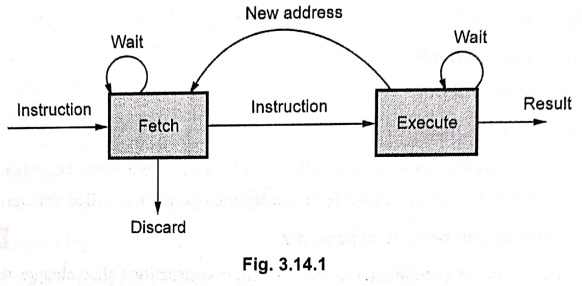
47. Draw
the structure of two stage instruction pipe line.
Answer: Fig. 3.14.1
shows the structure of two stage instruction pipe line.
48. What
would be the effect, if we increase the number of pipelining stages?
Answer: As the number of
pipeline stages increases, the probability of the pipeline being stalled also
increases because more instructions are being executed concurrently. Thus,
dependancies between instructions that are far apart may still cause the
pipeline to stall.
As
the number of pipeline stages increase, the branch penalties may become more
significant. 49.
What are the advantages of pipelining?
Answer:
1.
The instruction cycle time of the processor is reduced increasing, instruction
throughput.
2.
Increase in pipeline stages increase number of instructions that can be
processed at once which reduces delay between completed instructions.
50. What
is meant by pipeline bubble / pipeline stall ?
Answer: Pipeline bubble
or pipeline stall is a delay in execution of an instruction in an instruction
pipeline in order to resolve a hazard.
51. What
is datapath element ?
Answer: Datapath element
is unit used to operate on or hold data within a processor. In the MIPS
implementation, the datapath elements include the instruction and data
memories, the register file, the ALU and adders.
52. Name
the control signals required to perform arithmatic operation.
Answer: Control signals
RegDst, RegWrite and ALUop1 are required to perform arithmetic operation.
53. What
is data hazard in pipelining? What are the solutions?
Answer: When either the
source or the destination operands of an instruction are not available at the
time expected in the pipeline and as a result pipeline is stalled, we say such
a situation is a data hazard.
1.
The easiest way to handle data hazards is to stall the pipeline.
2.
The second simple hardware technique which can handle data hazard is called forwarding or register by passing.
54. What
are the classification of data hazards ?
Answer: The data hazard
can be classified as,
1. RAW
(Read After Write) hazard.
2. WAW
(Write After Write) hazard.
3. WAR
(Write After Read) hazard.
55. What
is the use of condition code register?
Answer: The conditional
branch instruction checks the condition code flags to decide the flow of
program execution.
56. What
do you mean by out‒of order execution ?
Answer: The dispatch
unit dispatches the instructions in the order in which they appear in the
program. But their execution may be completed in the different order because of
data dependency among the instructions. Such situation is called out‒of order
execution.
57. What
is instruction throughput ?
Answer: The instruction
throughput is the number of instructions executed per second. For sequential
execution, it is given by,
Ps
= R/S.
where
R is a clock rate measured in clocks per second and S is the average number of
steps needed to execute one machine instruction.
58. Why
is branch prediction algorithm needed?
Answer: Branch
prediction algorithm is needed to reduce the branch penalty.
59. List
commonly used branch prediction techniques.
Answer: The commonly
used branch prediction techniques are:
•
Predict never taken
•
Predict always taken
•
Predict by opcode
•
Taken / not taken switch
•
Branch History Table.
60. Name
the two types of branch prediction strategies.
Answer: The two types of
branch prediction strategies are:
•
Static branch strategy.
•
Dynamic branch strategy.
61. What
is branch target / prediction buffer?
Answer: The buffer in
which the recent branch information is stored is called branch target buffer.
62. What
is branch folding?
Answer: The instruction
fetch unit has executed the branch instruction concurrently with the execution
of other instructions. This technique is referred to as branch folding.
63. What
is delayed branching?
Answer: A technique
called delayed branching can minimize the penalty incurred as a result of
conditional branch instructions. The idea is simple. The instructions in the
delay slots are always fetched. Therefore, we would like to arrange for them to
be fully executed whether or not the branch is taken. The objective is to be
able to place useful instructions in these slots. If no useful instructions can
be placed in the delay slots, these slots must be filled with NOP instructions.
64. What
is meant by speculative execution?
Answer: Speculative
execution means that instructions are executed before the processor is certain
that they are in the correct execution sequence. Hence, care must be taken that
no processor registers or memory locations are updated until it is confirmed
that these instructions should indeed be executed. If the branch decision
indicates otherwise, the instructions and all their associated data in the
execution units must be purged, and the correct instructions fetched and
executed.
65. What
is called static and dynamic branch prediction ?
OR
Differentiate
between the static and dynamic techniques.
Answer: The branch
prediction decision is always the same every time a given instruction is
executed. Any approach that has this characteristic is called static branch
prediction. Another approach in which the prediction decision may change
depending on execution history is called dynamic branch predictionsion.
66. What
is the role of cache in pipelining?
Answer: Each pipeline
stage is expected to complete in one clock cycle. The clock period should be
long enough to let the slowest pipeline stage to complete. Faster stages have
to wait for the slowest one to complete. Since main memory is very slow
compared to the execution, if each instruction needs to be fetched from main
memory, pipeline is almost useless. The cache memory reduces the memory access
time and makes pipelining useful.
67. What
is imprecise and precise exception?
Answer: Situation in
which one or more of the succeeding instructions have been executed to
completion is called imprecise exception. Situation in which all subsequent
instructions that may have been partially executed are discarded. This is
called a precise exception.
68. What
is exception ?
Exceptions
are internally generated unscheduled events that disrupt program execution and
they are used to detect overflow. On the other hand, interrupt comes from
outside of the processor.
Arithmetic
overflow, invoking the operating system from user program and using an
undefined instruction are internally generated events and hence called
exceptions.
69. What
is meant by exception ? Give one example of MIPS exception.
Exceptions
are internally generated unscheduled events that disrupt program execution and they
are used to detect overflow. On the other hand, interrupt comes from outside of
the processor.
Arithmetic
overflow, invoking the operating system from user program and using an
undefined instruction are internally generated events and hence called exceptions.
Hardware
malfunctions may be either externally generated event or internally generated
event and called either interrupt or exception.
Computer Organization and Architecture: Chapter 3: Processor Design : Tag: Computer : Computer Organization and Architecture - Processor Design: Two Marks Important Questions and Answers
Computer Organization and Architecture: Chapter 3: Processor Design
Under Subject
Computer Organization and Architecture
CW25201 3rd Semester IT department. | 2025 Regulation | 3rd Semester 2025 Regulation
Related Subjects
Discrete Mathematics
MA25C14 3rd Semester CSE,IT,CY,AIDS departments. | 2025 Regulation | 3rd Semester 2025 Regulation
Data Structures
CS25C08 3rd Semester CSE,IT,CY,AIDS departments. | 2025 Regulation | 3rd Semester 2025 Regulation
Computer Organization and Architecture
CW25201 3rd Semester IT department. | 2025 Regulation | 3rd Semester 2025 Regulation
Object Oriented Programming
CS25C07 3rd Semester IT department. | 2025 Regulation | 3rd Semester 2025 Regulation
Web Technologies
IT25301 3rd Semester IT department. | 2025 Regulation | 3rd Semester 2025 Regulation
English Communication Skills Laboratory I
EN25C03 3rd Semester all department. | 2025 Regulation | 3rd Semester 2025 Regulation
Skill Development Course I
3rd Semester all department. | 2025 Regulation | 3rd Semester 2025 Regulation