Computer Programming C: UNIT I: Introduction to C
Algorithms
C Programming
It is defined as “a sequence of instructions designed in such a way that, if the instructions are executed in the specified sequence, the desired results will be obtained", thus the algorithm should be precise and unambiguous in practice and the results should be obtained after a finite number of steps.
ALGORITHMS
1. INTRODUCTION
After
the preparation of a suitable plan for developing the program by its logic,
i.e. the correct sequence and procedure of instructions required to carry out
the task, the algorithm is often used to refer the logic of a program. It is
one of the basic tools used to develop the problem solving.
• It is defined as “a sequence of instructions designed in such
a way that, if the instructions are executed in the specified sequence, the
desired results will be obtained", thus the algorithm should be precise
and unambiguous in practice and the results should be obtained after a finite
number of steps.
• It is also defined as "any problem whose solution can be
expressed in a list of executable instruction". By executing, we mean an
instruction which an independent executor can actually perform or carry out in
a step‒by‒step manner.
2. CHARACTERISTICS OF ALGORITHMS
In
order to qualify an algorithm in a sequence of instructions, it must possess
the following characteristics.
•
The algorithm should be written in sequence.
•
It looks like normal English.
•
In the algorithms, each and every instruction should be precise and
unambiguous.
•
The instructions in an algorithm should not be repeated infinitely. Ensure that
the algorithm will ultimately terminate.
•
The desired result should be obtained only after the algorithm terminates.
3. QUALITIES OF A GOOD ALGORITHM
There
are so many methods or logics available to solve the problem individually. All
of those methods and logics may not be good, for a given problem there may be
so many algorithms not of all equality.
•
Identify Main Steps/Processes: Break down the problem‒solving process
into its main steps or subtasks.
•
Utilize Decision Points: If decisions lead to different paths or
outcomes, use decision symbols (like diamonds in flowcharts) to represent these
points and their consequences.
•
Add Descriptions and Details: Use clear and concise labels and
descriptive phrases to explain each step or decision point in the chart.
Relationship with other problem‒solving tools
Problem
Analysis Charts often work in conjunction with other problem‒solving
•
Flowcharts: PACs can provide the structured analysis that is then
visually represented in a flowchart, showing the sequence of steps and
decisions in a problem's solution.
•
Algorithms: Algorithms, which are step‒by‒step procedures, are often
derived from the analysis and structure provided by a PAC.
By
using Problem Analysis Charts and integrating them with tools like flowcharts
and algorithms, individuals and teams can approach problem‒solving in a
structured and efficient manner, leading to more organized and understandable
solutions.
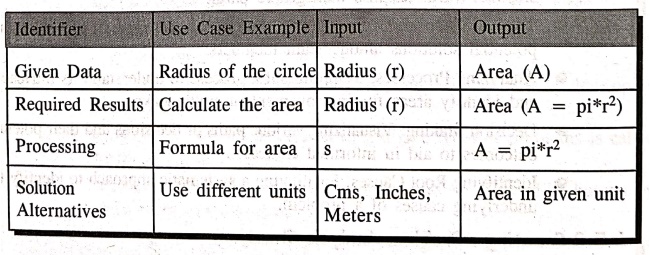
Example:
Problem Analysis Chart: Area of a Circle
The
following are the primary factors that are often used to judge the quality of
the algorithms.
Factors:
Quality of good Algorithm
1.
Time: To execute a program, the computer system takes some amount of
time. The lesser is the time required, the better is the algorithm.
2.
Memory: To execute a program, computer system takes some amount of
memory storage. The lesser is the memory required, the better is the algorithm.
3.
Accuracy: Multiple algorithms may provide suitable or correct solutions
to a given problem, some of these may provide more accurate results than
others, such algorithms may be suitable.
4.
Sequence: The procedure of an algorithm must form in a sequence and some
of the instructions of an algorithm may be repeated a number of times or until
a particular condition is met.
5.
Generality: The designed algorithm must solve a single isolated problem
and more often algorithms are designed to handle a range of input data to meet
these criteria, so the algorithms must be generalised.
Computer Programming C: UNIT I: Introduction to C : Tag: Computer Science : C Programming - Algorithms
Computer Programming C: UNIT I: Introduction to C
Under Subject
Computer Programming C
CS25C01 1st Semester | 2025 Regulation | 1st Semester 2025 Regulation
Related Subjects

English Essentials I
EN25C01 1st Semester | 2025 Regulation | 1st Semester 2025 Regulation

தமிழர் மரபு - Heritage of Tamils
UC25H01 1st Semester | 2025 Regulation | 1st Semester 2025 Regulation
Applied Calculus
MA25C01 Maths 1 M1 - 1st Semester | 2025 Regulation | 1st Semester 2025 Regulation
Applied Physics I
PH25C01 1st Semester | 2025 Regulation | 1st Semester 2025 Regulation

Applied Chemistry I
CY25C01 1st Semester | 2025 Regulation | 1st Semester 2025 Regulation
Makerspace
ME25C04 1st Semester | 2025 Regulation | 1st Semester 2025 Regulation
Computer Programming C
CS25C01 1st Semester | 2025 Regulation | 1st Semester 2025 Regulation
Computer Programming Python
CS25C02 1st Semester | 2025 Regulation | 1st Semester 2025 Regulation
Fundamentals of Electrical and Electronics Engineering
EE25C03 1st Semester EEE Depart | 2025 Regulation | 1st Semester 2025 Regulation
Introduction to Mechanical Engineering
ME25C03 1st Semester Mechanical Dept | 2025 Regulation | 1st Semester 2025 Regulation

Introduction to Civil Engineering
CE25C01 1st Semester Civil, Agri Departments | 2025 Regulation | 1st Semester 2025 Regulation
Essentials of Computing
CS25C03 1st Semester - AIDS, CSE, CSE(CY), IT Department | 2025 Regulation | 1st Semester 2025 Regulation

Applied Physics I Laboratory
PH25C01 1st Semester practical Laboratory Manual | 2025 Regulation | 1st Semester Laboratory 2025 Regulation

Applied Chemistry I Laboratory
CY25C01 1st Semester practical Laboratory Manual | 2025 Regulation | 1st Semester Laboratory 2025 Regulation

Computer Programming C Laboratory
CS25C01 1st Semester EEE, ECE, CSE, CSE(CY), AIDS, IT practical Laboratory Manual | 2025 Regulation | 1st Semester Laboratory 2025 Regulation

Computer Programming Python Laboratory
CS25C02 1st Semester practical Laboratory Manual | 2025 Regulation | 1st Semester Laboratory 2025 Regulation
Engineering Drawing
ME25C01 EEE, Mech, Agri, EEE Depts | 2025 Regulation | 2nd Semester 2025 Regulation

Basic Electronics and Electrical Engineering
EE25C04 1st Semester ECE Dept | 2025 Regulation | 1st Semester 2025 Regulation
Essentials of Computing - Laboratory
CS25C03 1st Semester AIDS, CSE, CSE(CY), IT Depts | practical Laboratory Manual | 2025 Regulation | 1st Semester 2025 Regulation