Computer Programming C: UNIT I: Introduction to C
Introduction to Programming Paradigims
C Programming
1. Introduction 2. Why programming languages? 3. High level languages 4. History of 'C' language 5. Features and applications of 'C' language
INTRODUCTION TO PROGRAMMING
PARADIGIMS
1. INTRODUCTION
Usually
computer software may be classified into application software and system
software. Application software is the set of programs necessary to carry out
operations for specific applications. System software are the general programs
written for the system, which provide the environment to facilitate the writing
of application software. Programming language translators are the best example
of system software.
2. WHY PROGRAMMING LANGUAGES?
The
purpose of using computers is to solve problems, which are difficult to solve
manually. So the computer user must concentrate on the development of good
algorithms for solving problems. After preparing the algorithms, the programmer
has to concentrate the programming language which is understandable by the
computer.
Computer
programming languages are developed with the primary objectives of facilitating
a large number of people to use computer without the need to know the details
of internal structure of the computer.
Languages
are matched to the type of operation to be performed in algorithms for various
applications. Languages are also designed to be machine independent.
3. HIGH LEVEL LANGUAGES
This
section describes some of the popular high level languages and the areas of
their applications.
FORTRAN:
It stands for FORmula TRANslation, which is the oldest high level language.
This language was developed by John
Backus and his team at IBM in 1956‒57. The main aim behind the development
of this language is to solve scientific and engineering applications. The first
version of this language was used in 1950s and early 1960s it was known as
FORTRAN‒II, next popular version was FORTRAN‒IV. In 1977, the FORTRAN77 was
released which was more powerful than its predecessors.
COBOL:
It stands for Common Business Oriented Language. The work of this language
began in 1959 in USA, department of defense under the guidance of Grace Murray
Hooper, and further it is maintained by CODASYL (COnfereance ‒on DAta SYstem.
Language). The first formal COBOL was published in 1960 and revised in 1965 and
this version was gradually enhanced. ANSI has standardized COBOL in 1968, 1974
and in 1984. Currently COBOL is a widely used programming language for business
data processing.
BASIC:
It stands for Beginners All Purpose Symbolic Instruction Code, developed in
Darmouth College, USA in 1963 by Dr.John G.Kemeny and Thomas E.Kurtz. It is
developed for the users who are starting their learning in computers and it can
be learnt quickly.
PASCAL:
It is named after the French mathematician Blaise Pascal and it is designed and
developed by Nickolus Wirth in 1971. The main objective behind this language
development was, to allow beginners to learn good problem solving and programming
methods.
'C' Language:
The following chapters elaborates details about the 'C' Programming language.
4. HISTORY OF 'C' LANGUAGE
'C'
is one of the most popular programming languages, it was developed by Dennis
Ritchie at AT & T's Bell Laboratories at USA in 1972. It is an upgraded
version of two earlier languages, called BCPL and B, which were also developed
at Bell laboratories.
The
root map for all modern computer languages is started through the ALGOL
language, in early 1960's after then COBOL was being used for commercial
applications, FORTRAN was being developed for scientific Applications. At this
stage, people started thinking about the single language which can program all
possible applications.
A
committee was formed to develop a new language called Combined Programming
Language (CPL) at Cambridge University. It seemed to abstract. too general
another language called Basic Combined Programming Language (BCPL) was
developed by Martin Richards at Cambridge University with some additional features
than CPL.
At
the same time, a language called 'B' was developed by Ken Thompson at AT &
T's Bell labs. But like BCPL and B turned out to be very specific, Dennis
Ritchie developed a language with some additional features of BCPL and B which
is very simple, relatively good programming efficiency and a relatively good
machine efficiency called 'C' language, consequently the ANSI (American
National Standard Institute) has begun to work on a standardised definition of
'C' Language to make it still powerful.
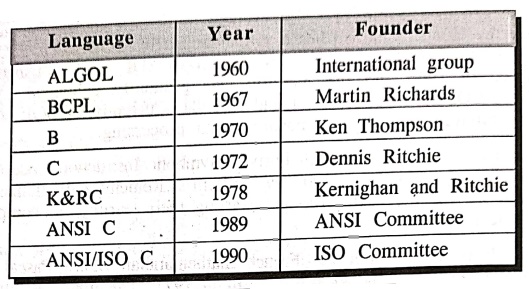
The
following table illustrates the history of "C" Language.
5. FEATURES AND APPLICATIONS OF 'C' LANGUAGE
i)
'C' is a general purpose, powerful, efficient, compact and flexible structured
programming language.
ii)
'C' is highly portable (i.e., It can be run in different operating systems
environments).
iii)
'C' is a robust language whose rich set of built in functions and operators can
be used to write any complex program.
iv)
'C' has the ability to extend itself. We can continuously add our own functions
to the existing library functions.
v)
'C' is well suited for writing system software as well as application software.
vi)
'C' program can be run on different operating systems of the different
computers with little or no alteration.
vii)
'C' is a middle level language, i.e. it supports both the low level language
and high level language features.
viii)
'C' language allows reference to a memory allocation with the help of pointers,
which holds the address of the memory location.
ix)
'C' language allows dynamic memory allocation i.e. a program can request the
operating system to allocate or release memory at runtime.
x)
'C' language allows manipulation of data at the lowest level. This feature is
extensively useful in writing system software program.
xi)
'C' is a widely available, commercial 'C' compilers are available on most PC's.
xii)
'C' programs are fast and efficient, has got rich set of operators.
xiii)
'C' can be applied in systems programming areas like Compilers, Interpreters
and Assemblers etc.
Computer Programming C: UNIT I: Introduction to C : Tag: Computer Science : C Programming - Introduction to Programming Paradigims
Computer Programming C: UNIT I: Introduction to C
Under Subject
Computer Programming C
CS25C01 1st Semester | 2025 Regulation | 1st Semester 2025 Regulation
Related Subjects

English Essentials I
EN25C01 1st Semester | 2025 Regulation | 1st Semester 2025 Regulation

தமிழர் மரபு - Heritage of Tamils
UC25H01 1st Semester | 2025 Regulation | 1st Semester 2025 Regulation
Applied Calculus
MA25C01 Maths 1 M1 - 1st Semester | 2025 Regulation | 1st Semester 2025 Regulation
Applied Physics I
PH25C01 1st Semester | 2025 Regulation | 1st Semester 2025 Regulation

Applied Chemistry I
CY25C01 1st Semester | 2025 Regulation | 1st Semester 2025 Regulation
Makerspace
ME25C04 1st Semester | 2025 Regulation | 1st Semester 2025 Regulation
Computer Programming C
CS25C01 1st Semester | 2025 Regulation | 1st Semester 2025 Regulation
Computer Programming Python
CS25C02 1st Semester | 2025 Regulation | 1st Semester 2025 Regulation
Fundamentals of Electrical and Electronics Engineering
EE25C03 1st Semester EEE Depart | 2025 Regulation | 1st Semester 2025 Regulation
Introduction to Mechanical Engineering
ME25C03 1st Semester Mechanical Dept | 2025 Regulation | 1st Semester 2025 Regulation

Introduction to Civil Engineering
CE25C01 1st Semester Civil, Agri Departments | 2025 Regulation | 1st Semester 2025 Regulation
Essentials of Computing
CS25C03 1st Semester - AIDS, CSE, CSE(CY), IT Department | 2025 Regulation | 1st Semester 2025 Regulation

Applied Physics I Laboratory
PH25C01 1st Semester practical Laboratory Manual | 2025 Regulation | 1st Semester Laboratory 2025 Regulation

Applied Chemistry I Laboratory
CY25C01 1st Semester practical Laboratory Manual | 2025 Regulation | 1st Semester Laboratory 2025 Regulation

Computer Programming C Laboratory
CS25C01 1st Semester EEE, ECE, CSE, CSE(CY), AIDS, IT practical Laboratory Manual | 2025 Regulation | 1st Semester Laboratory 2025 Regulation

Computer Programming Python Laboratory
CS25C02 1st Semester practical Laboratory Manual | 2025 Regulation | 1st Semester Laboratory 2025 Regulation
Engineering Drawing
ME25C01 EEE, Mech, Agri, EEE Depts | 2025 Regulation | 2nd Semester 2025 Regulation

Basic Electronics and Electrical Engineering
EE25C04 1st Semester ECE Dept | 2025 Regulation | 1st Semester 2025 Regulation
Essentials of Computing - Laboratory
CS25C03 1st Semester AIDS, CSE, CSE(CY), IT Depts | practical Laboratory Manual | 2025 Regulation | 1st Semester 2025 Regulation