Computer Programming C: UNIT I: Introduction to C
C Programming: Expressions
An expression represents data item such as variables, constants and are interconnected with operators as per the syntax of the language.
EXPRESSIONS
1. INTRODUCTION
An
expression represents data item such as variables, constants and are
interconnected with operators as per the syntax of the language. An expression
is evaluated using assignment operator.
Syntax:
variable=expression;
Description:
Any 'c'
valid variable and expression.
Example: x=a*b‒c;
In
the above statement the expression evaluated first from left to right. After
the evaluation of the expression the final value is assigned to the variable
from right to left.
Example:
y=(a/b)+c;
z=(a*b)‒d;
The
blank space around an operator is optional and adds only to improve readability
of the program. The variables that are used in an expression must be declared
at the declaration part of the program.
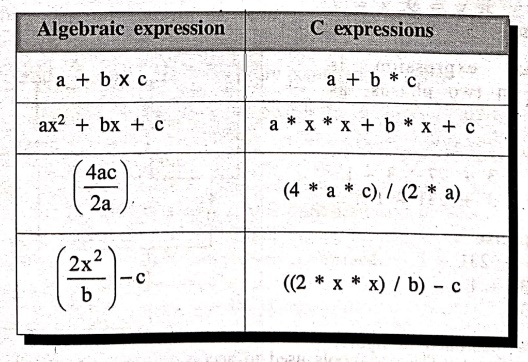
Examples
of Algebraic expressions and C expressions
2. OPERATOR PRECEDENCE AND ASSOCIATIVITY OF OPERATORS
Precedence
is used to determine the order in which different operators in a complex
expression are evaluated.
Associativity
is used to determine the order in which operators with same precedence are
evaluated in a complex expression.
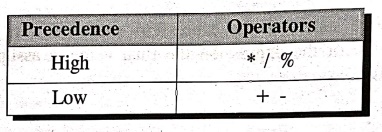
1. Arithmetic Operators Precedence
Usually
the Arithmetic Operators are evaluated from left to right using the precedence
of operators when the expression is written without the parameters. The
Arithmetic Operator precedence
The
Arithmetic expression evaluation is carried out using the two phases from left
to right through the expression.
First Phase:
The highest priority operators are evaluated in the expression.
Second Phase:
The lowest priority operators are evaluated in the expression.
Examples:
result
= x ‒ y/3 + z * 3 ‒ 1
where,
x = 3, y = 9, z = 77
sum
= 3 ‒ 9/3 + 77 * 3 ‒ 1
This
expression is revalued in two phases, as follows:
First phase :
sum
= 3‒3+ 77 * 3 ‒ 1
sum
= 3‒3+ 231 ‒ 1
Second phase:
sum
= 0 + 231 ‒ 1
sum
= 231 ‒ 1
sum
= 230
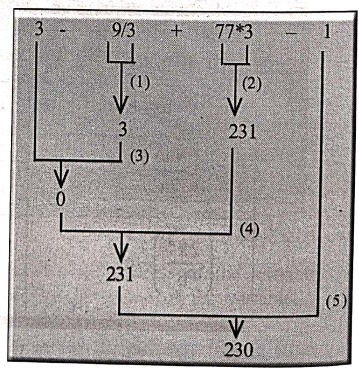
This
is illustrated in figure.
However,
during the evaluation of expression, the order of evaluation can be changed by
putting the parenthesis in an expression.
Example
:
(3‒9)
/ 3 + 77 * (3 ‒1)
‒
6/3 + 77 * (3 ‒ 1)
‒
6/3 + 77 * 2
‒
2 + 154
=
152
2. Rules for evaluation of expression
a)
Evaluate the sub expressions from left to right if parenthesized.
b)
Evaluate the arithmetic expression from left to right using the rules of
precedence.
c)
The highest precedence is given to the expressions with in parenthesis.
d)
Apply the associative rule, if more operators of the same precedence occurs.
e)
Evaluate the inner most sub expression if the parenthesis are nested.
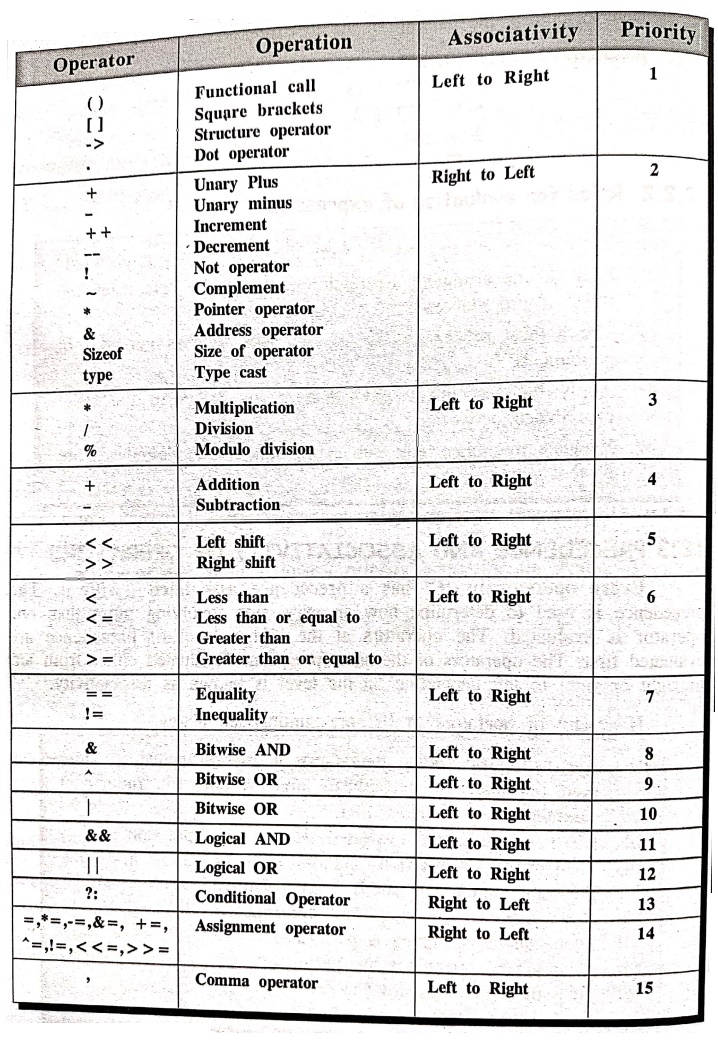
3. PRECEDENCE AND ASSOCIATIVITY OF OPERATORS
Every
operator in 'C' has a precedence associated with it. The precedence is used to
determine how an expression involving more than one operator is evaluated. The
operators at the higher level of precedence are evaluated first. The operators
of the same precedence evaluated either from left to right or right to left
depending on the level is known as associativity.
Hierarchy
of operators in 'C' are summarised below.
i)
Any expression within parenthesis is first evaluated, if more than one pair of
parenthesis are present, the innermost parenthesis is evaluated first.
ii)
Unary operators are evaluated first in an expression.
iii)
Then priority is given for multiplication and division.
iv)
Then subtraction and addition are performed.
v)
Then relational operations are performed.
vi)
Then equality checking is performed.
vii)
Then logical operations are performed.
viii)
Then the conditions are checked.
ix)
Finally the assignment operation is carried out.
Summary of 'C' operators precedence
and associativity
Computer Programming C: UNIT I: Introduction to C : Tag: Computer Science : - C Programming: Expressions
Computer Programming C: UNIT I: Introduction to C
Under Subject
Computer Programming C
CS25C01 1st Semester | 2025 Regulation | 1st Semester 2025 Regulation
Related Subjects

English Essentials I
EN25C01 1st Semester | 2025 Regulation | 1st Semester 2025 Regulation

தமிழர் மரபு - Heritage of Tamils
UC25H01 1st Semester | 2025 Regulation | 1st Semester 2025 Regulation
Applied Calculus
MA25C01 Maths 1 M1 - 1st Semester | 2025 Regulation | 1st Semester 2025 Regulation
Applied Physics I
PH25C01 1st Semester | 2025 Regulation | 1st Semester 2025 Regulation

Applied Chemistry I
CY25C01 1st Semester | 2025 Regulation | 1st Semester 2025 Regulation
Makerspace
ME25C04 1st Semester | 2025 Regulation | 1st Semester 2025 Regulation
Computer Programming C
CS25C01 1st Semester | 2025 Regulation | 1st Semester 2025 Regulation
Computer Programming Python
CS25C02 1st Semester | 2025 Regulation | 1st Semester 2025 Regulation

Fundamentals of Electrical and Electronics Engineering
EE25C03 1st Semester EEE Depart | 2025 Regulation | 1st Semester 2025 Regulation

Introduction to Mechanical Engineering
ME25C03 1st Semester Mechanical Dept | 2025 Regulation | 1st Semester 2025 Regulation

Introduction to Civil Engineering
CE25C01 1st Semester Civil, Agri Departments | 2025 Regulation | 1st Semester 2025 Regulation
Essentials of Computing
CS25C03 1st Semester - AIDS, CSE, CSE(CY), IT Department | 2025 Regulation | 1st Semester 2025 Regulation

Applied Physics I Laboratory
PH25C01 1st Semester practical Laboratory Manual | 2025 Regulation | 1st Semester Laboratory 2025 Regulation

Applied Chemistry I Laboratory
CY25C01 1st Semester practical Laboratory Manual | 2025 Regulation | 1st Semester Laboratory 2025 Regulation

Computer Programming C Laboratory
CS25C01 1st Semester EEE, ECE, CSE, CSE(CY), AIDS, IT practical Laboratory Manual | 2025 Regulation | 1st Semester Laboratory 2025 Regulation

Computer Programming Python Laboratory
CS25C02 1st Semester practical Laboratory Manual | 2025 Regulation | 1st Semester Laboratory 2025 Regulation
Engineering Drawing
ME25C01 EEE, Mech, Agri, EEE Depts | 2025 Regulation | 2nd Semester 2025 Regulation

Basic Electronics and Electrical Engineering
EE25C04 1st Semester ECE Dept | 2025 Regulation | 1st Semester 2025 Regulation
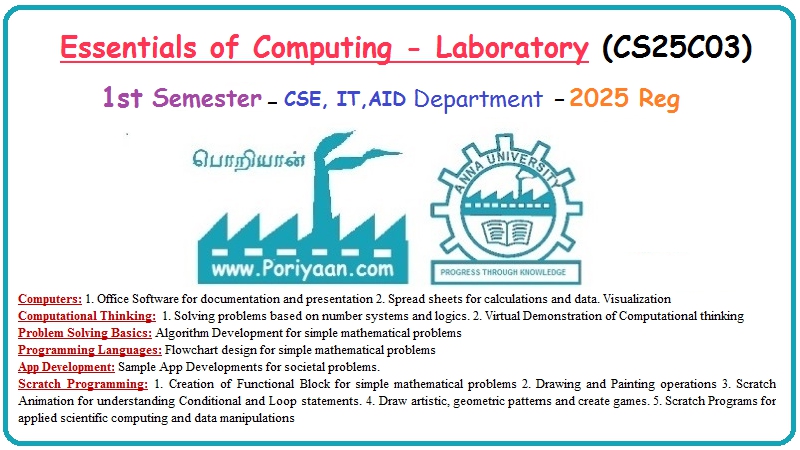
Essentials of Computing - Laboratory
CS25C03 1st Semester AIDS, CSE, CSE(CY), IT Depts | practical Laboratory Manual | 2025 Regulation | 1st Semester 2025 Regulation