Computer Programming C: UNIT I: Introduction to C
Problem Solving Through Algorithms, Flowcharts and Pseudocodes
C Programming
C Programs - Problem Solving Through Algorithms, Flowcharts and Pseudocodes
PROBLEM SOLVING THROUGH ALGORITHMS,
FLOWCHARTS AND PSEUDOCODES
Example 1: Write a program to find the area
and circumference of the circle.
Algorithm
Step
1: Start
Step
2: Input the radius of the circle
Step
3: Find the area and circumference of the circle using the formula Area ←3.14 *
r * r
circumference
← 2* 3.14 * r
Step
4: Print the area and circumference of the circle
Step
5: Stop
Pseudocode
Set
initial zero to Area, Circumference
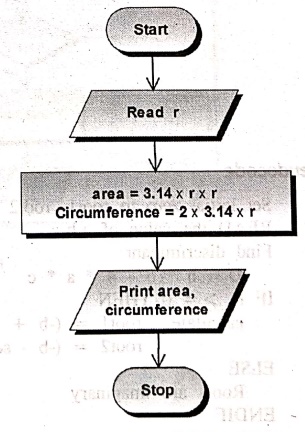
READ
the radius of the circle Find the area and circumference of the circle using
formula
Area
= 3.14 * r * r
Circumference
= 2 * 3.14 * r
WRITE
output of area and circumference of the circle
Example 2: Write a program to find the roots of the quadratic equation.
Algorithm
Step
1: Start
Step
2: Enter the value of a,b,c
Step
3: Find the value of 'D' of using the formula
D
← b * b ‒ 4 * a * c.
Step
4: If D is greater than or equal to zero then find the two roots are root 1 ← (‒b
+ sqrt(d)) / (2 * a)
root
2 ← (‒b‒sqrt(d)) / (2 * a)
Step
5: Print the two roots, root1, root2
Step
6: If D.is not greater than or equal to zero, then print the roots are
imaginary
Step
7: Stop
Flow
chart
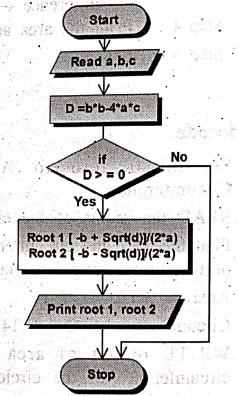
Pseudocode
Set
initial zero to rootl, root2
READ
the value of a,b,c
Find
discriminant
D
= b * b ‒ 4 * a * c
IF
D > = 0 THEN
calculate
root1 = (‒b + sqrt(D)) / (2 * a)
root2 = (‒b ‒ sqrt(D)) / (2 * a)
ELSE
Roots are imaginary
ENDIF
WRITE
root1, root2
Example 3: Write a program to find the factorial of the given number.
Algorithm
Step
1: Start
Step
2: Read the value of n
Step
3: Set initial values to Fact ← i ← 1
Step
4: Is i<= n else Goto Step 6
Step. 4.1 Fact ← Fact*i
Step 4.2 i ← i + 1
Step
5: Goto Step 4
Step
6: Print Fact
Step
7: Stop
Flow
chart
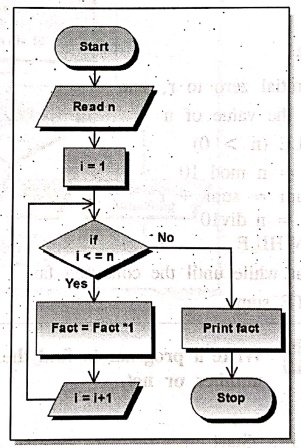
Pseudocode
Set
initial one to Fact, i
READ
n value to find Factorial
IF
(i<=n) THEN
Fact = Fact * i
i = i + 1
ENDIF
Example 4: Write a program to find the sum of the digits of a positive number.
Algorithm
Step
1: Start
Step
2: Enter the value of n
Step
3: Assign r ← 0, sum ← 0
Step
4: IF n>0 ELSE Goto step 6
Step
4: r←n mod 10
Step 4.2: sum ← sum + r
Step 4.3: n ← n div 10
Step
5: Goto Step 4
Step
7: Stop
Flowchart
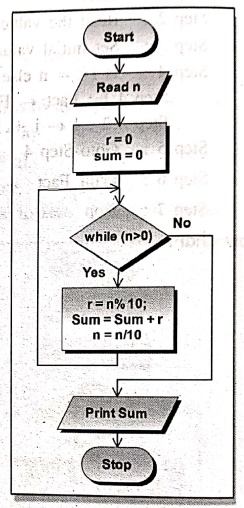
Pseudocode
Set
initial zero to r, sum
Read
the value of n
WHILE
(n > 0)
r = n mod 10
sum = sum + r
n =
n div10
ENDWHILE
Repeat
while until the condition fail
WRITE
sum
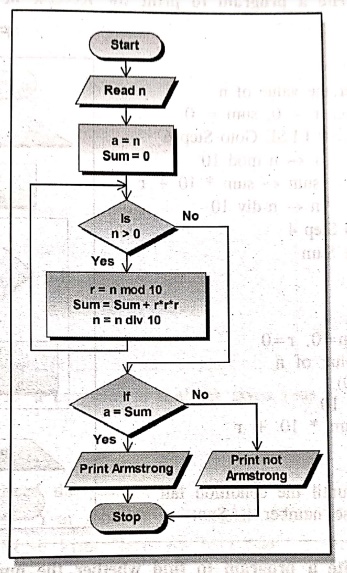
Example 5: Write a program to find the given number is an Armstrong number or not.
Algorithm
Step
1: Start
Step
2: Enter the value of n
Step
3: Assign a ←n, r = 0, sum = 0
Step
4: IF n>0 ELSE Goto Step 6
Step 4.1: r ← n mod 10
Step 4.2: sum ← sum + r * r * r
Step 4.3: n ← n div 10
Step
5: Goto Step 4
Step
6: IF a = sum THEN print Armstrong
ELSE print Not Armstrong
Step
7: Stop
Flow
chart
Pseudocode
Set
initial a=n, sum=0, r=0
READ
the value of n
WHILE
(n>0)
r = n % 10
sum = sum+r*r*r
n = n/10
ENDWHILE
Repeat
while until the condition fail
IF
(sum = = a) THEN
WRITE the result is Armstrong
ELSE
WRITE
the result is not Armstrong
ENDIF
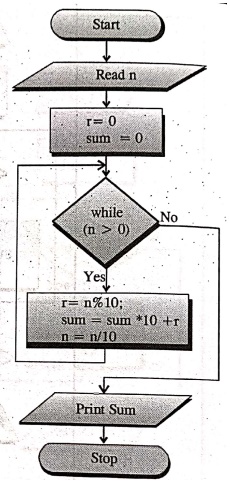
Example 6: Write a program to print the Reverse of a Number.
Algorithm
Step
1: Start
Step
2: Enter the value of n
Step
3: Assign r = 0, sum = 0
Step
4: IF n>0 ELSE Goto Step 6
Step 4.1: r ← n mod 10
Step 4.2: sum ← sum * 10 + r
Step 4.3: n ← n div 10
Step
5: Goto Step 4
Step
6 Print Sum
Step
7: Stop
Flow
chart
Pseudocode
Set
initial sum=0, r=0
READ
the value of n
WHILE
(n>0)
r = n % 10
sum = sum * 10 + r
n = n/10
ENDWHILE
Repeat
while until the condition fail
WRITE
reverse number is Sum
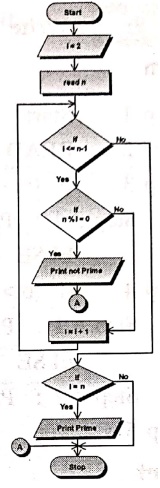
Example 7: Write a program to find whether the number is prime or not.
Algorithm
Step
1: Start
Step
2: Assign i← 2
Step
3: READ n
Step
4: REPEAT Steps 4.1, 4.2 UNTIL i <= n‒1
Step 4.1: IF (n mod i=0) THEN
Step 4.1.1: Print Not Prime
Step 4.1.2: Exit
Step 4.2: I ← i + 1
Step
5: IF (i=n) Then
Step
6: Print Prime
Step
7: Stop
Flow
chart
Pseudocode
Set
initial 2 to i
READ
n
IF
(i <= n‒1)
IF (n mod i=0)
WRITE "Not Prime".
EXIT
ENDIF
i
= i + 1
IF
(i=n)
WRITE "Prime"
ENDIF
ENDIF
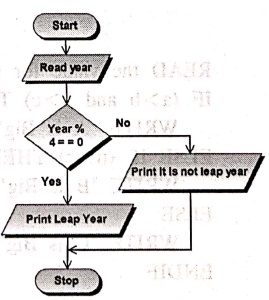
Example 8: Write a program to find the given year is a leap year or not.
Algorithm
Step
1: Start
Step
2: Read the year.
Step
3: IF (Year mod 4) = 0 THEN Print "it is a leap year"
ELSE Print "It is not leap
year"
Step
5: Stop
Flow
chart
Pseudocode
READ
the year
IF
(year % 4 = 0) THEN
WRITE the year is leap year
ELSE
WRITE the year is not a leap year
ENDIF
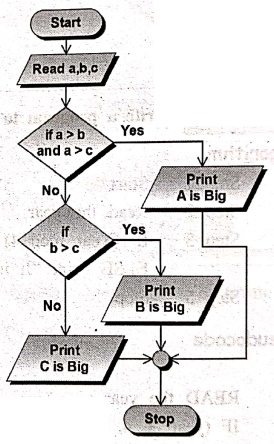
Example 9: Write a program to find the largest of three numbers.
Algorithm
Step
1: Start
Step
2: READ a,b,c
Step
3: IF (a>b) and (a>c) Then
Step 3.1: Print 'A is Big'
ELSE
Step
4: IF (b>c) Then
Step 4.1: Print 'B is Big'
ELSE
Step 4.2 Print 'C is Big'
Step
5: Stop
Flow
Chart
Pseudocode
READ
the value for a, b, с
IF
(a>b and a>c) THEN
WRITE 'A is Big'
ELSE
IF (b>c) THEN
WRITE
'B is Big'
ELSE
WRITE 'C is Big'
ENDIF
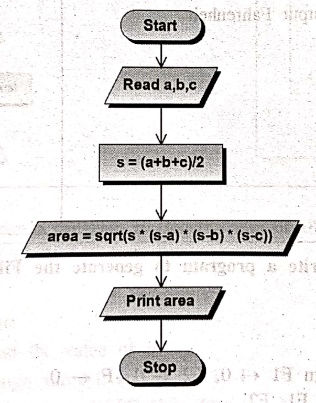
Example 10: Write a program to find area of the triangle.
Algorithm
Step
1: Start
Step
2: Read the value of a,b,c
Step
3: To calculate three sides of the triangle using formula
s ← (a+b+c)/2
Step
4: To find area of a triangle apply formula
area ← sqrt (s*(s‒a)*(s‒b)*(s‒c))
Step
5: Print the area
Step
6: Stop
Flow
chart
Pseudocode
READ
the value of a,b,c
To
calculate three sides of triangle using formula
s = (a+b+c)/2
To
find area of a triangle using formula
area=sqrt (s * (s‒a) * (s‒b) * (s‒c))
WRITE
output area
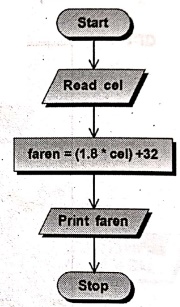
Example 11: Write a program to convert the Celsius into Fahrenheit.
Algorithm
Step
1: Start
Step
2: Read the Celsius value
Step
3: Calculate the Fahrenheit value by using the formula
Fahrenheit ← (1.8* Celsius) + 32.
Step
4: Print the Fahrenheit value
Step
5: Stop
Flow
chart
Pseudocode
READ
the value of Celsius
Calculate
Faren = (1.8* Celsius) + 32
WRITE
the output Fahrenheit
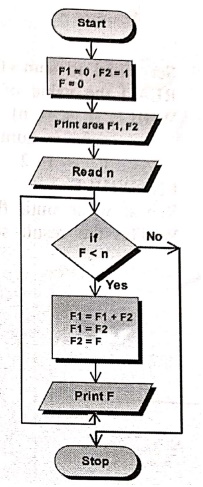
Example 12. Write a program to generate the Fibonacci series.
Algorithm
Step
1: Start
Step
2: Assign F1←0, F2 ← 1, F ← 0
Step
3: Print F1, F2
Step
4: F ← F1+F2
Step
5: READ n
Step
6: IF (F<n) ELSE Goto Step 8
Step 6.1: F ← F1 + F2
Step 6.2: F1 ← F2
Step 6.3: F2← Ƒ
Step 6.1: Print F
Step
7: Goto Step 6
Step
8: Stop
Flow Chart
Pseudocode
Set
inital zero to F1, F, one to F2
WRITE
F1, F2
F
= F1+F2
READ
n
WHILE
(F<N)
F = F1 + F2
F1 = F2
F2
= F
WRITE F
Repeat
while until the condition fail
ENDWHILE
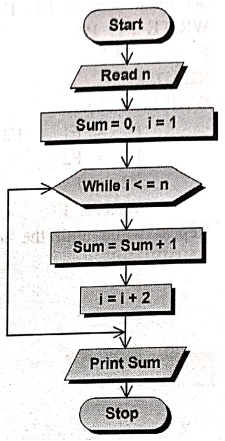
Example 13: Write a program to find the sum of all odd integers between 1 and n.
Algorithm
Step
1: Start
Step
2: Read the value of n
Step
3: Assign sum←0 and initial i<1
Step
4: IF i <= n ELSE Goto Step 6
Step 4.1: Sum←sum+i
Step 4.2: i←i + 2
Step
5: Goto Step 4
Step
6: Print sum
Step
7: Stop
Flow Chart
Pseudocode
Set
initial to sum=0, i=1
READ
the value of n
WHILE
(i <= n)
sum = sum+i
i= i+2
ENDWHILE
Repeat
while until the condition fail
WRITE
the result sum
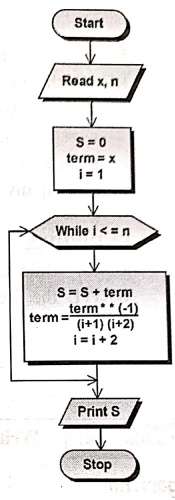
Example 14: Write a program to solve the series s = x ‒ x3/3! + x5/5! + x7/7! + xn/n!.
Algorithm
Step
1: Start
Step
2: Read the value of x, n
Step
3: Assign s←0, term←x, i←l
Step
4: The value of the term incremented to get next term and the term is added to
s
Step
5: s←s+ term
Step
6: term = term * x *x(‒1) / (i+1) (i+2)
Step
7: i ← i+2
Step
8: Repeat step 5 to step 7 WHILE (i <= n)
Step
9: Stop
Flow Chart
Pseudocode
Set
initial to s, term=x, i=1
WHILE
(i <= n)
s=s+term
term (term*x*x(‒1)/(i+1)*(i+2))
i = = i+2
ENDWHILE
Repeat
while until the condition fail
WRITE
the Result
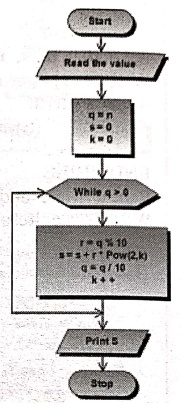
Example 15: Write a program to convert a binary number to decimal number.
Algorithm
Step
1: Start
Step
2: Read the binary value
Step
3: Initialise q←n, S←0, k←0
Step
4: Check whether (q>0)
Step
5: Calculate q=q % 10,
S=S+r* Pow (2,k), q=q/10, k++
Step
6: Print the value of s
Step
7: Stop
Flow Chart
Pseudocode
Set
initial q=n, s=0, k=0
READ
the binary value
WHILE
(q>0)
r = q mod 10
s = s+r * Pow(2, k)
q = q div 10
k = k+1
ENDWHILE
Repeat
while until the condition fail
WRITE
the Result
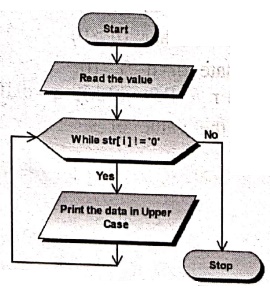
Example 16: Write a program to convert the string into upper case.
Algorithm
Step
1: Start
Step
2: Enter the string
Step
3: Set a loop up to the null character
Step
4: Print the character of the string in the upper case using to upper function
Step
5: After the execution of the loop and the program
Step
6: Stop
Flow
chart
Pseudocode
READ
the string
WHILE
(Str[i]! = '\0')
WRITE to upper case
i++
ENDWHILE
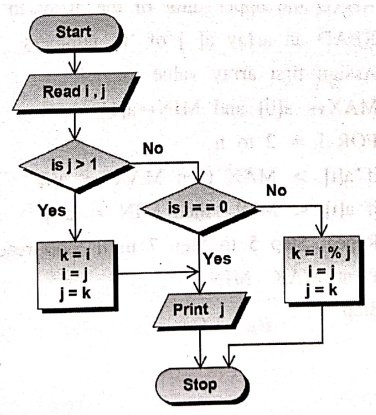
Example 17: Write a program to find the Greatest Common Division (GCD) of two given numbers.
Algorithm
Step
1: Start
Step
2: READ data into variable i,j
Step
3: Assign highest value to i and smallest to j
Step
4: If j equal to zero then i value is the GCD. Otherwise divide the i until j
equal to zero
Step
5: Print the resulted value as GCD
Step
6: Stop
Flow
chart
Pseudocode
Set
initial i, j
READ
the value for i, j
IF
(j<i)
k=i
i=j
j=k
ENDIF
ELSEIF
(j==0)
WRITE the GCD value
ELSE
k = i % j
i=j
j=k
ENDIF
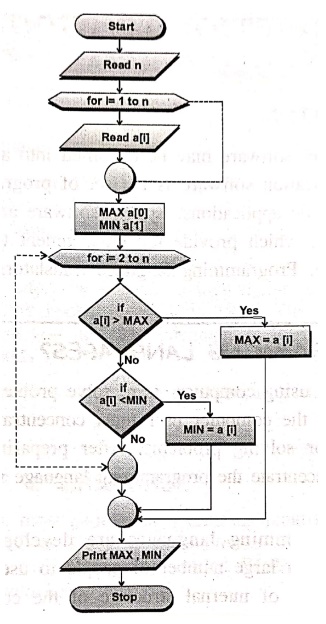
Example 18: Write a program to find minimum and maximum number from the list.
Algorithm
Step
1: Start
Step
2: READ the upper limit of the array 'n'
Step
3: READ an array a[] of 'n' numbers
Step
4: Assign first array value to
MAX ← a[0] and MIN←a[1]
Step
5: FOR I = 2 to n
Step
6: if a[i] > MAX then MAX = a[i]
Step
7: if a[i] < MIN then MIN = a[i]
Step
8: Repeat Step 5 to Step 7 until loop reached to 'n'
Step
9: Print MAX, MIN
Step
10: Stop
Flow
chart
Pseudocode
Set
initial i
READ
n
READ
an array a[] of 'n' numbers
Set
MAX = a[0], MIN=a[1]
FOR
i = 2 to n
IF a[i] > MAX then MAX=a[i]
IF a[i] < MIN then MIN=a[i]
end‒for
Print
MAX, MIN
Computer Programming C: UNIT I: Introduction to C : Tag: Computer Science : C Programming - Problem Solving Through Algorithms, Flowcharts and Pseudocodes
Computer Programming C: UNIT I: Introduction to C
Under Subject
Computer Programming C
CS25C01 1st Semester | 2025 Regulation | 1st Semester 2025 Regulation
Related Subjects

English Essentials I
EN25C01 1st Semester | 2025 Regulation | 1st Semester 2025 Regulation

தமிழர் மரபு - Heritage of Tamils
UC25H01 1st Semester | 2025 Regulation | 1st Semester 2025 Regulation
Applied Calculus
MA25C01 Maths 1 M1 - 1st Semester | 2025 Regulation | 1st Semester 2025 Regulation
Applied Physics I
PH25C01 1st Semester | 2025 Regulation | 1st Semester 2025 Regulation

Applied Chemistry I
CY25C01 1st Semester | 2025 Regulation | 1st Semester 2025 Regulation
Makerspace
ME25C04 1st Semester | 2025 Regulation | 1st Semester 2025 Regulation
Computer Programming C
CS25C01 1st Semester | 2025 Regulation | 1st Semester 2025 Regulation
Computer Programming Python
CS25C02 1st Semester | 2025 Regulation | 1st Semester 2025 Regulation
Fundamentals of Electrical and Electronics Engineering
EE25C03 1st Semester EEE Depart | 2025 Regulation | 1st Semester 2025 Regulation
Introduction to Mechanical Engineering
ME25C03 1st Semester Mechanical Dept | 2025 Regulation | 1st Semester 2025 Regulation

Introduction to Civil Engineering
CE25C01 1st Semester Civil, Agri Departments | 2025 Regulation | 1st Semester 2025 Regulation
Essentials of Computing
CS25C03 1st Semester - AIDS, CSE, CSE(CY), IT Department | 2025 Regulation | 1st Semester 2025 Regulation

Applied Physics I Laboratory
PH25C01 1st Semester practical Laboratory Manual | 2025 Regulation | 1st Semester Laboratory 2025 Regulation

Applied Chemistry I Laboratory
CY25C01 1st Semester practical Laboratory Manual | 2025 Regulation | 1st Semester Laboratory 2025 Regulation

Computer Programming C Laboratory
CS25C01 1st Semester EEE, ECE, CSE, CSE(CY), AIDS, IT practical Laboratory Manual | 2025 Regulation | 1st Semester Laboratory 2025 Regulation

Computer Programming Python Laboratory
CS25C02 1st Semester practical Laboratory Manual | 2025 Regulation | 1st Semester Laboratory 2025 Regulation
Engineering Drawing
ME25C01 EEE, Mech, Agri, EEE Depts | 2025 Regulation | 2nd Semester 2025 Regulation

Basic Electronics and Electrical Engineering
EE25C04 1st Semester ECE Dept | 2025 Regulation | 1st Semester 2025 Regulation
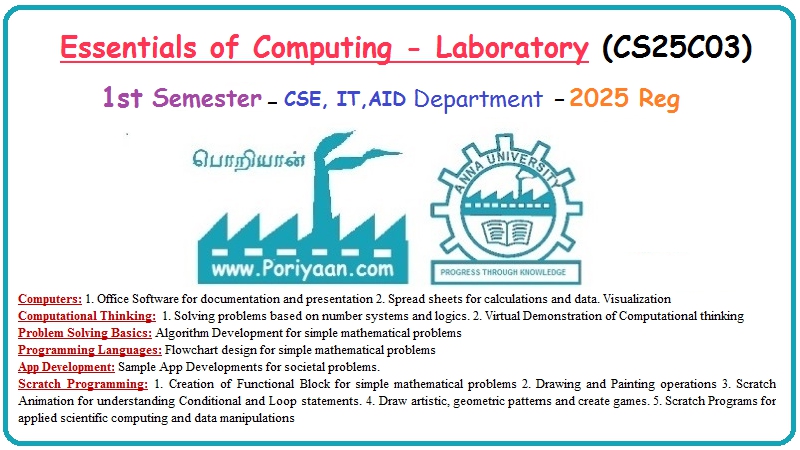
Essentials of Computing - Laboratory
CS25C03 1st Semester AIDS, CSE, CSE(CY), IT Depts | practical Laboratory Manual | 2025 Regulation | 1st Semester 2025 Regulation