Electron Devices: Chapter 6: Thyristors UJT and Optoelectronic Devices
Phototransistor
Construction, Working Principle, Operation, Characteristics, Applications

Questions: 1. Explain the construction and working principle of a phototransistor. 2. Draw and explain the characteristics of phototransistor. 3. State the applications of phototransistor and discuss any one in detail. 4. Write a note on phototransistor.
Phototransistor
•
A transistor providing internal current multiplication when exposed to light is
called phototransistor.
•
It has light sensitive collector to base junction. A lens is used so that the
base is exposed to the light.
•
The base collector area is kept large as it is light sensitive.
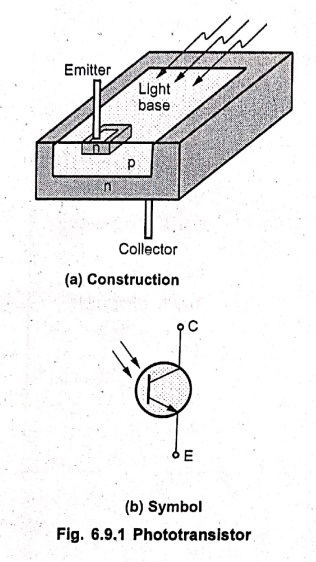
• The base terminal is generally not brought out hence phototransistor acts as a two terminal device.
•
The construction of a phototransistor is shown in Fig. 6.9.1 (a) while its
symbol is shown in Fig. 6.9.1 (b).
•
When no light is incident small leakage current flows from collector to emitter
called ICEO due to small thermal generation. This is called dark
current which is very small of the order of 10‒9 A.
•
When base is exposed to light, base current is produced due to generated
electron‒hole pairs. This is photocurrent. This is denoted as Iλ.
•
This produces collector current which is β times Iλ.
IC = βIλ
•
The base current Iλ increases as light intensity increases hence
collector current also increases with the light intensity.
Characteristics
•
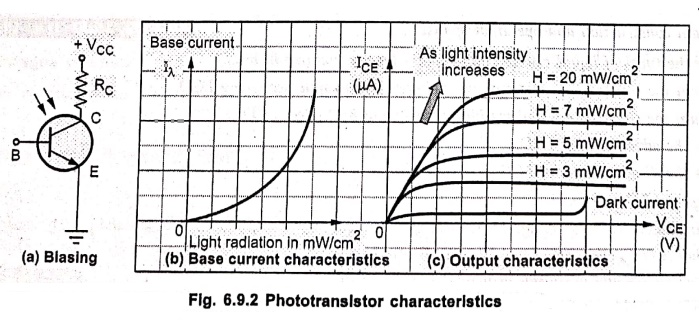
While biasing phototransistor, the base terminal is kept open.
•
The collector is connected to positive of supply through a resistance RC.
•
While the emitter is grounded as shown in Fig. 6.9.2 (a).
•
As light intensity increases, the base current Iλ increases. This is
shown in Fig. 6.9.2 (b).
•
The output characteristics are shown in the Fig. 6.9.2 (c) which shows that as
the intensity of the light increases (H) then the collector current also
increases.
•
The phototransistor speed is good but not as fast as photodiode.
•
If the base terminal is brought out, the phototransistor can be used as a
conventional transistor.
Applications
•
The various applications of phototransistor are,
1.
In computer logic circuits.
2.
In level indicators and relays.
3.
In punch card readers.
4.
In alarm systems.
5.
In various opto electronic systems like counting systems, smoke detector
circuits intrusion detector circuits, etc.
•
Let us discuss few phototransistor applications in detail :
1. Light Operated Relay Circuit
•
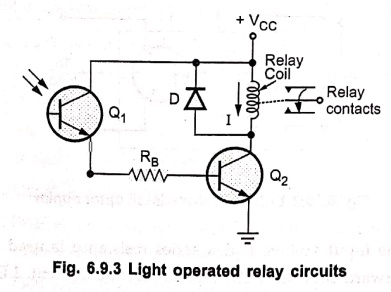
The light operated relay circuit using phototransistor is shown in Fig. 6.9.3.
•
The transistor Q1 is a phototransistor while the transistor Q2
is the conventional BJT.
•
When the incident light is enough, the Q1 conducts heavily which
drives the Q2 into saturation. Hence collector current through the
coil, enerzises the relay.
•
The diode acts as a protecting device which protects Q2 from large
voltage transient to occur at the collector of Q2, when the
transistor turns off.
2. Darkness Operated Relay Circuit
•
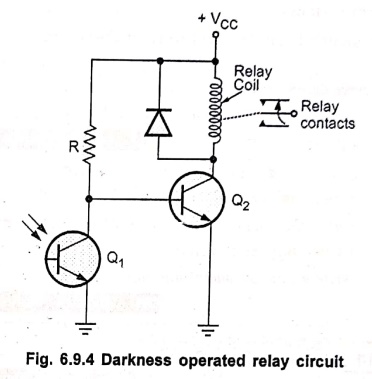
The darkness operated relay circuit also can be constructed in the similar
fashion which is used to de‒enerzise the relay coil. The circuit is shown in
Fig. 6.9.4.
•
When there is dark, the transistor Q2 remains properly biased,
keeping relay coil energized.
•
When there is enough light, the phototransistor Q1 turns on which
reduces forward bias of base‒emitter junction of Q2, turning it off.
This de‒energizes the relay.
3. Light Interruption System
•
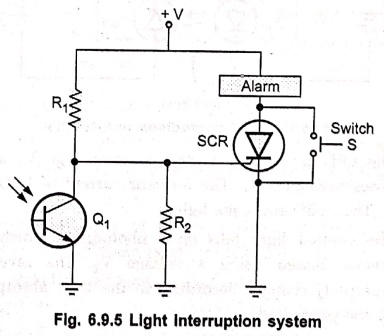
The phototransistor is also used in the alarm circuits. One such light
interruption system using phototransistor is shown in Fig. 6.9.5.
•
Normally the phototransistor is ON and which holds the gate of SCR low hence
keeping it OFF.
•
When the light is interrupted, the phototransistor Q1 becomes OFF.
The high voltage swing at collector of Q1 turns SCR ON. This
activates the alarm system.
•
The switch S can be used to reset the alarm.
Review Questions
1. Explain the construction and working principle of a
phototransistor.
2. Draw and explain the characteristics of phototransistor.
3. State the applications of phototransistor and discuss any one
in detail.
4. Write a note on phototransistor.
Electron Devices: Chapter 6: Thyristors UJT and Optoelectronic Devices : Tag: electronics : Construction, Working Principle, Operation, Characteristics, Applications - Phototransistor
Electron Devices: Chapter 6: Thyristors UJT and Optoelectronic Devices
Under Subject

Electron Devices
EC25C01 2nd Semester ECE Dept | 2025 Regulation | 2nd Semester 2025 Regulation
Related Subjects

English Essentials II
EN25C02 2nd Semester | 2025 Regulation | 2nd Semester 2025 Regulation

Tamils and Technology தமிழர்களும் தொழில்நுட்பமும்
UC25H02 2nd Semester | 2025 Regulation | 2nd Semester 2025 Regulation
Linear Algebra
MA25C02 2nd Semester | 2025 Regulation
Electron Devices
EC25C01 2nd Semester ECE Dept | 2025 Regulation | 2nd Semester 2025 Regulation

Data Structures using CPlusPlus
CS25C05 2nd Semester ECE Dept | 2025 Regulation | 2nd Semester 2025 Regulation

Circuits and Network Analysis
EC25C02 2nd Semester ECE Dept | 2025 Regulation | 2nd Semester 2025 Regulation

Re-Engineering for Innovation
ME25C05 2nd Semester | 2025 Regulation | 2nd Semester 2025 Regulation
Engineering Drawing - Laboratory
ME25C01 2nd Semester | 2025 Regulation | 2nd Semester 2025 Regulation

Data Structures using CPlusPlus - Laboratory
CS25C05 2nd Semester ECE Dept | 2025 Regulation | 2nd Semester 2025 Regulation
Devices and Circuits Laboratory
EC25C03 2nd Semester ECE Dept | 2025 Regulation | 2nd Semester 2025 Regulation