Basic Electronics and Electrical Engineering: Chapter 4: Synchronous Machines
Brushless DC Motor (BLDC Motor)
Construction, Operation
The term BLDC motor is applied to a specific class of AC synchronous motors in which semiconductor control is used to control stator currents so that a rotating torque is available to rotate the rotor without the use of brush and commutator.
BRUSHLESS
DC MOTOR (BLDC Motor)
The term BLDC motor is
applied to a specific class of AC synchronous motors in which semiconductor
control is used to control stator currents so that a rotating torque is
available to rotate the rotor without the use of brush and commutator. Solid
state switching devices like thyristors, IGBT or transistors triggered by rotor
position sensors can replace the brush and commutator arrangement as in
conventional DC motors by fully electronic processes.
Construction
The stator of the BLDC
motor is similar to that of a conventional reduction motor. The stator has a
three‒phase winding which is star connected. The stator core is made up of
silicon steel stompings which are stacked together and fixed on the stator
frame. The stator windings are supplied through a variable voltage current
source inverter (CSI) insure a sequence that they produce a rotating magnetic
field around the airgap. The rotor in a BLDC motor is of salient pole permanent
magnet type.
Position sensors paced
on the rotor shaft provide signals to the control and gate drive circuit which
cause the SCRS in the inverted circuit to be triggered in proper sequence so as
to be in synchronism with the rotor's mechanical position. The stator and rotor
fields thus get locked to each other and remain in synchronism at any and every
rotor speed. The schematic diagram of a BLDC motor along with its drive system
is shown in Fig. 4.26
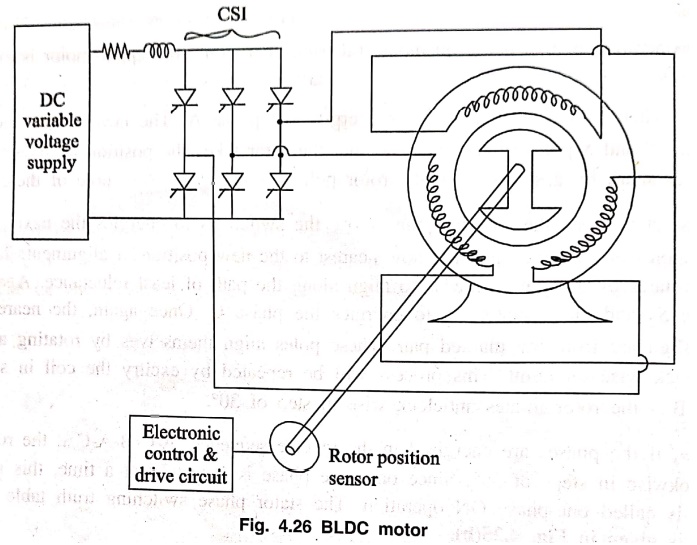
Commonly used rotor
position sensors are Hall‒effect sensors and optical sensor consisting of LEDs
and photo transistors.
Operation
When supply is switched
on, current flows through the armature winding whose distribution depends on
the rotor position and switching ON the devices at various instants. Due to the
interaction between current and magnetic field, rotor experiences torque, and
if this torque is greater than the load torque, rotor starts moving, BLDC motor
is thus a self‒starting motor. As the rotor moves, a relative velocity exists
between the rotor and the stator. This results in the emf induction in armature
winding whose direction is opposite to the applied voltage. Due to this back
emf, a momentary change in torque and speed will occur. The armature draws more
current and increases the torque and hence the speed returns to the some value.
These changes are very fast and the performance is not affects.
Basic Electronics and Electrical Engineering: Chapter 4: Synchronous Machines : Tag: Basic Engineering : Construction, Operation - Brushless DC Motor (BLDC Motor)
Basic Electronics and Electrical Engineering: Chapter 4: Synchronous Machines
Under Subject

Basic Electronics and Electrical Engineering
EE25C04 1st Semester ECE Dept | 2025 Regulation | 2nd Semester 2025 Regulation
Related Subjects

English Essentials I
EN25C01 1st Semester | 2025 Regulation | 1st Semester 2025 Regulation

தமிழர் மரபு - Heritage of Tamils
UC25H01 1st Semester | 2025 Regulation | 1st Semester 2025 Regulation
Applied Calculus
MA25C01 Maths 1 M1 - 1st Semester | 2025 Regulation | 1st Semester 2025 Regulation
Applied Physics I
PH25C01 1st Semester | 2025 Regulation | 1st Semester 2025 Regulation

Applied Chemistry I
CY25C01 1st Semester | 2025 Regulation | 1st Semester 2025 Regulation
Makerspace
ME25C04 1st Semester | 2025 Regulation | 1st Semester 2025 Regulation
Computer Programming C
CS25C01 1st Semester | 2025 Regulation | 1st Semester 2025 Regulation
Computer Programming Python
CS25C02 1st Semester | 2025 Regulation | 1st Semester 2025 Regulation
Fundamentals of Electrical and Electronics Engineering
EE25C03 1st Semester | 2025 Regulation | 1st Semester 2025 Regulation
Introduction to Mechanical Engineering
ME25C03 1st Semester | 2025 Regulation | 1st Semester 2025 Regulation

Introduction to Civil Engineering
CE25C01 1st Semester Civil Department | 2025 Regulation | 1st Semester 2025 Regulation
Essentials of Computing
CS25C03 1st Semester - AID CSE IT Department | 2025 Regulation | 1st Semester 2025 Regulation

Applied Physics I Laboratory
PH25C01 1st Semester practical Laboratory Manual | 2025 Regulation | 1st Semester Laboratory 2025 Regulation

Applied Chemistry I Laboratory
CY25C01 1st Semester practical Laboratory Manual | 2025 Regulation | 1st Semester Laboratory 2025 Regulation

Computer Programming C Laboratory
CS25C01 1st Semester practical Laboratory Manual | 2025 Regulation | 1st Semester Laboratory 2025 Regulation

Computer Programming Python Laboratory
CS25C02 1st Semester practical Laboratory Manual | 2025 Regulation | 1st Semester Laboratory 2025 Regulation
Engineering Drawing
ME25C01 EEE Mech Dept | 2025 Regulation | 2nd Semester 2025 Regulation
Basic Electronics and Electrical Engineering
EE25C04 1st Semester ECE Dept | 2025 Regulation | 2nd Semester 2025 Regulation