Electron Devices: Chapter 2: PN Junction Diodes
Effect of Temperature on PN Junction Diode Behaviour
Questions: 1. What is the effect of temperature on cut‒in voltage and reverse saturation current ? 2. Explain the effect of temperature on the diode characteristics. 3. Important Example Solved Problems
Effect
of Temperature on Diode Behaviour
•
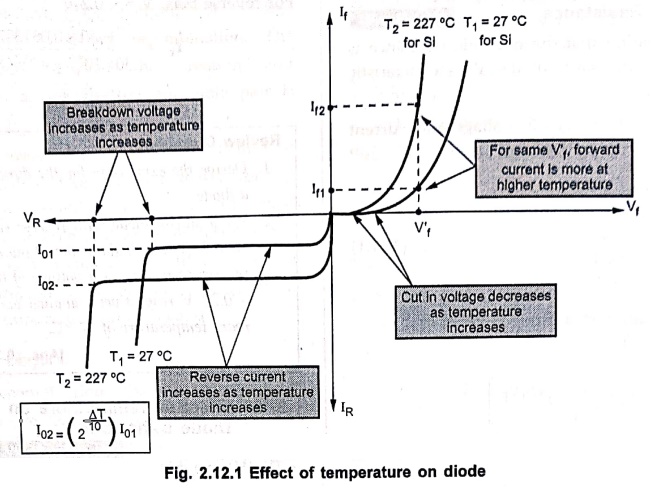
The temperature has following effects on the diode parameters,
1.
The cut‒in voltage decreases as the temperature increases. The diode conducts
at smaller voltages at large temperature.
2.
The reverse saturation current increases as temperature increases.
This
increase in reverse current I0 is such that it doubles at every 10
°C rise in temperature. Mathematically,
I02 = 2(ΔT/10)I01
……… ΔT = (T2‒ T1)
where
I02 = Reverse current at T2 °C
and
I01
= Reverse current at T1 °C
3.
The voltage equivalent of temperature VT also increases as
temperature increases.
4.
The reverse breakdown voltage increases as temperature increases.
5.
The maximum safe value of power dissipation is mentioned in the datasheet of
the diode as (PD)max which is specified at normal room
temperature of 25 °C. At higher temperatures, as the device junction
temperature is higher, it can dissipate less power. Thus maximum power
dissipation of the device decreases at higher temperatures.
•
The effect of characteristics is shown in Fig. 2.12.1.
Ex. 2.12.1: The reverse saturation current of
a silicon diode is 5 mA at room temperature. Find the diode current at i) 40 °C
and a forward voltage of 0.3 V. ii) 60 °C and a forward voltage of 0.5 V.
Solution:
I01 = 5 mA at room temperature of T1
= 27 °C = 300 °K
i)
At T2 = 40 °C = 40+ 273 = 313 °K and V = 0.3 V
ΔT
= T2‒T1 = 313‒300 = 13
(I02)
= (2ΔT/10) I01
=
(213/10) × 5 × 10-3
=
12.3114 mA
η = 2 for silicon
VT
= T2 / 11600 = 313 / 11600
=
0.02698 A
I
= I02 [eV/ηVT
‒1]
=
12.3114 [e0.3/2×0.02698 ‒1]
=
3185.428 mA = 3.185 A
i)
At T3 = 60 °C = 333 °K and V
= 0.5 V
ΔT
= T3‒T1 = 333‒300 = 13
(I03)
= (2ΔT/10) I01
=
(233/10) × 5 × 10-3
=
49.2457 mA
VT
= T3 / 11600 = 333 / 11600
=
0.0287 A
I
= I03 [eV/ηVT
‒1]
=
49.2457 [e0.5/2×0.0287 ‒1]
=
298778.75 mA
=
298.7787 A
Ex. 2.12.2: The reverse saturation current of
a germanium diode is 100 μA at room temperature of 27 °C. Calculate the current
in forward biased condition, if forward bias voltage is 0.2 V at room
temperature. If temperature is increased by 20 °C, calculate the reverse
saturation current and the forward current, for same current and the forward
voltage, at new temperature.
Solution:
At
T1 = 27 °C = 300 °K, VT = 26 mV
(I0)1 = 100 μA,
V
= 0.2 V
I
= I0 [eV/ηVT
‒1]
=
100×10‒6 [e0.2/1×26×10−3 −1]
=
219.04 mA
Using
the approximate result,
(I0)2 = 2T2‒T1 /
10] ×(I0)1
=
2(20/10) ×(I0)1
…… T2‒T1 =20°C
=
4×100 = 400 μА
New
reverse current at 27 + 20 = 47°C is 400 μA. So for V = 0.2 V, the new forward
current can be calculated using current equation of diode.
VT
at T2 = 47 + 273 = 320 °K = KT
=
8.62×10‒5×320 = 27.584 mV
I
= I0 [eV/ηVT
‒1]
=
400 × 10‒6 [e0.2/1×27.584 × 10−3 ‒ 1 ]
=
563.158 mA
Review Questions
1. What is the effect of temperature on cut‒in voltage and
reverse saturation current ?
2. Explain the effect of temperature on the diode characteristics.
3. A p‒n junction silicon diode has a reverse room saturation
current of 50 nA at the temperature 27 °C. If the new reverse saturation
current is observed to be 160 nA, calculate the new temperature. [Ans.: 44.19°C]
4. The reverse of saturation current silicon diode is found to
be 50 nA at 27 °C. In a certain circuit the junction temperature is observed to
rise up to 105 °C. Calculate the value of new reverse current. [Ans.: 9.79 μA]
5. A silicon diode operates at a forward voltage of 0.4 V.
Calculate the factor by which the current will be multiplied when the
temperature is increased from 25 °C to 150 °C. [Ans. : 476.29]
Electron Devices: Chapter 2: PN Junction Diodes : Tag: electronics : - Effect of Temperature on PN Junction Diode Behaviour
Electron Devices: Chapter 2: PN Junction Diodes
Under Subject

Electron Devices
EC25C01 2nd Semester ECE Dept | 2025 Regulation | 2nd Semester 2025 Regulation
Related Subjects

English Essentials II
EN25C02 2nd Semester | 2025 Regulation | 2nd Semester 2025 Regulation

Tamils and Technology தமிழர்களும் தொழில்நுட்பமும்
UC25H02 2nd Semester | 2025 Regulation | 2nd Semester 2025 Regulation

Linear Algebra
MA25C02 2nd Semester | 2025 Regulation
Electron Devices
EC25C01 2nd Semester ECE Dept | 2025 Regulation | 2nd Semester 2025 Regulation

Data Structures using CPlusPlus
CS25C05 2nd Semester ECE Dept | 2025 Regulation | 2nd Semester 2025 Regulation

Circuits and Network Analysis
EC25C02 2nd Semester ECE Dept | 2025 Regulation | 2nd Semester 2025 Regulation

Re-Engineering for Innovation
ME25C05 2nd Semester | 2025 Regulation | 2nd Semester 2025 Regulation

Engineering Drawing - Laboratory
ME25C01 2nd Semester | 2025 Regulation | 2nd Semester 2025 Regulation

Data Structures using CPlusPlus - Laboratory
CS25C05 2nd Semester ECE Dept | 2025 Regulation | 2nd Semester 2025 Regulation
Devices and Circuits Laboratory
EC25C03 2nd Semester ECE Dept | 2025 Regulation | 2nd Semester 2025 Regulation